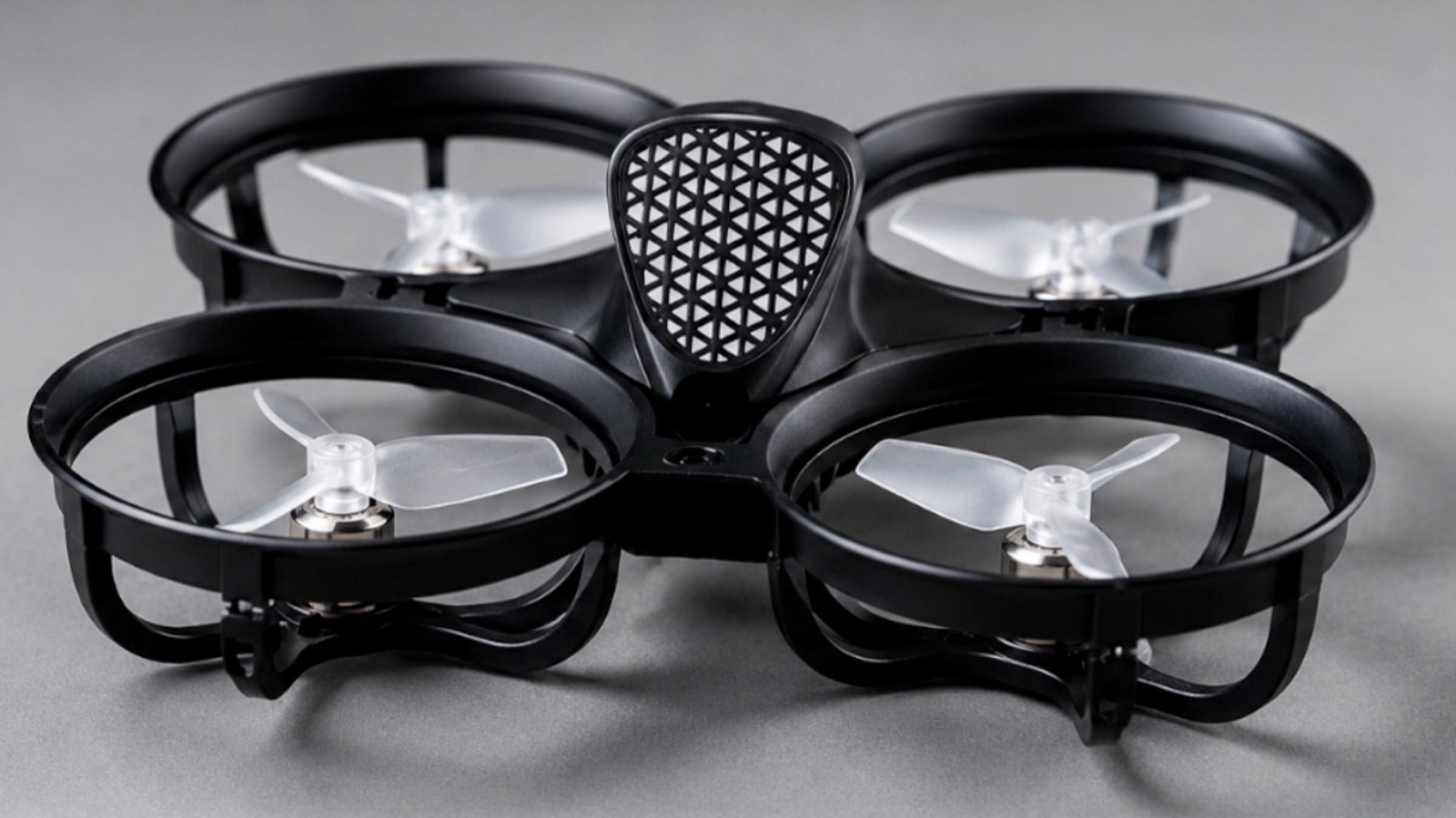
Every summer cookout comes with the same unwanted guests — the citronella candles, the DEET-soaked wrists, the futile arm-slapping that accomplishes nothing. French startup Tornyol wants to replace all of it with a 40-gram autonomous quadcopter that listens for mosquitoes, locks onto their wingbeat frequency, and physically shreds them mid-flight. No spray. No trap. Just a tiny airborne assassin the weight of a golf ball. The Y Combinator-backed company — founded by ex-MBDA missile engineer Alex Toussaint and co-founder Clovis Piedallu — recently demonstrated what they call the first autonomous mid-air insect kill: a moth, intercepted indoors during a controlled test. Mosquitoes kill roughly 700,000 people annually, making the stakes behind this quirky gadget considerably larger than a backyard nuisance.
Bat-Like Sonar Meets Backyard Warfare
The base station packs 380 microphones and serious signal processing into what amounts to a very focused acoustic command center.
The real brains sit in the base station: 380 smartphone-grade microphones and an Artix-7 FPGA that builds a real-time 3D acoustic map, detecting movements as small as 0.1mm, according to TechNews.tw. The drone itself mimics a bat — emitting ultrasonic pulses, identifying mosquitoes by their unique wingbeat signature, and operating within roughly 8 meters of that station. When it locks on, there is no chemical payload. The propellers are the weapon.
| Spec | Value |
|---|---|
| Weight | 40 grams |
| Kill method | physical interception via propeller contact |
| Operational range | approximately 8 meters from base station |
| Flight endurance | roughly 3 minutes per sortie, ~30-minute recharge |
| Price | $1,100 upfront or $50/month; $100 refundable deposit to reserve |
According to Tornyol’s Y Combinator launch page, the system is designed as “micro-drones that kill mosquitoes” — a description that is accurate, if not exactly subtle.
Ambitious Claims, Proof-of-Concept Reality
Tornyol says 10 drones could clear a square kilometre of mosquitoes — but that figure has not been tested outside a controlled environment.
Coverage claims are bold. Tornyol suggests one unit protects 5 acres, with 10 drones reportedly capable of clearing a full square kilometre at 100 times less cost than chemical programs. The founders bring serious hardware credentials from missile defense engineering. But as NDTV notes, none of these area-coverage figures have been validated under real-world field conditions. The successful kill demo targeted a moth. Indoors.
Three minutes of airtime followed by thirty on the charger. That is the gap between a compelling demo and a product that actually clears a patio during peak mosquito hours.
Battery-swapping docks are in development to keep drones cycling more continuously. The team also plans acoustic species-and-sex identification — critical, since only certain female mosquitoes transmit disease — but that capability remains aspirational rather than operational.
Worth the $1,100?
Early adopters and resort operators are the realistic first market — the average suburban backyard will have to wait.
At this price point, Tornyol occupies territory somewhere between a genuinely novel public health tool and an early-stage concept that still needs field validation. The underlying technology — autonomous acoustic tracking, real-time 3D mapping, micro-interception without chemicals — is more sophisticated than anything a bug zapper ever promised. Whether it scales from a controlled indoor room to a malaria-endemic neighborhood is the question that matters most, and the one that still needs an answer.