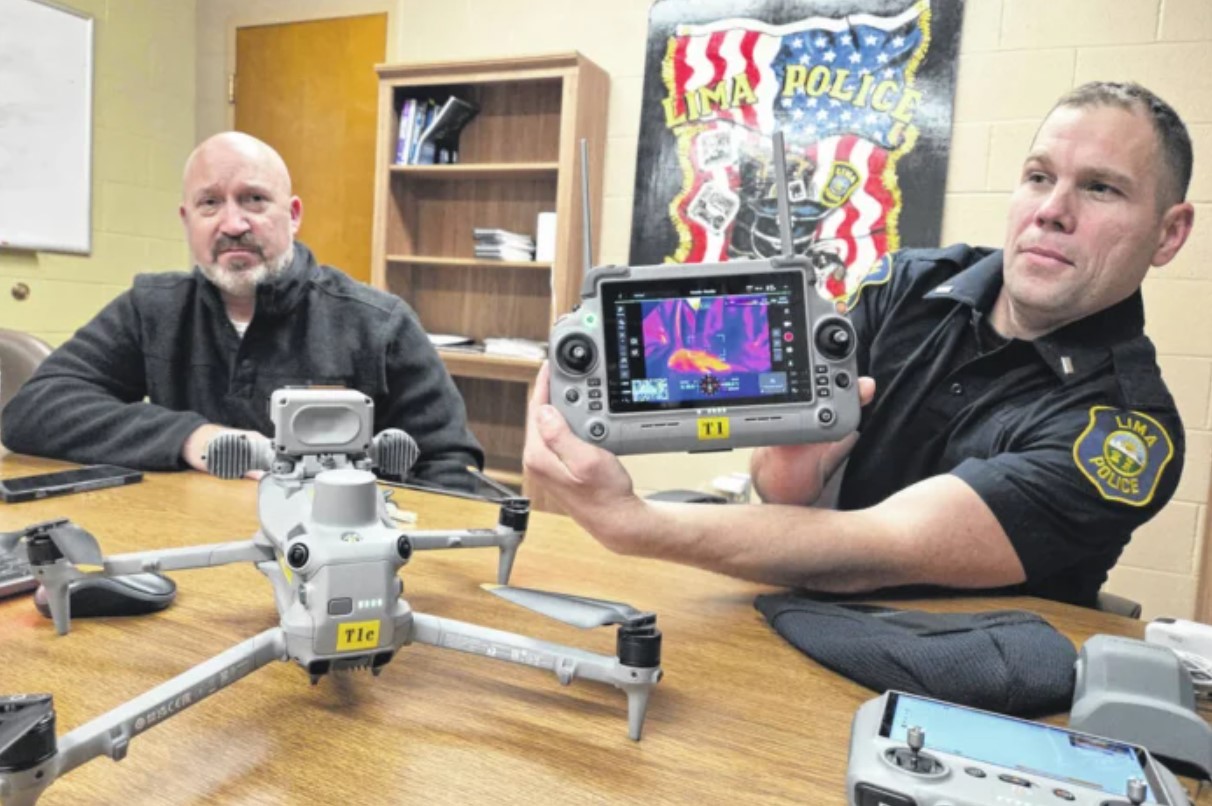
Nine Ohio police and fire departments now have drones that launch before squad cars leave the lot. House Bill 96, signed June 30, 2025, created the country’s first statewide Drone First Responder pilot — a $2.5 million program that puts autonomous aerial systems directly into emergency dispatch workflows, from Toledo to Kelleys Island. Think of it as your neighborhood Ring doorbell network, except taxpayer-funded, airborne, and operated by people with badges — much like the systems secretly tracking users in other taxpayer-funded programs that outpaced their legal guardrails.
What “Drone as First Responder” Actually Means in Practice
When a high-priority 911 call hits dispatch, a drone is already airborne and streaming live overhead video before officers reach their vehicles.
A high-priority call hits dispatch. A drone-in-a-box system — a weatherproof docking station mounted on a rooftop or pole — launches an aircraft automatically. It reaches the scene first and streams real-time video back to commanders. Some units can drop medical supplies.
The program, managed by SkyfireAI and administered through ODOT’s DriveOhio initiative, equips agencies across nine jurisdictions:
- Nine selected agencies (early 2026): Springfield, Athens, Lima, Toledo, Violet Township, Austintown, Hamilton, Amherst, and Kelleys Island
- Funding: $2.5 million allocated under House Bill 96, signed June 30, 2025
- Program management: SkyfireAI, administered by ODOT’s DriveOhio initiative
- Hardware requirement: NDAA-compliant only — no components from countries flagged as national security risks
- Airspace approvals: FAA beyond-visual-line-of-sight (BVLOS) clearances required; HB 96 directs the state to standardize that process
Dayton Police pursued a different architecture entirely. The city commission considered roughly $96,700 for multiple Fotokite Sigma tethered drones, according to Police Magazine. These aircraft are physically cabled to a base unit, providing continuous power and unlimited flight time without battery swaps. Where drone-in-a-box means rapid autonomous deployment, tethered systems mean persistent overhead presence — a Black Mirror episode that never needs recharging.
“The big overall problem here in Ohio is we really have zero laws at the statewide level and almost none at the local level, too, to govern the use of drones in a way that would give Ohioans more confidence that they’re not being used to surveil their whereabouts.” — Civil-liberties advocate, quoted by Ohio public radio via StateNews.org
The Surveillance Layer Underneath the Safety Pitch
License-plate readers, shared police databases, and potential drone-trigger integrations raise questions Ohio law hasn’t answered yet.
Multiple Ohio jurisdictions already run Flock Safety fixed license-plate reader cameras capturing vehicle plates and feeding data into shared law-enforcement networks. Flock calls its point-in-time snapshots something other than mass surveillance. Critics counter that network density across dozens of jurisdictions effectively approximates continuous location tracking over time. Investigative reporting from Cleveland.com flagged those same networks being queried for immigration enforcement purposes.
Social media posts assert that Flock ALPR plate hits and gunshot-detection alerts autonomously trigger drone launches — a tightly coupled sensor-to-aerial loop. That integration is technically consistent with how DFR systems are designed. It is not, however, documented in official Ohio state records or tier-one tech journalism. Treat it as plausible, not confirmed.
That gap between what’s technically possible and what’s legally constrained is exactly the problem. Much like the surveillance app built to target dissidents without adequate legal oversight, House Bill 251 would require warrants before drones observe building interiors — but explicitly permits warrantless flights over anything already visible from public airspace. The infrastructure is already overhead. Ohio residents funded it. Whether they have meaningful say over how it operates is, at this point, a genuinely open question.