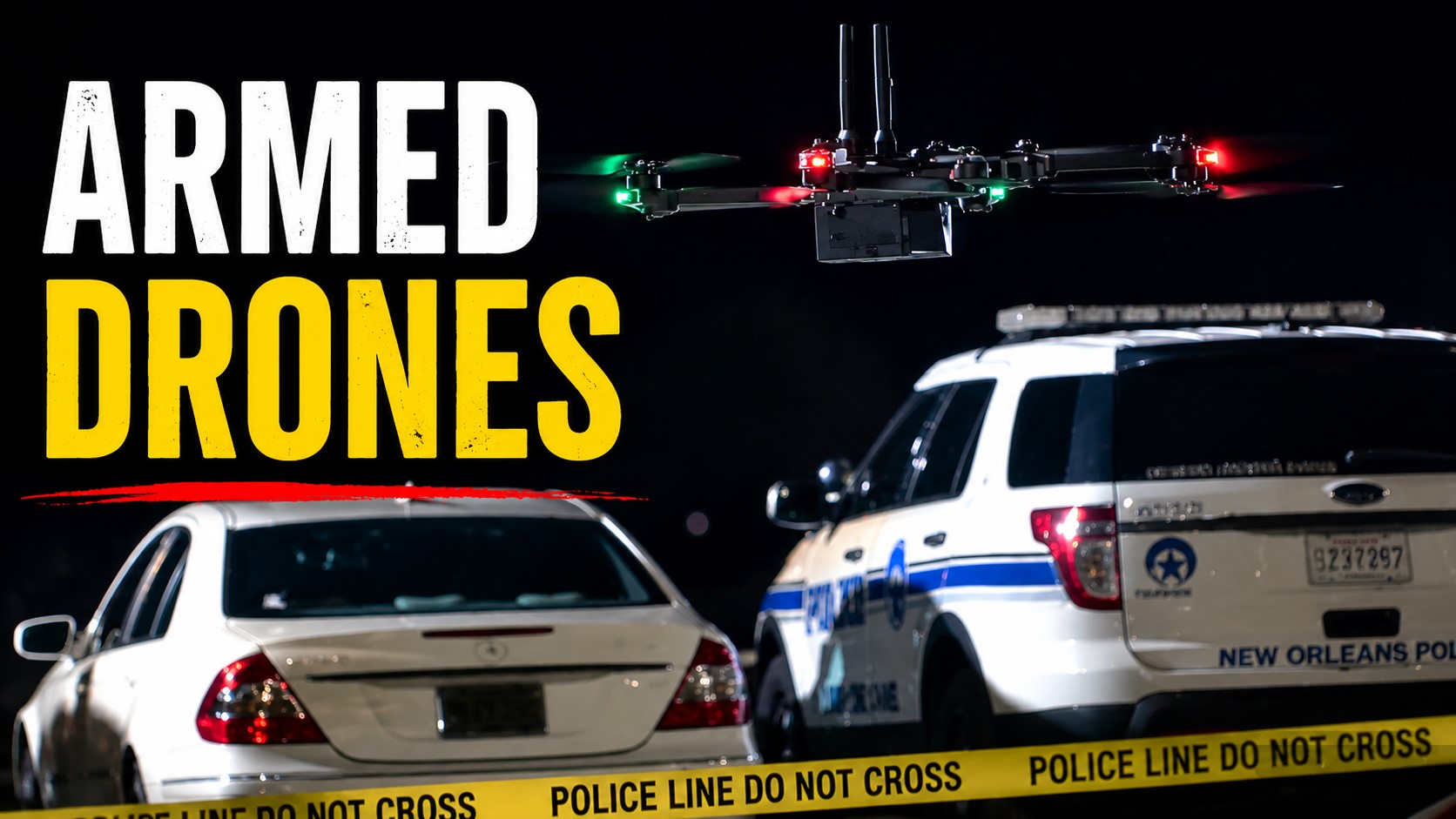
While NOPD was telling residents its drones carry no weapons, a version of the department’s own policy manual said otherwise. Posted to NOPD’s website on June 21, 2026, the revised Chapter 43.5 explicitly allowed drones to be equipped with weapons — provided the Superintendent approved it in writing. Nine days later, the page vanished. A replacement manual, dated July 1, now reads: “The sUAS shall not be equipped with weapons or hazardous materials of any kind.” Much like the surveillance app built by U.S. operatives to covertly monitor political dissidents, the episode raises urgent questions about who authorizes covert government tracking tools — and who is watching the watchers.
NOPD called the weapon-enabling document an “early draft presented for review before adoption of the current policy,” according to 404 Media. The department has not explained who wrote it, who posted it, or why.
A Timeline That Raises Questions
The weapon-enabling draft appeared three days before the City Council voted to fund drone expansion.
- February 7, 2024: NOPD’s formal drone policy takes effect. Weapons explicitly prohibited.
- April 16, 2026: Captain Samuel Palumbo tells City Council no current or planned drones are armed.
- June 21, 2026: Revised manual appears on NOPD’s site, permitting weaponized drones with written Superintendent approval.
- June 24, 2026: Council votes 4–3 to fund French Quarter Drone First Responder expansion, including roughly $250,000 for Skydio infrastructure.
- June 30–July 1, 2026: Draft disappears; weapon ban restored.
Eye on Surveillance, a Louisiana activist group, spotted the change and alerted council members before the reversal. That sequence — draft posted, council funds expansion, draft quietly pulled — is not easy to dismiss as a clerical error.
“Police have yet to demonstrate that they can responsibly handle the data collection and surveillance capabilities of drones… choosing to arm already unaccountable sky cameras is a threat on top of a threat,” Kelsey Atherton, Chief Editor at the Center for International Policy, told 404 Media.
A Pattern of Say One Thing, Do Another
NOPD’s history with surveillance tech makes the “just a draft” explanation difficult to accept at face value.
NOPD operates under a federal consent decree — court-supervised oversight imposed after documented misconduct. The department also ran a secret facial recognition partnership called Project New Orleans for roughly two years before journalists exposed it, according to reporting by the Washington Post and the ACLU. Publicly, the department has maintained that its drones carry no weapons and use no facial recognition. These patterns echo broader concerns about agencies secretly tracking users without public disclosure or meaningful oversight.
Skydio, which supplies NOPD’s drones and pledged in 2020 never to weaponize its platforms, has since shifted its stance. By June 2026, CEO Adam Bry told the Decoder podcast it’s “not our place to tell them what they can and can’t do.” Skydio did not respond to 404 Media’s inquiry about the NOPD draft.
Current FAA rules prohibit civil drones carrying “dangerous weapons” without special authorization. Matthew Guariglia of the Electronic Frontier Foundation told 404 Media he “didn’t see how the police arming drones could possibly be legal” under existing federal law. San Jose’s ongoing Flock Problem with automated license-plate surveillance cameras offers a cautionary parallel for how municipal police departments deploy and quietly expand surveillance infrastructure with little accountability.
“We have precious little time” to stop police from arming drones, Guariglia warned, arguing that deploying force via button press lowers the emotional and physical threshold compared to a face-to-face encounter.
NOPD has not identified who authored the draft, who approved its publication, or why it disappeared without public notice. That absence of explanation is itself a kind of answer.