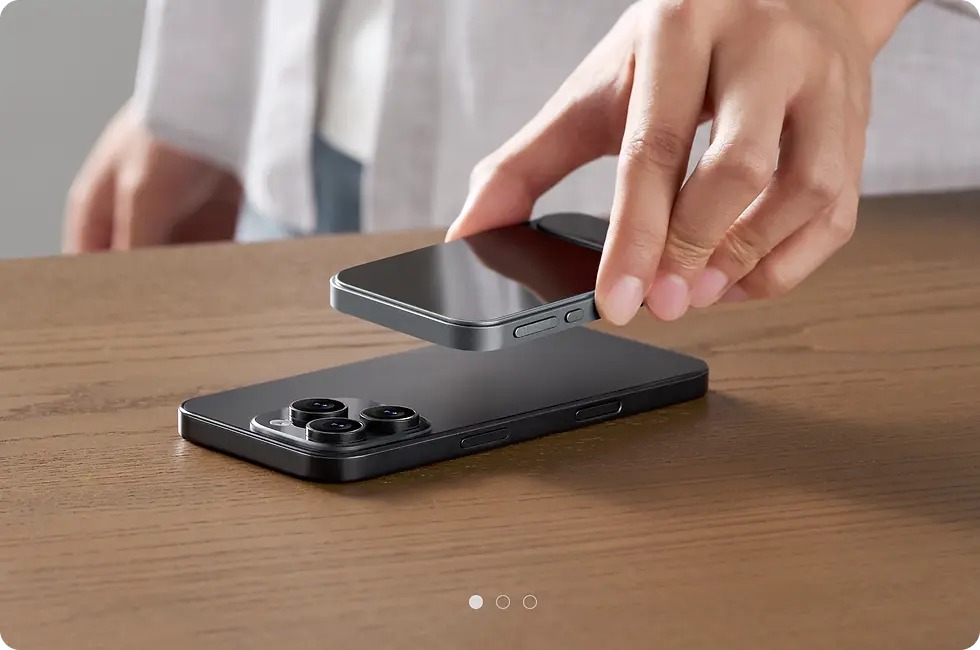
Most portable audio falls into two frustrating camps. Cheap USB dongles that sound marginally better than your phone’s built-in output. Or brick-sized amplifiers that deliver serious power but require their own dedicated bag. The Khadas Tea Pro refuses to pick a side. At roughly 96 grams with magnetic mounting that snaps flush to your phone like a MagSafe accessory for your ears, this ultra-slim DAC/amp threads a needle that most competitors don’t even attempt — and it’s aimed squarely at commuters and audiophiles who refuse to compromise on smart gadgets.
Desktop Performance, Pocket Footprint
An ESS flagship DAC chip and 122dB signal-to-noise ratio packed into something not much thicker than two stacked credit cards.
Under the machined aluminum chassis sits an ESS ES9039Q2M DAC handling PCM up to 32-bit/768kHz and DSD512. That’s overkill on paper. In practice, it means the Tea Pro introduces almost zero coloration between your music files and your headphones. The balanced output posts THD+N of 0.000126% and a 122dB signal-to-noise ratio — figures that rival desktop units costing considerably more.
- ESS ES9039Q2M DAC; PCM up to 32-bit/768kHz, DSD512
- Dual outputs: 4.4mm balanced (up to 180mW at 16.5 ohms) and 3.5mm single-ended (up to 100mW)
- Bluetooth 5.1 via Qualcomm QCC5181 with LDAC and aptX Adaptive
- 2100mAh battery delivering 8–11 hours depending on mode
- 128-step digital volume control — zero channel imbalance, zero hiss on sensitive IEMs
TechRadar describes the Tea Pro as “thin yet mighty,” praising its sound and connectivity while noting output power sits closer to a strong dongle than a heavy-duty portable amp.
The color display showing codec, sample rate, and battery status feels almost luxurious for this size class. No companion app is required; every setting lives on the device itself. Bluetooth wireless through LDAC and aptX Adaptive means your commute playlist doesn’t automatically downgrade to compressed mediocrity — whatever phone sits in your pocket, the QCC5181 chip speaks its language fluently.
Where It Earns Its Price — and Where It Doesn’t
Honest about the power ceiling, because that honesty is exactly what makes the praise land.
Here’s the tension. That 180mW balanced output drives IEMs and most portable headphones with real authority. Headfonics notes 5 Vrms into 600-ohm loads, which is genuinely useful territory for high-impedance classics. But power-hungry planar magnetics will expose the limits fast, and you should know that going in.
According to Ear-Fidelity, the Tea Pro “works well with IEMs and portable headphones, but anything more demanding and you’ll feel it’s lacking juice.”
That’s not a dealbreaker. That’s a deliberate design choice built around a specific listener. The 2100mAh battery and slow-but-steady USB-C charging reinforce the same philosophy: optimized for daily use, not endurance records. If your daily drivers are quality IEMs or moderate over-ears and your source is a smartphone, the Tea Pro delivers exactly the upgrade your music deserves — without turning your pocket into a gear bag. It travels with you rather than weighing you down.