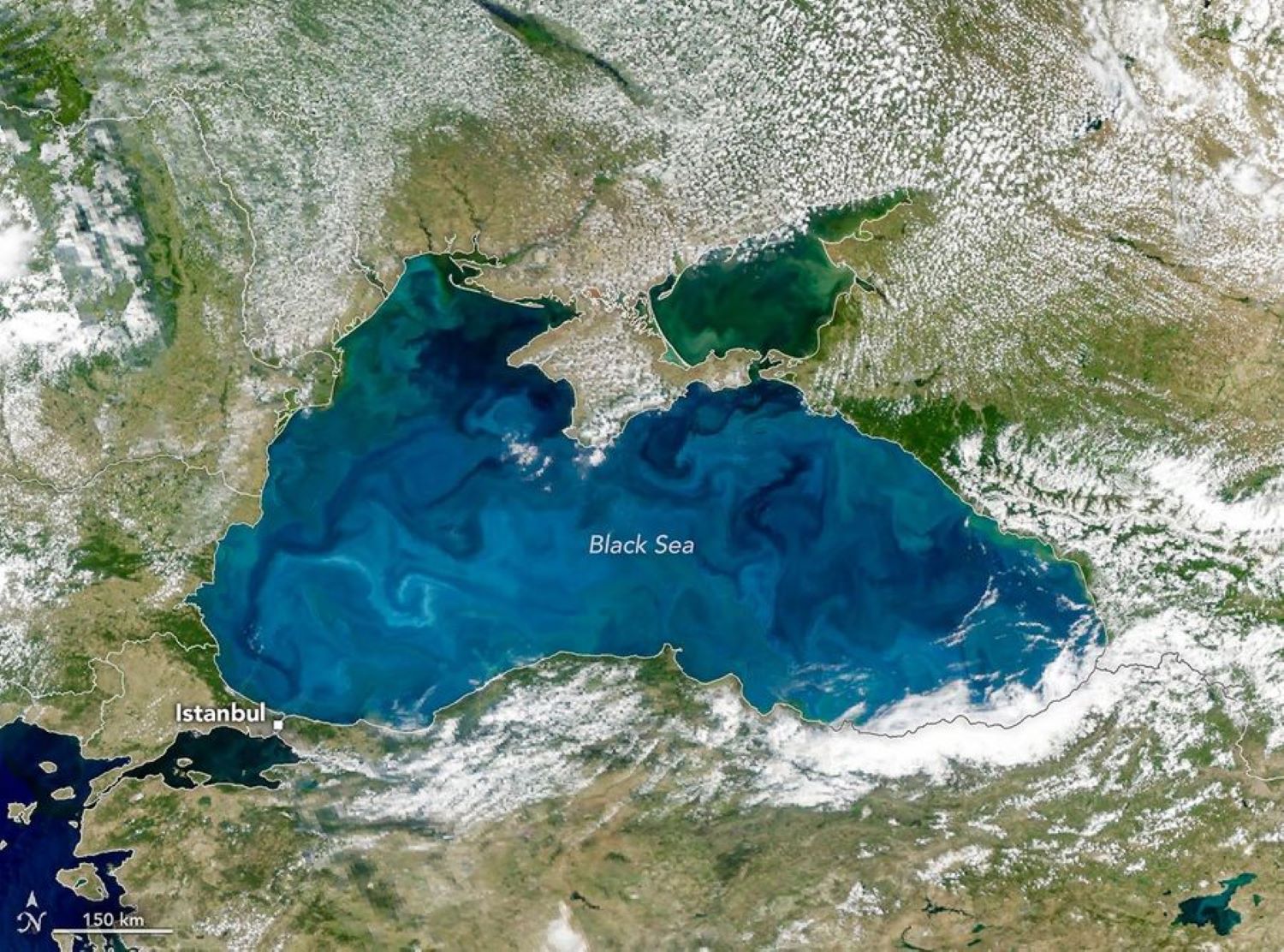
A sea named for its darkness has a branding problem every summer. Starting in late spring, vast stretches of the Black Sea flip from deep navy to swimming-pool turquoise — a transformation so dramatic that NASA’s newest ocean-watching satellite and an astronaut with a Nikon both captured it within weeks of each other. On June 22, 2026, the PACE satellite’s Ocean Color Instrument recorded the bloom across the broader Black Sea. About a month earlier, on May 27, an Expedition 74 crew member aboard the ISS pointed a Nikon Z9 with a 50mm lens at the Bosphorus and photographed phytoplankton tracing swirling currents through Istanbul’s famous strait. NASA’s Earth science teams later cropped and contrast-enhanced that frame, but the turquoise needed no filters.
Tiny Shells, Massive Color
One microscopic organism is quietly repainting an entire sea, and you can see it from 400 kilometers up.
The culprits are coccolithophores — microscopic phytoplankton armored in calcium carbonate plates called coccoliths. When billions of them bloom simultaneously in late spring and early summer, their reflective shells scatter sunlight and turn surface water milky turquoise. Think of it like an Instagram filter applied across thousands of square kilometers of open ocean, except the algorithm here is pure biology. During other seasons, diatoms with silica shells dominate, the water darkens, and the Black Sea earns its name again. As NASA Earth Observatory puts it, phytoplankton “paint the water with color so brilliant it becomes visible from space.”
Why a Pretty Picture Is Also a Warning System
Stunning as it looks, this bloom is doing serious scientific work — and satellites are the only tools wide enough to read it.
Beyond the spectacle, these blooms function as a real-time readout of ocean health. Coccolithophores absorb carbon as they grow. Their shells sink after death, locking carbon into seafloor sediments over long timescales. That makes satellite imagery a critical tool for monitoring a process that shore-based labs simply cannot track at this scale.
NASA has documented Black Sea blooms for over two decades — MODIS instruments captured similar turquoise swirls in 2008 near Sinop and Samsun, and again in 2022 off Romania, Bulgaria, and Turkey. PACE upgrades the picture considerably, measuring subtler variations in ocean color with higher fidelity and greater frequency. That matters because warming seas and shifting nutrient patterns could alter bloom timing and composition, offering early-warning signals of ecosystem disruption long before anyone notices from the shoreline.
Scroll past a satellite image that looks too vivid to be real, and the instinct is to doubt it. These blooms are real — and those microscopic organisms are broadcasting live data about the planet’s carbon budget that no shore-based lab can replicate at scale. PACE keeps watching.