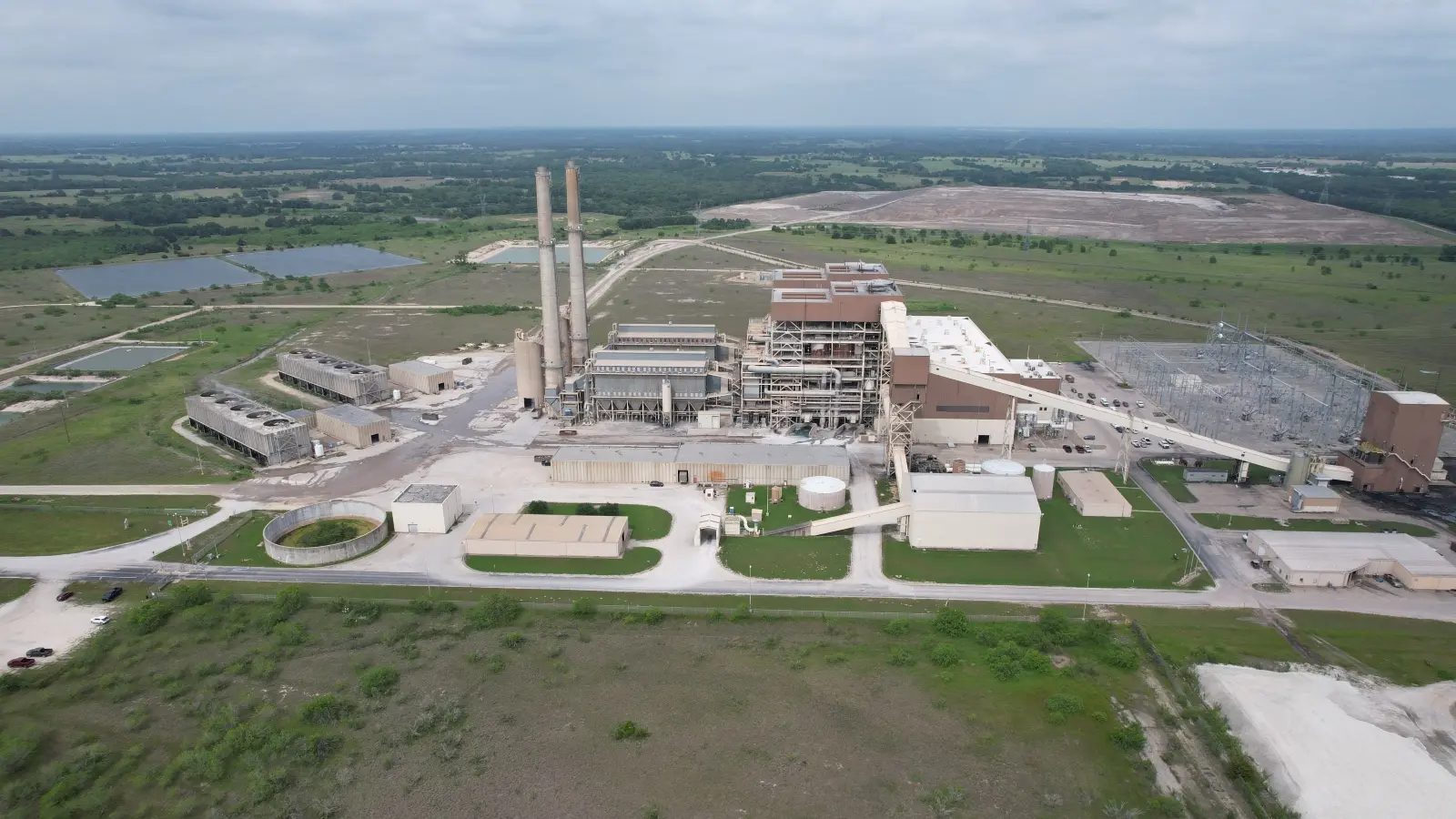
Halfway between Dallas and Houston, in a stretch of Texas most people drive past without blinking, a coal mine is about to become something else — without actually stopping being a coal mine. Panamint Capital has broken ground on Big Rooter Power, a $1.7 billion solar and storage project covering roughly 10,000 acres tied to the Twin Oaks coal plant and Calvert surface mine. The kicker: both the plant and the mine keep operating. This isn’t an energy retirement party. It’s more like a roommate situation — one running on sunlight, the other still burning coal.
What’s Actually Being Built
The project’s specs dwarf every previous coal-to-solar conversion in North America.
Big Rooter is planned as a 1.2 GWdc solar farm built in two phases, paired with serious storage and grid infrastructure:
- Phase 1: 491 MWdc, expected online August 2028
- Phase 2: 658 MWdc, construction starting December 2026, online August 2029
- 1.6 GWh of battery storage
- Approximately 20 miles of new 345 kV transmission lines
- Partners: SOLV Energy (construction), First Solar (domestic modules), Nextracker (tracking systems)
According to Panamint, this will be “the largest solar array ever built at a brownfield site in North America.” For context, the next biggest coal-to-solar conversions — Dolet Hills in Louisiana (240 MW), Tilden in Illinois (186 MW), Martin County in Kentucky (111 MW) — look like appetizers by comparison.
Why Here, Why Now, and What’s Quietly Missing
Federal tax credits, surging Texas demand, and an uncomfortable truth about what “transition” actually means.
The project reportedly qualifies for a 50% federal investment tax credit under an “energy community” designation, which the developer says was secured before recent federal legislation tightened those rules. That timing matters. Without it, the economics shift considerably.
Texas demand is the other engine. Data center construction is accelerating across the state. Manufacturing is expanding. Summers keep getting hotter. The grid needs capacity from everywhere, and Robertson County sits squarely in that pressure zone.
But here’s the tension worth sitting with: Twin Oaks keeps burning coal. Panamint has signaled an all-of-the-above approach, not a fossil fuel exit. The site is evolving into a multi-fuel energy complex — solar panels and smokestacks sharing a fence line.
Whether that’s pragmatism or compromise depends entirely on your time horizon. Either way, Big Rooter is about to test whether coal-adjacent clean energy can scale in Texas without forcing anyone to turn the lights off next door.