Somewhere before year-end, a compact AI chip designed for warehouse robots and delivery drones will touch down on the lunar surface — making it likely the first commercial GPU to reach the Moon. That chip, Nvidia’s Jetson, will face cosmic radiation with zero magnetic field protection, temperature swings that would destroy consumer electronics in minutes, and two-week-long nights running on almost no power. Two separate missions, both launching on SpaceX Falcon 9 rockets, will put Jetson to work in places where failure means a very expensive paperweight 238,000 miles from the nearest repair shop.
Two Missions, One Chip
Lunar Outpost and Firefly Aerospace are deploying Nvidia’s edge-AI platform on the Moon’s surface and in lunar orbit simultaneously.
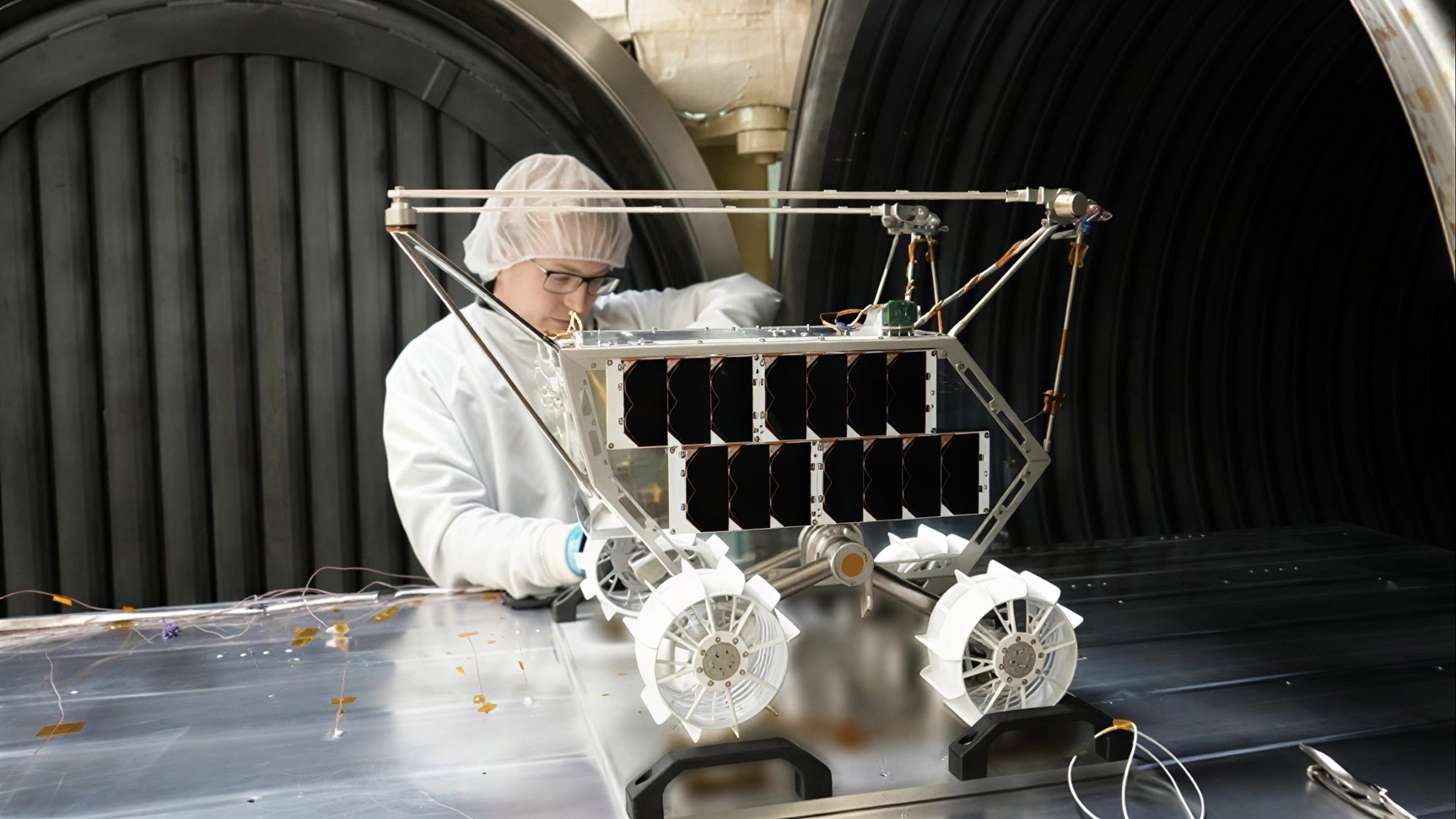
Colorado-based Lunar Outpost will use Jetson to run onboard LiDAR for mapping and perception on a rover riding an Intuitive Machines lander. Separately, Firefly Aerospace’s Elytra spacecraft — part of Blue Ghost Mission 2 — embeds Jetson inside Lawrence Livermore-built telescopes for its Ocula Moon imaging service, processing lunar surface imagery in orbit rather than downlinking raw data to Earth. That marks the first time Jetson will operate in lunar orbit, according to Nvidia’s blog.
A few things worth knowing about the broader picture:
- Lunar Outpost’s MAPP rover already operated at the lunar South Pole in 2025 under NASA’s CLPS-3 program
- Firefly’s Elytra is expected to orbit the Moon for roughly five years, serving NASA, the U.S. Space Force, and commercial mining firms
- Lunar Outpost holds seven contracted lunar and cislunar missions, plus the Pegasus crewed terrain vehicle targeting a 2028 Artemis launch
Jetson is not the hulking data center GPU associated with large-scale AI training. It’s a compact system-on-chip built for edge AI — processing sensor data locally for real-time decisions without any cloud connection. On the Moon, that distinction matters enormously. A signal round-trip to Earth takes about 2.6 seconds. A rover dodging a crater cannot afford to wait.
“We’re taking the NVIDIA Jetson and comparing it to our flight compute platform… pushing towards trying to adopt these more capable GPU-powered systems in these extreme environments,” Lunar Outpost CEO Justin Cyrus told TechCrunch.
The Hard Part Nobody’s Advertising
Commercial chips face cosmic radiation and brutal lunar nights that were never part of their original design specs.
Think of it as running a PS5 inside a blast freezer for a fortnight — except the freezer also bombards the hardware with particle radiation. Engineers are working to ruggedize Jetson for conditions it was never built to handle. Success means rovers that process their environment faster and depend far less on Earth-based operators calling the shots.
“Our autonomy stack was a bit more deterministic five years ago, and now it’s a combination of deterministic and physical AI,” Cyrus told TechCrunch.
Lunar Outpost’s stated endgame is moving from “exploration to permanence” — autonomous robots building landing pads, roads, and habitats before astronauts arrive. If a Jetson chip survives lunar night, the Moon just got measurably closer to having its own IT department.