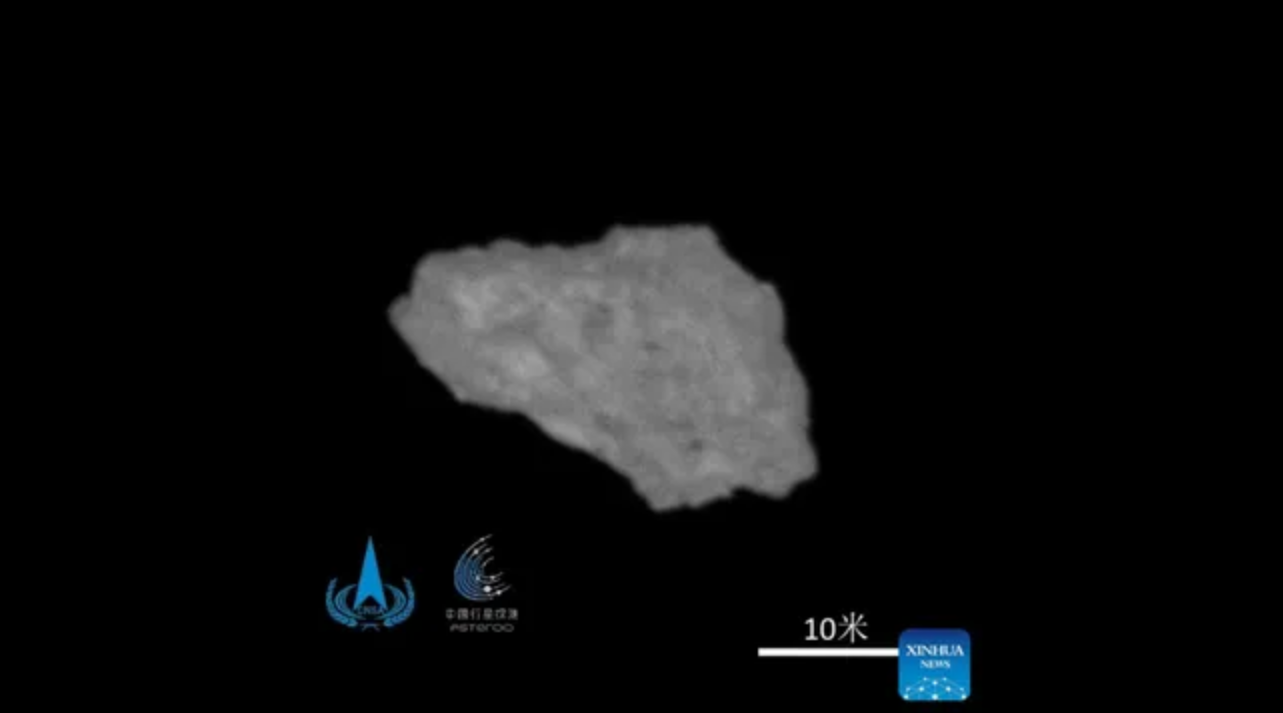
Earth has a stalker. For roughly a century, a tiny asteroid called Kamoʻoalewa has been locked in a gravitational dance with our planet — not quite a moon, not quite a passing rock, but a quasi-satellite that orbits the Sun while looping near Earth for centuries. Nobody even noticed until 2016. Now China’s Tianwen-2 probe, after traveling roughly 1 billion kilometers over 400 days, has pulled within 20 km of this object. The first photos are already back — and what they show changes the picture considerably.
A Rock That Might Be a Piece of the Moon
Tianwen-2’s close-up imagery reveals Kamoʻoalewa is far smaller than expected — and its surface chemistry points to a lunar origin.
Discovered by Hawaii’s Pan-STARRS survey, Kamoʻoalewa is one of only about seven known quasi-moons of Earth. Spectral analysis suggests its surface resembles lunar regolith, raising the possibility that this asteroid is actually debris from an ancient impact on the Moon — cosmic shrapnel that has been quietly tagging along ever since. Tianwen-2’s first close-up image confirmed the object is elongated and roughly 16–20 meters across, dramatically smaller than earlier ground-based estimates of 40–100 meters. The rock spins once every 30 minutes and should maintain its quasi-orbit for another 300 years. Planetary scientist Cristina Thomas put it plainly “Kamoʻoalewa is the smallest object that humans have ever visited with a spacecraft.”
- Launched: late May 2025 aboard a Long March rocket
- Close approach to 20 km: early July 2026
- Science instruments onboard: 11
- Sampling target: 200–1,000 grams
- Sample return to Earth: late 2027
- Bonus leg: spacecraft slingshots to comet 311P/PANSTARRS, arriving around 2035
The Art of Landing on Something That Won’t Hold Still
Tianwen-2’s novel anchor-and-drill sampling method has never been attempted on an asteroid.
Previous asteroid missions — NASA’s OSIRIS-REx at Bennu, JAXA’s Hayabusa2 at Ryugu — used touch-and-go techniques, briefly contacting the surface to collect loose regolith. Tianwen-2 plans something different. The spacecraft will anchor itself to Kamoʻoalewa’s surface, then bore into the rock with an ultrasonic drill to extract subsurface material. That’s genuinely new territory. Executing it on a body with near-zero gravity that completes a full rotation every 30 minutes compounds the difficulty considerably. A two-ton probe nudging it incorrectly could measurably alter the asteroid’s orbit, according to mission analysts — which is why CNSA is staging a gradual descent over months rather than rushing the approach.
Success would make China the third nation to return asteroid samples, joining the U.S. and Japan. Think of it less as a space race trophy and more like a Marvel post-credits scene — the real implications play out later, in asteroid resource extraction, planetary defense capabilities, and the quiet repositioning of who holds influence in deep space.
Those samples are still roughly two years from landing on Earth. If they confirm Kamoʻoalewa is genuine lunar ejecta, researchers will need to rethink models of impact debris distribution and material exchange between Earth and Moon — and reconsider which near-Earth objects deserve a much closer look. The harder work hasn’t even started.