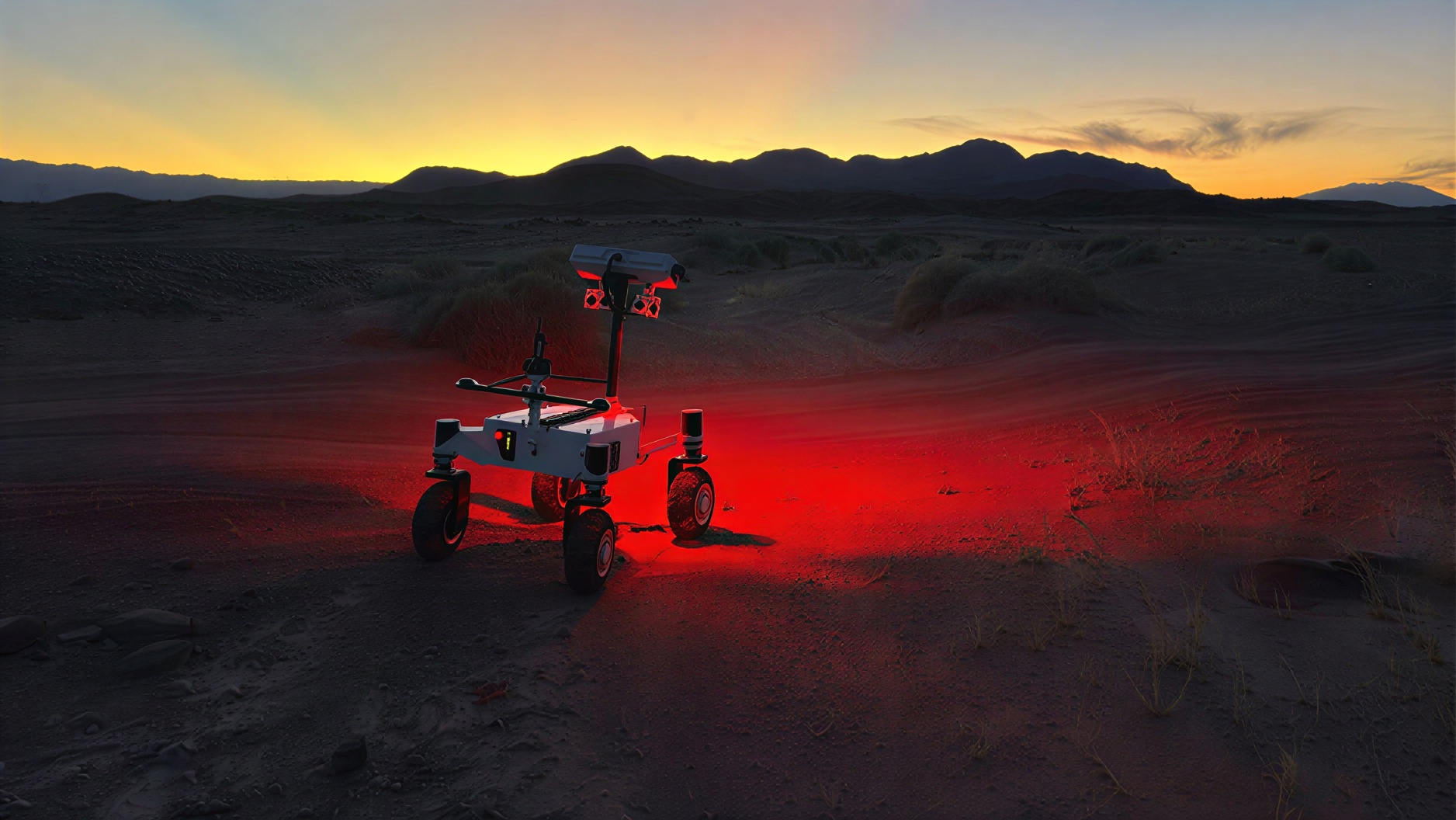
Something strange happened in the California desert this past March. A four-foot robot drove itself 16 miles across rocky, unforgiving terrain over 37 hours — at dusk, at dawn, in full darkness — with engineers trailing behind but intervening minimally. That robot was ERNEST (Exploration Rover for Navigating Extreme Sloped Terrain), a prototype developed at NASA’s Jet Propulsion Laboratory. Its top speed of 0.6 mph doesn’t sound impressive until you realize it’s more than 10 times faster than Perseverance can navigate on Mars, according to NASA/JPL. Every rover since Sojourner in 1997 has crept along at a pace that makes a Roomba look reckless. ERNEST suggests that the era might be ending.
Built Different From the Wheels Up
ERNEST ditches the suspension design that every Mars rover has relied on since 1997 — and the upgrade is significant.
Forget the rocker-bogie suspension that has carried every Mars rover since the Clinton administration. ERNEST runs an active gimbal suspension with two powered front joints and four steerable mesh wheels that move omnidirectionally — sideways included. It can lift individual wheels, redistribute its weight, and switch between locomotion “gaits” like squirming, wheel-walking, and obstacle-climbing. Think less cautious golf cart, more parkour athlete on four wheels.
- Size: 4 feet (1.2 meters) long — compact by rover standards
- Test: 16 miles (26 km) autonomous traverse, Colorado Desert, March 2026
- Speed: 0.6 mph (1 kph) — over 10× Perseverance’s top navigational speed
- Brain: Reinforcement-learning autonomy trained in JPL’s Mars Yard, then deployed in real terrain
- Future target: inform the design of a rover roughly twice ERNEST’s size for long-range lunar missions
“You could do a science road trip across the Moon — or Mars — with this vehicle.” — JPL planetary scientist James Keane
For context, Perseverance’s AutoNav set a record with 347.7 meters of autonomous driving in a single Martian day, according to NASA. That’s less than a quarter mile. ERNEST just did 16 miles.
Speed without a science payload is just a fast machine going nowhere interesting — and that’s the legitimate counterpoint mission designers will raise. The real test is whether future mission architectures are built around this capability or keep defaulting to the cautious playbook.
Driving in the Dark to Practice for the Moon
JPL’s low-light testing wasn’t a stunt — it was a direct simulation of the shadowed polar terrain where the Moon’s most valuable resources may be hiding.
The desert campaign wasn’t just about distance. JPL deliberately ran ERNEST at dusk, dawn, and night to simulate lunar polar conditions, where permanent shadow regions — potential water ice deposits — create exactly the kind of harsh, low-contrast lighting that breaks conventional hazard detection. “This testing is helping us refine the mobility hardware and autonomy software to navigate extreme distances across a wide range of terrain and lighting conditions anticipated on the Moon,” said JPL principal technologist Issa Nesnas.
ERNEST itself won’t fly — no mission name exists yet. But the hardware and software it validated point toward a Moon or Mars where rovers don’t inch across one geological unit per decade. The pace of planetary discovery may finally be catching up to planetary ambition.