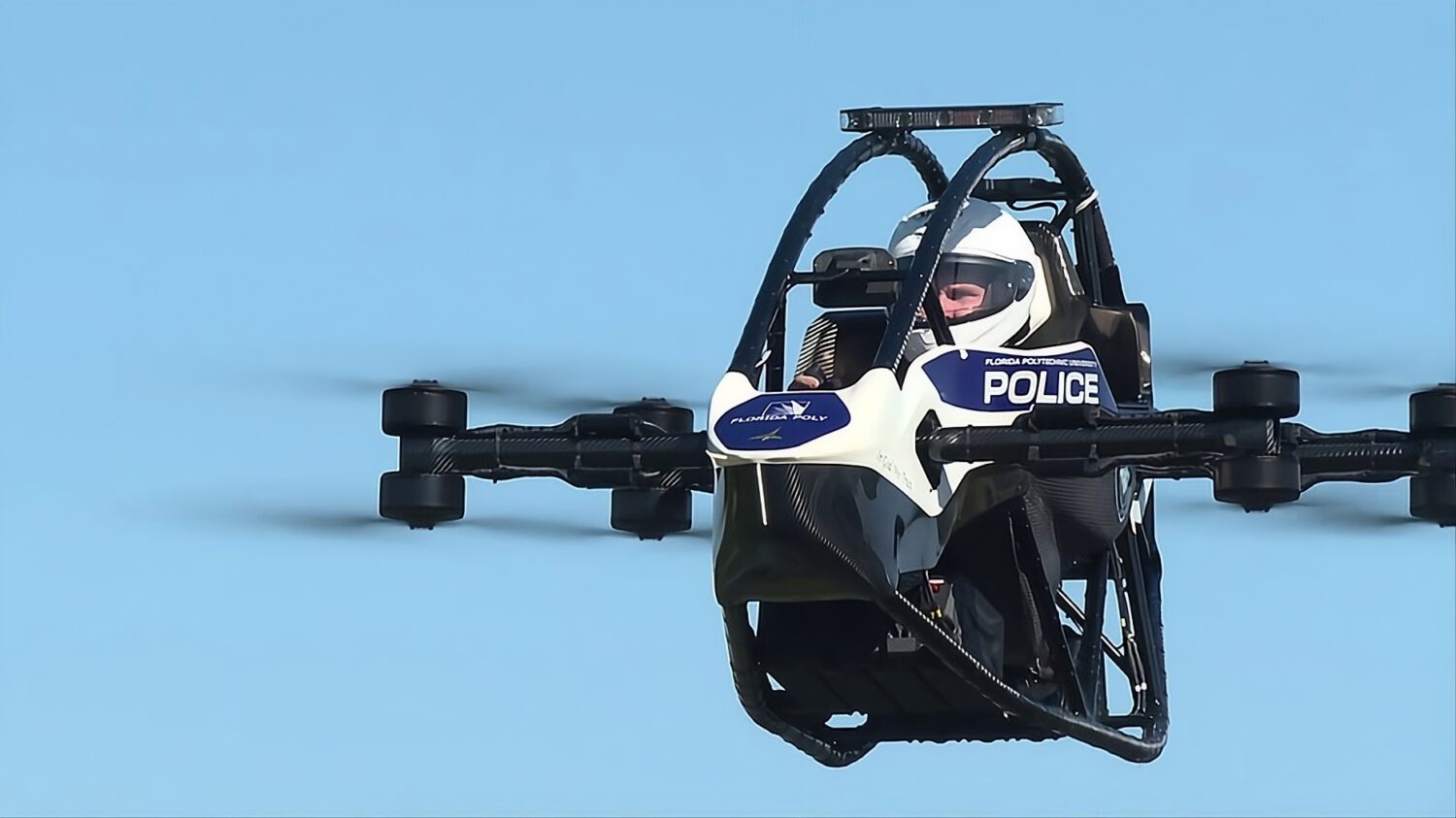
A campus police officer in Lakeland, Florida, may soon patrol from the air in a single-seat electric aircraft. Florida Polytechnic University announced on October 20, 2026, that its police department had unveiled Astro, a Jetson ONE eVTOL, claiming the title of first law-enforcement agency in the United States to plan operational use of a manned electric vertical takeoff and landing vehicle. Final FAA approval had not yet been granted at the time of the announcement.
What Astro Actually Is
The aircraft is a single-seat, open-cockpit machine built by California-based Jetson, purchased by Florida Poly for just under $150,000.
Astro is built from aluminum and controlled by eight rotors and a joystick. Its electric motors produce roughly 102 horsepower combined, enough to reach a top speed of 63 mph.
Flight time runs approximately 20 minutes per charge, and higher speeds reduce that window further.
Astro is a piloted aircraft, not a drone. That distinction carries real consequences: manned operation likely triggers different pilot training requirements and regulatory treatment than a remotely piloted aircraft would face, though the specific conditions of Florida Poly’s FAA authorization had not been confirmed as of the announcement. Safety features include motor redundancy, allowing continued flight after a motor failure, and an automatic parachute as a backup.
The manufacturer lists the aircraft’s empty mass at approximately 121 pounds and a maximum pilot weight of 210 pounds.
What It Can (and Cannot) Do
Florida Poly has outlined an ambitious set of proposed uses, but operational and regulatory limits keep those ambitions firmly in the future tense.
According to Florida Polytechnic University, Astro is intended to monitor campus property, reach areas difficult to access by road, assist with missing-person searches, respond to traffic crashes, support post-storm recovery, and deliver emergency supplies. The aircraft will also serve as a research and teaching platform for students and faculty studying advanced air mobility.
The operational limits are significant. Florida Poly says Astro will not fly in rain, citing moisture risk to the battery pack, and pilots will avoid heavy winds. The university expects to operate the aircraft under restrictions similar to those applied to unmanned drones, though the precise altitude cap had not been confirmed by the FAA as of the announcement date. Those constraints would limit Astro’s usefulness for extended patrol coverage or all-weather emergency response.
Florida is participating in an FAA advanced-air-mobility testing program at the SunTrax facility in Auburndale, near the campus, with testing expected before the end of 2026. The “first law-enforcement agency” designation is Florida Poly’s own claim; no independent source confirmed that Astro had completed routine police missions before FAA approval was finalized.
For Astro to move from demonstration platform to genuine patrol asset, battery endurance would need to extend well beyond 20 minutes, meaningful weather resilience would have to be demonstrated, and pilot training infrastructure would need to be established. Operational data would also need to show clear advantages over unmanned drones or conventional helicopters in specific scenarios. None of those conditions had been met as of the announcement date. What Florida Poly currently holds is a proof of concept with a price tag, a pending regulatory decision, and a stated ambition to lead public-safety aviation into new territory.