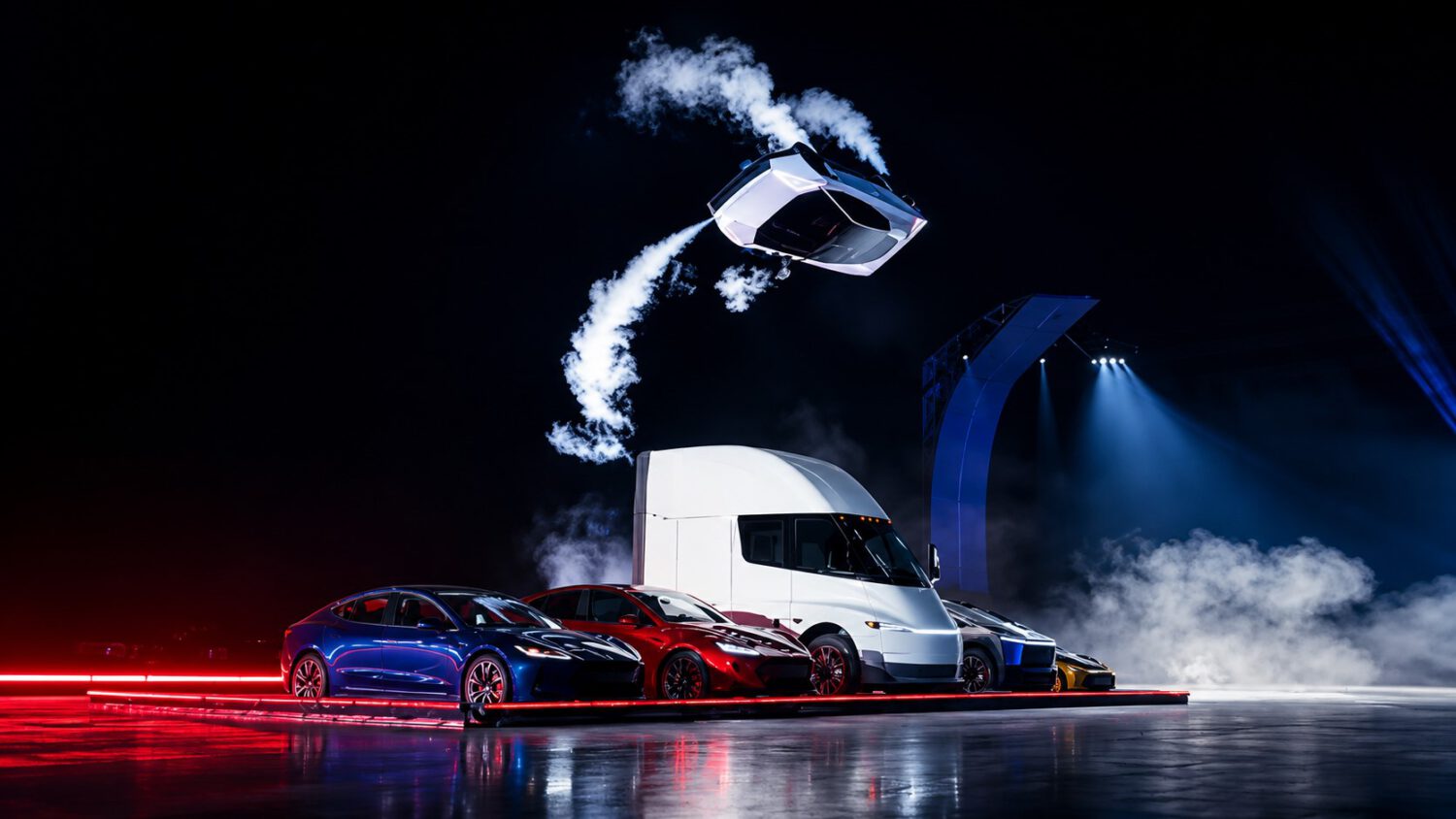
A Tesla Roadster briefly left the ground in Texas last month, rotating through the air before landing on its wheels. What you saw and what Tesla is actually selling you may be two very different things.
Tesla blurred the line between a driverless Tesla stunt vehicle and a consumer product at an invite-only event. The supplied reporting does not document independent inspection of the prototype’s hardware, leaving the distinction unresolved.
What Actually Happened in Texas
The Texas demonstration showed two separate stunts, each raising distinct questions about what the hardware can actually do.
One Roadster drove partway up an inverted ramp, apparently held to the surface by a suction system, then launched, rotated midair, and landed. A second vehicle jumped over a row of Tesla cars, including a Semi, with thrusters reportedly cushioning the landing.
Tesla also claimed a 0-to-60-mph time under one second during the event. That figure is a manufacturer claim, not an independently validated benchmark.
The Hardware Tesla Claims Is Inside
Tesla describes an elaborate compressed-air system, though none of it has been confirmed by outside inspection.
Tesla says the Rocket version packs up to 600 liters of compressed air into carbon-fiber pressure vessels fitted into every usable void in the chassis. Ten cold-gas thruster nozzles reportedly handle upward, forward, lateral, and rotational control, and the tanks can supposedly be recharged without conventional rocket fuel.
To fit all of it, Tesla removed the passenger seat entirely. The Rocket configuration holds one person.
The supplied reporting does not document independent inspection of the prototype’s hardware, and Tesla has not released production specifications or test data for the final vehicle configuration.
Why Skeptics Are Asking Hard Questions
The credibility gap here is not just about physics; it is also about a company with a documented history of overstating demonstration results.
AI researcher Yann LeCun estimated that useful thrust from such a system would last under 10 seconds, possibly closer to five. His argument: even if half the car’s mass were compressed air, the energy density does not support sustained lift , a physics challenge familiar to anyone who has studied Hypersonic Missiles and high-thrust propulsion systems. Achieving even that brief window would require the vehicle to be an unusually light shell.
Separately, observers noted that screenshots of the airborne car reportedly did not show the large suction-fan system Tesla described. That discrepancy remains unverified speculation, not established fact, but it is the kind of question independent inspection would answer quickly.
Tesla’s track record makes that inspection more urgent, not less. Reuters and other outlets have reported that the company’s earlier autonomous-driving promotional video was later described by Tesla engineers as staged. Reports from the 2024 “We, Robot” event indicated that Optimus robots operated via remote control during at least some interactions, rather than autonomously.
Neither precedent proves the Roadster stunt was fabricated. Both justify demanding more before treating a presentation as a product guarantee.
The Road-Legal Reality
Regulatory barriers alone are enough to keep the Rocket version off public roads for the foreseeable future.
The Rocket version is reportedly marked not approved for public-road use. The Performance version, described by Tesla as road-ready, does not include the thruster system at all , a reminder of how wide the gap remains between EV showmanship and what consumers can actually buy, whether weighing Gas vs Diesel alternatives or fully electric options.
According to TechRadar’s reporting on Tesla’s claims, the four rear thrusters alone produce more than 80 kilonewtons of force. That figure signals a substantial safety validation burden before any version of this system operates near bystanders.
Road certification in any major market would require compliance across crash, braking, pedestrian, and operational standards. The FAA has indicated the vehicle does not meet its definition of an aircraft, but any operation involving flight-like maneuvers may still raise separate regulatory and safety questions depending on jurisdiction.
Production is reported around 2028, and the Rocket configuration is described as invite-only.
Tesla demonstrated that a specially configured car can become airborne under controlled conditions on a closed course. It has not demonstrated that the car you might eventually order can do the same. Until independent testing and full specifications exist, what happened in Texas is a proof-of-concept, not a product promise.