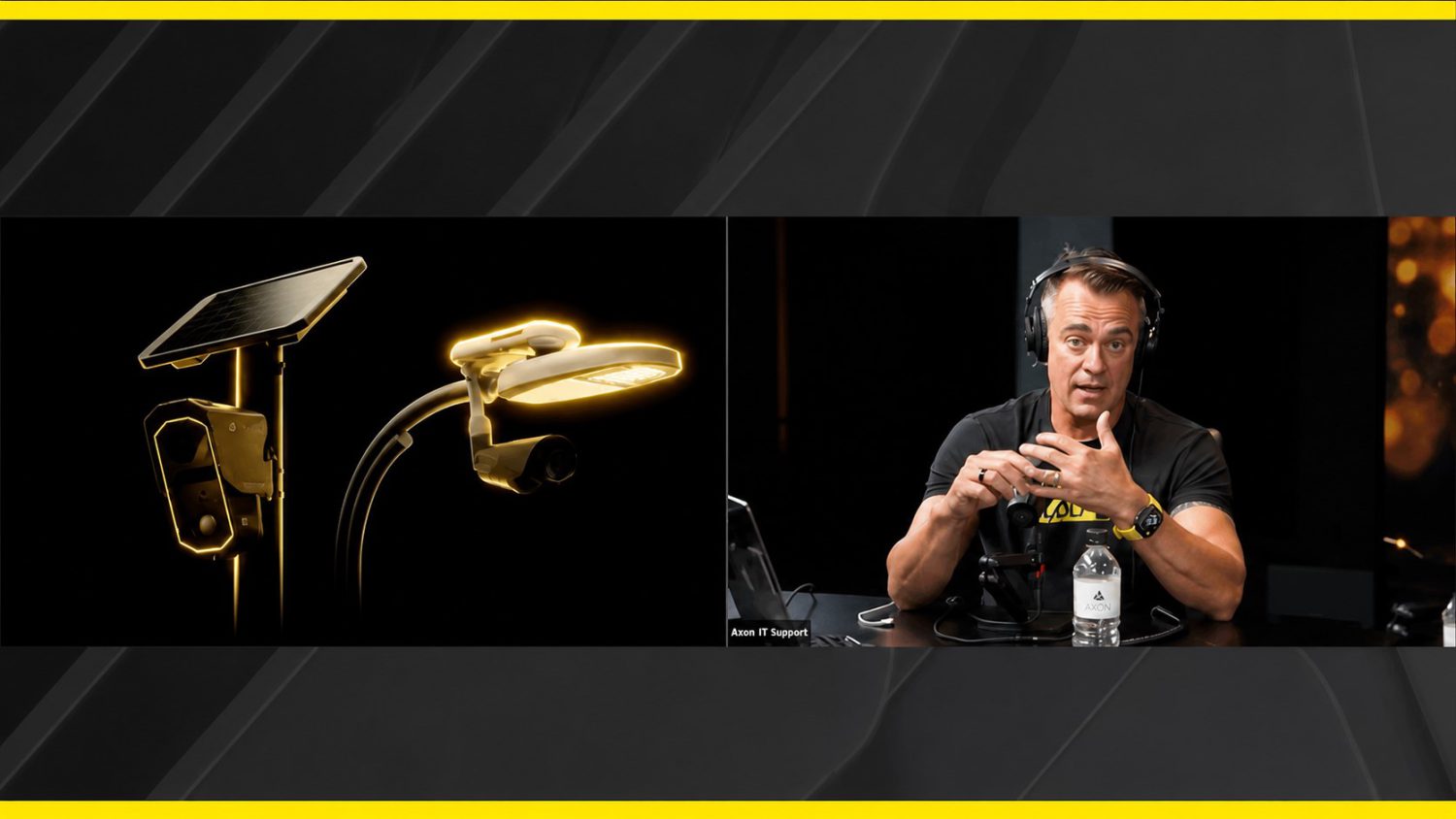
It’s the product feedback no tech company wants to read aloud in a webinar: “Can you redesign your camera so it doesn’t look exactly like the one people keep destroying?” That’s the question Axon Chief Customer Officer Mike Wagers read live during a now-deleted August 26 session titled “From backlash to trust.” CEO Rick Smith‘s response was direct: “We are looking at […] do we change the general shape.” Not the data policy. Not the warrant requirements. The shape.
The Camera Everyone Wants Gone
Flock Safety’s ALPR brand became toxic fast — and the physical backlash spreading across 36 states is now reshaping how its competitors think about hardware design.
ALPRs — automatic license plate readers — log your plate, vehicle type, and location with a timestamp, searchable by law enforcement without a warrant in most jurisdictions. Flock Safety’s version became particularly radioactive after documented cases of ICE lookups, tracking a woman who self-administered an abortion, and officers using the system to stalk ex-partners, according to 404 Media. Vandalism has hit cameras in at least 36 states, per NPR — shot in Tennessee, sawed down in Texas, hit by trucks in California. The darkest detail: authorities deployed a fake 3D-printed Flock camera as bait. The person who destroyed the decoy was charged with three felonies.
Smith confirmed that Axon’s Lightpost camera — mounted on streetlights via partner Ubicquia — already appeals to agencies for sitting higher up and being “harder to vandalize.” Some jurisdictions are pushing the opposite direction, favoring visible signage and posted policy descriptions at camera sites to rebuild public trust. The webinar was later deleted from Axon’s Vimeo channel, and the company did not respond to requests for comment.
“A hell of a storm.” — Axon CEO Rick Smith, describing the backlash against ALPR surveillance during the now-deleted “From backlash to trust” webinar, August 26, 2026.
“Trust” Is a Product Now
Axon is positioning itself as the responsible alternative to Flock — while offering surveillance capabilities that are functionally identical.
Swap the logo, keep the menu. Several jurisdictions have followed the same pattern:
- Denver let its Flock contract lapse, then approved Axon.
- Douglas County replaced 50 Flock cameras with 100 Axon cameras under a multi-million-dollar contract.
- Syracuse pulled all Flock cameras over data-sharing concerns, then approved city-wide Axon installation.
- Grand Chute, Wisconsin officially ended Flock — and immediately began evaluating Axon.
The surveillance capability doesn’t disappear. The branding does. It’s the policing-tech equivalent of a fast food chain rebranding after a health scare while the kitchen stays exactly the same.
Axon’s “trust” pitch is doing heavy lifting for a product that scans plates, logs vehicle descriptors, and feeds data into real-time crime center platforms — which is precisely what Flock did. Asking Axon to redesign its camera shape is like asking a band to change the album art because people are burning it. The music hasn’t changed. If the redesign succeeds — cameras blending into streetlights, mounted out of reach, shaped differently — the same networked infrastructure becomes less visible to the communities being watched and harder to contest. That’s not “from backlash to trust.” That’s camouflage.