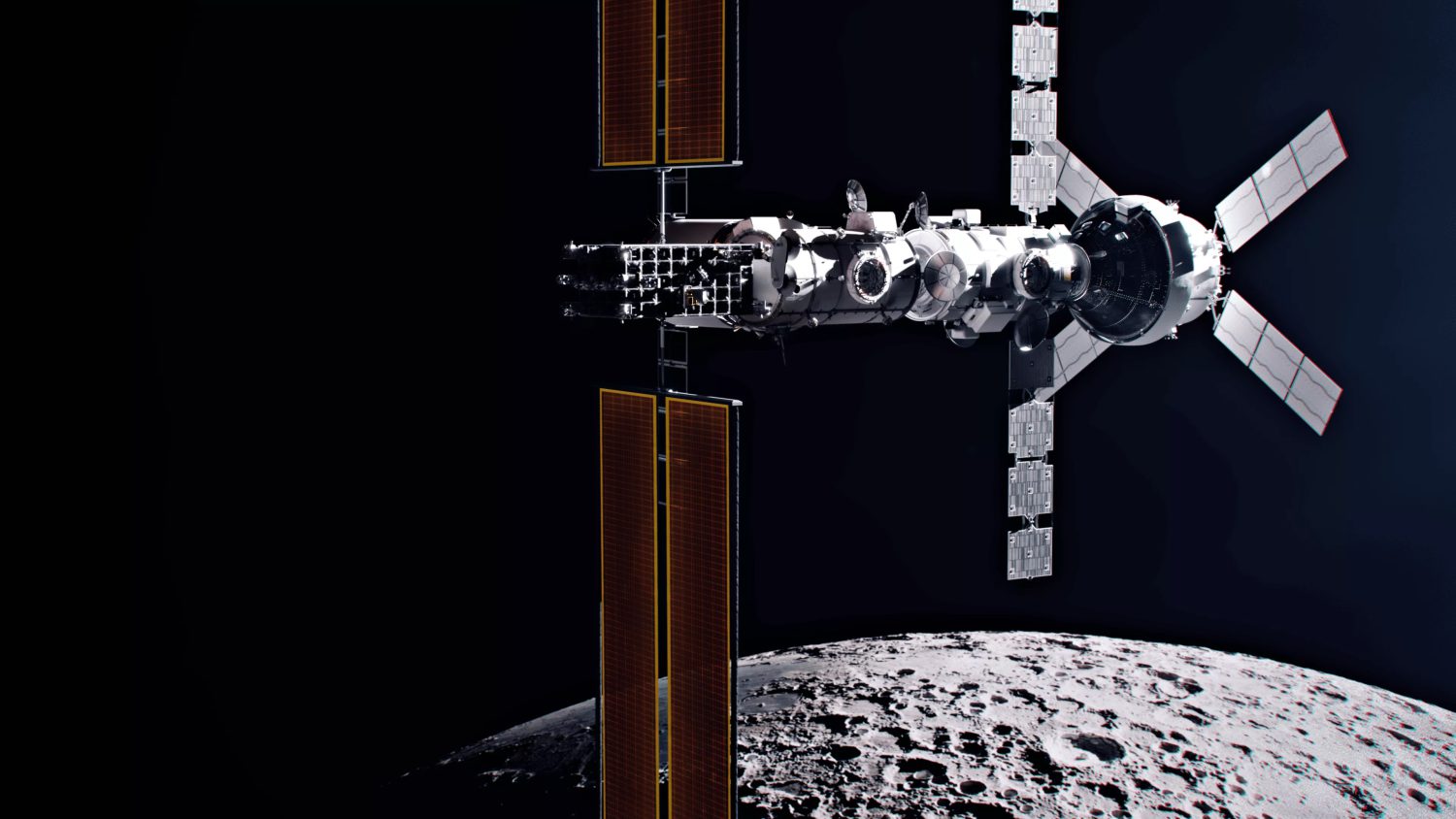
Think about a spacecraft queuing for a docking port 240,000 miles from Earth — and you’ve basically described what NASA is building. Gateway is the agency’s planned lunar station, orbiting the Moon in a lopsided egg-shaped path called a near-rectilinear halo orbit (NRHO): a 6.5-day polar loop ranging from roughly 1,000 miles at closest approach to tens of thousands of miles at its farthest. That weird orbit is both the design feature and the operational headache.
No Parking in Lunar Orbit
Gateway’s gravitational environment makes multi-vehicle traffic management far more complex than anything attempted at the ISS.
Nothing hovers out here. Unlike the ISS in low Earth orbit — where visiting vehicles follow well-worn docking playbooks — Gateway’s NRHO sits in a gravitational tug-of-war between Earth and Moon. Every spacecraft keeps moving, all the time. When multiple vehicles arrive on overlapping schedules, Orion capsules, cargo ships, and lunar landers sharing the same orbital neighborhood, you need rules. Without them, the lunar equivalent of a runway incursion is no longer hypothetical.
“Maintaining the loitering vehicle relative to Gateway enables a closer formation and reduces the risk of vehicles drifting dangerously close together.” — Diane C. Davis, lead researcher, Acta Astronautica
Researchers from Texas A&M, NASA’s Johnson Space Center, and Purdue University published the solution in Acta Astronautica in 2026 — with popular coverage arriving in August of that year — proposing a “string of pearls” formation. Spacecraft queue ahead of or behind Gateway at carefully calculated intervals along the same orbital path. Think boarding zones on a trans-Pacific flight, except the terminal is moving at thousands of miles per hour and there’s no ground beneath it.
Rules of the Road — Not Law, Yet
The framework is rigorous technical guidance, but binding cislunar traffic regulations remain a future challenge.
Running thousands of simulations — accounting for navigation errors, imperfect thruster burns, and real-world messiness — the team found that anchoring each vehicle’s guidance to Gateway’s position rather than absolute coordinates keeps formations tighter with only marginal extra fuel. Small, frequent corrections beat large, infrequent ones — an approach the team likens to adaptive cruise control for cislunar space.
These aren’t binding regulations yet. NASA already maintains interoperability standards covering docking and communications, but this research fills a specific gap: where do visiting spacecraft wait, and how do they do it safely at scale. International partners involved in the program include:
- SpaceX, signed on for recurring Gateway logistics runs, with one delivery anticipated per crewed Artemis mission
- ESA
- JAXA
- CSA
More spacecraft means this framework moves from academic paper to operational necessity fast.
Gateway is planned to operate for at least 15 years, with first elements launching no earlier than the late 2020s. If this traffic framework holds, the string-of-pearls concept could become the template for every lunar orbital hub that follows — turning holding patterns around the Moon into something as routine as circling O’Hare on a Tuesday.