Drifting for over a year like forgotten luggage in the cosmic lost-and-found, a school-bus-sized Falcon 9 upper stage slammed into the Moon on Aug. 5, 2026, at roughly 5,400 mph — unleashing energy equivalent to three tons of TNT. Nobody planned this. Nobody could stop it. But two orbiting spacecraft were watching, and the images they sent back are sharp enough to make you genuinely uncomfortable about how much hardware humanity is flinging into deep space.
What the Images Actually Show
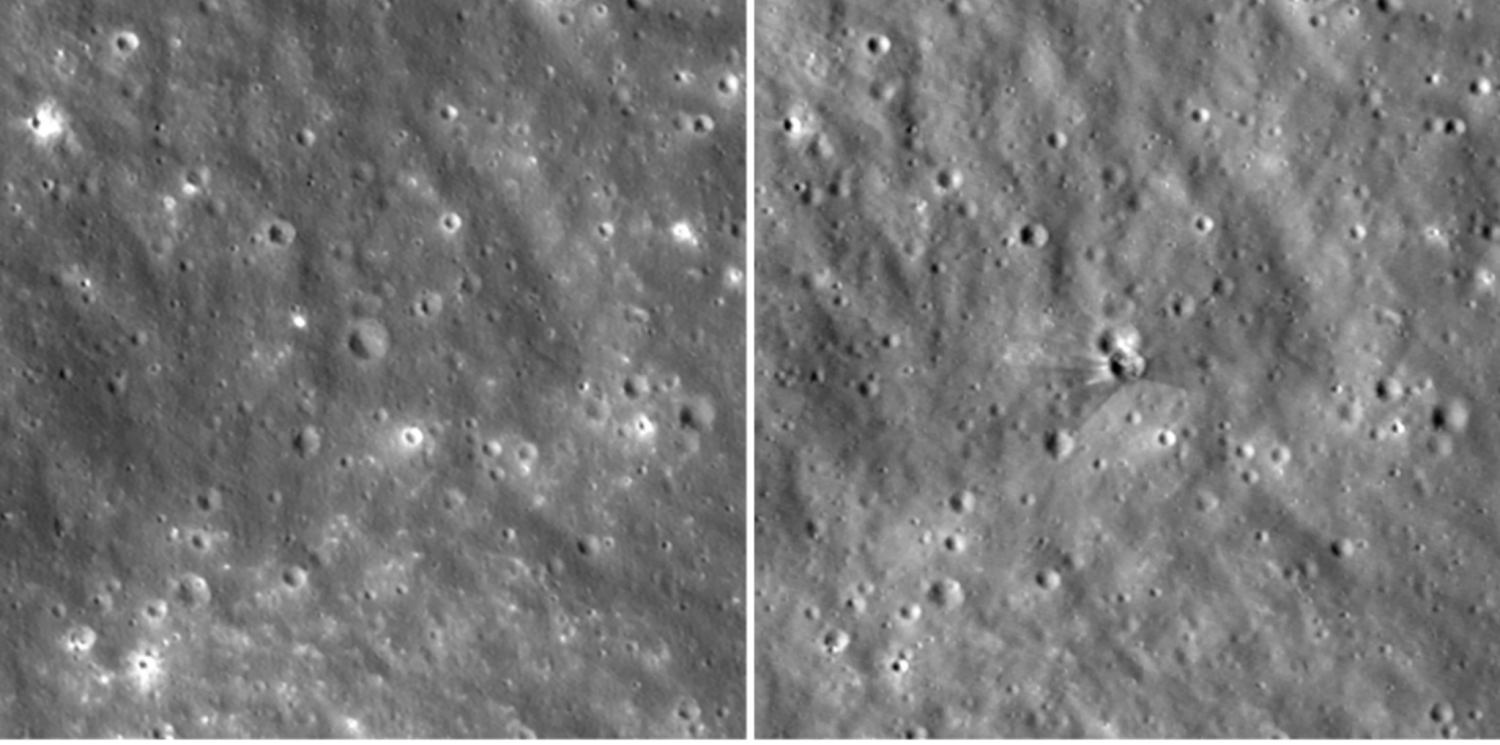
NASA’s Lunar Reconnaissance Orbiter captured the sharpest before-and-after views of the impact site, revealing a crater measurably smaller than scientists predicted.
NASA’s Lunar Reconnaissance Orbiter, circling the Moon continuously since 2009, had to physically tilt itself to aim its Narrow-Angle Camera at the impact zone — 60 miles below, with the spacecraft moving at roughly one mile per second. It took six days post-impact for the site to rotate into view. LRO imaged the area Aug. 11–12 and released the imagery Aug. 18–19, revealing a crater measurably smaller than predicted — about 60 feet wide and less than 10 feet deep — notably smaller than the 90-foot-wide, 16-foot-deep crater scientists had anticipated.
Key details of the impact:
- Location: near Einstein Crater at coordinates 19.4759°N, 266.7138°E
- Rocket stage weight: approximately 8,800–10,800 lbs
- Impact velocity: roughly 5,400 mph
NASA scientists noted that LRO’s images help “learn new details” about impact mechanics and regolith properties by comparing pre- and post-crash data, per NASA.gov. That prediction gap isn’t a failure — it’s exactly the kind of real-world calibration that makes this accidental collision scientifically valuable.
South Korea Got There First
South Korea’s Danuri orbiter beat NASA to the scene, proactively adjusting its orbit to capture the terrain before, during, and after impact.
Thirty minutes before the rocket hit, South Korea’s Danuri orbiter was already repositioning. The Korean Pathfinder Lunar Orbiter adjusted its orbit and sensor pointing, ultimately completing eight imaging sessions around the event. Images released by the Korea Aerospace Research Institute show a noticeably darker patch and radial ejecta patterns spreading outward — confirmation of genuine geomorphic change. Think of it as an unexpected international relay: a Korean spacecraft doing reconnaissance, a NASA orbiter delivering the high-resolution close-up.
The dark and bright “butterfly wing” rays radiating from the crater tell a geological story worth pausing on:
- Dark streaks represent ancient, space-weathered material excavated from near the surface — dulled by eons of solar wind and micrometeorite bombardment.
- Bright rays mean fresher rock thrown up from deeper layers, not yet touched by any of that.
Like cutting into an avocado and finding the vivid green beneath the oxidized outer flesh, the impact briefly exposed what the Moon has kept buried for billions of years.
Scientists are quietly treating this as a rare gift — a known mass, known velocity, known impact point, documented by two independent spacecraft before and after. Real-world crater formation data is hard to come by. The uncomfortable flip side, however, is that international frameworks governing what commercial rockets can leave behind on the Moon remain underdeveloped. As lunar missions multiply under NASA’s commercialization push, that regulatory gap looks less like an oversight and more like a problem with a deadline.