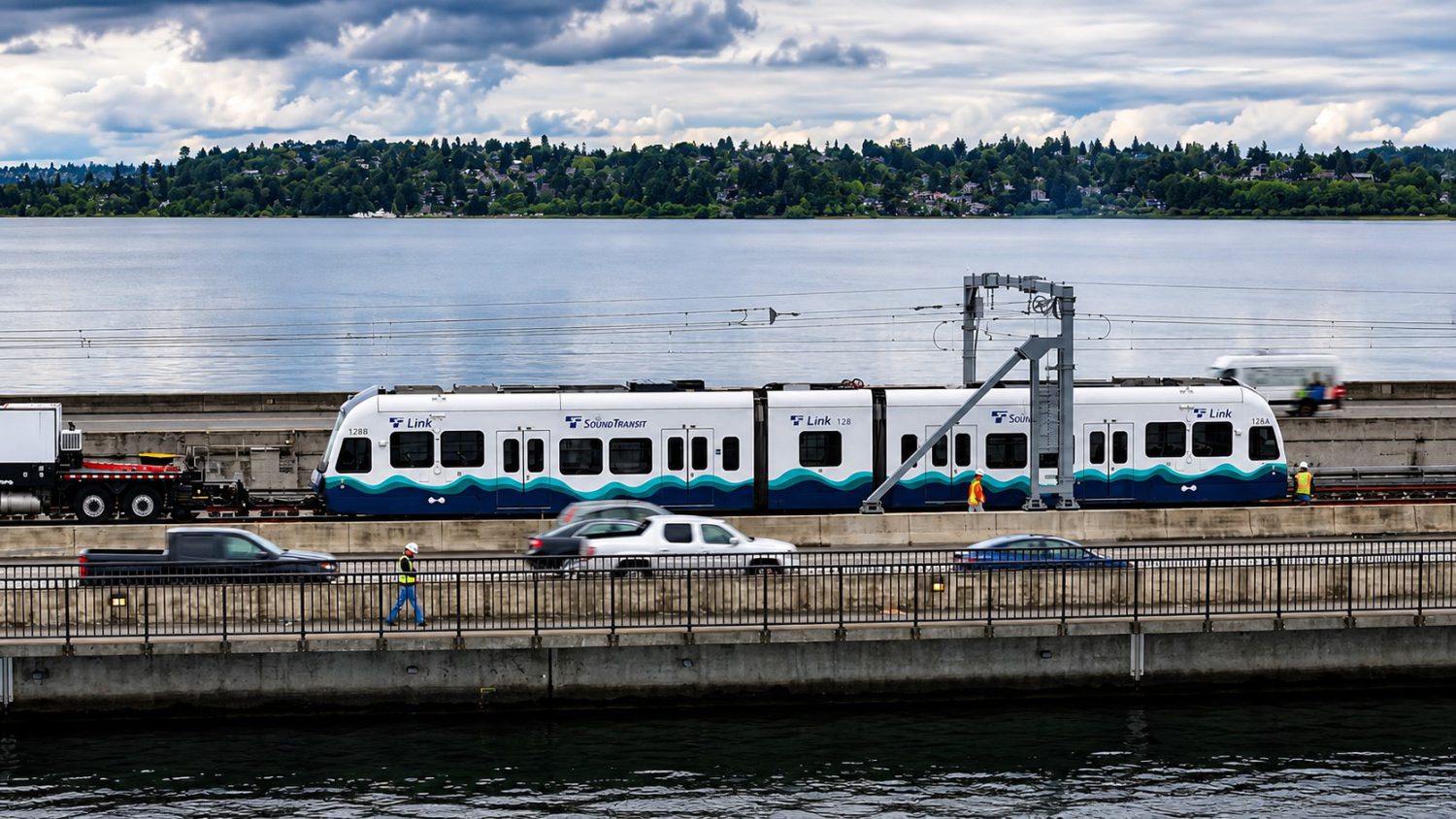
Passengers gliding across Lake Washington catch Mount Rainier filling the window — unaware the bridge beneath them floats on 200 feet of glacial water and carries 600,000 pounds of train. Sound Transit’s 2 Line opened March 28, 2026, completing the East Link corridor and delivering the world’s first passenger light rail line on a floating bridge. That it works at all is the story.
Three Problems. No Easy Answers.
Weight, motion, and electricity — three forces that made engineers rethink everything they assumed about floating bridges.
- Weight: A stalled train threatened to sink the pontoons by inches. The fix was almost brutally mechanical — crews removed gravel ballast from inside the pontoons, switched to lightweight concrete on the deck, and threaded 20 high-tension steel cables through the center pontoons to make them act as a single stiffened unit. Then they pre-stressed the deck with enough jacking force to compress it roughly three inches. Under a fully loaded train, the bridge dips about one inch. Better than the models predicted.
- Motion: Lake Washington’s water level shifts roughly two feet annually, and wind, waves, and traffic flex the deck constantly. Rigid rails would buckle. Custom 43-foot steel “track bridge” platforms — reportedly first sketched using wooden coffee stirrers — sit on seismic bearings over expansion joints, letting the rails flex subtly while keeping geometry precise. Riders feel nothing.
- Electricity: Electric trains leak stray current. On a water-surrounded structure, that current attacks structural steel and anchor cables like rust on a forgotten bicycle chain. Around 9,000 rubber-insulated concrete rail support blocks cut off current paths, while sacrificial metal anodes corrode preferentially — protecting the bridge’s critical elements.
MxV Rail ran full-scale testing in 2013, collecting over 500 channels of data per train pass and confirming safe operations up to 55 mph — the maximum Link operating speed. Sound Transit project leaders characterized the floating rail segment as their “moon shot.” That framing is earned.
Watching cable tension, pontoon depth, GPS position, and structural stress in real time, University of Washington researchers built a digital twin of the I-90 bridge. It’s a live 3D model fed by IoT sensors, run on Microsoft Azure Digital Twins in trial deployments. UW Civil & Environmental Engineering describes it as a “one-of-a-kind” monitoring system — one designed to shift maintenance from scheduled inspections to continuous structural health monitoring.
What This Means Beyond Seattle
For regions where deep lakes and soft soils make conventional bridges impractical, this project hands engineers a proven playbook.
Traditional engineering consensus held floating bridges and rail were simply incompatible — too much weight, too much movement, too much electrical risk. This project dismantles that assumption with data. East Link faced multi-year delays and cost roughly $3.7 billion, criticism that’s fair and documented. But for regions facing deep lakes, soft soils, or corridors where tunnels are prohibitively expensive, the engineering case now exists.
UW Civil & Environmental Engineering describes the monitoring system as “one-of-a-kind” — built to show how IoT and cloud computing can shift infrastructure maintenance from scheduled inspections to continuous health monitoring.
The rails flex constantly. Passengers feel none of it — just a smooth, butter-like crossing with Rainier on the horizon. Convincing everyone that was possible in the first place turned out to be the hardest engineering problem of all.