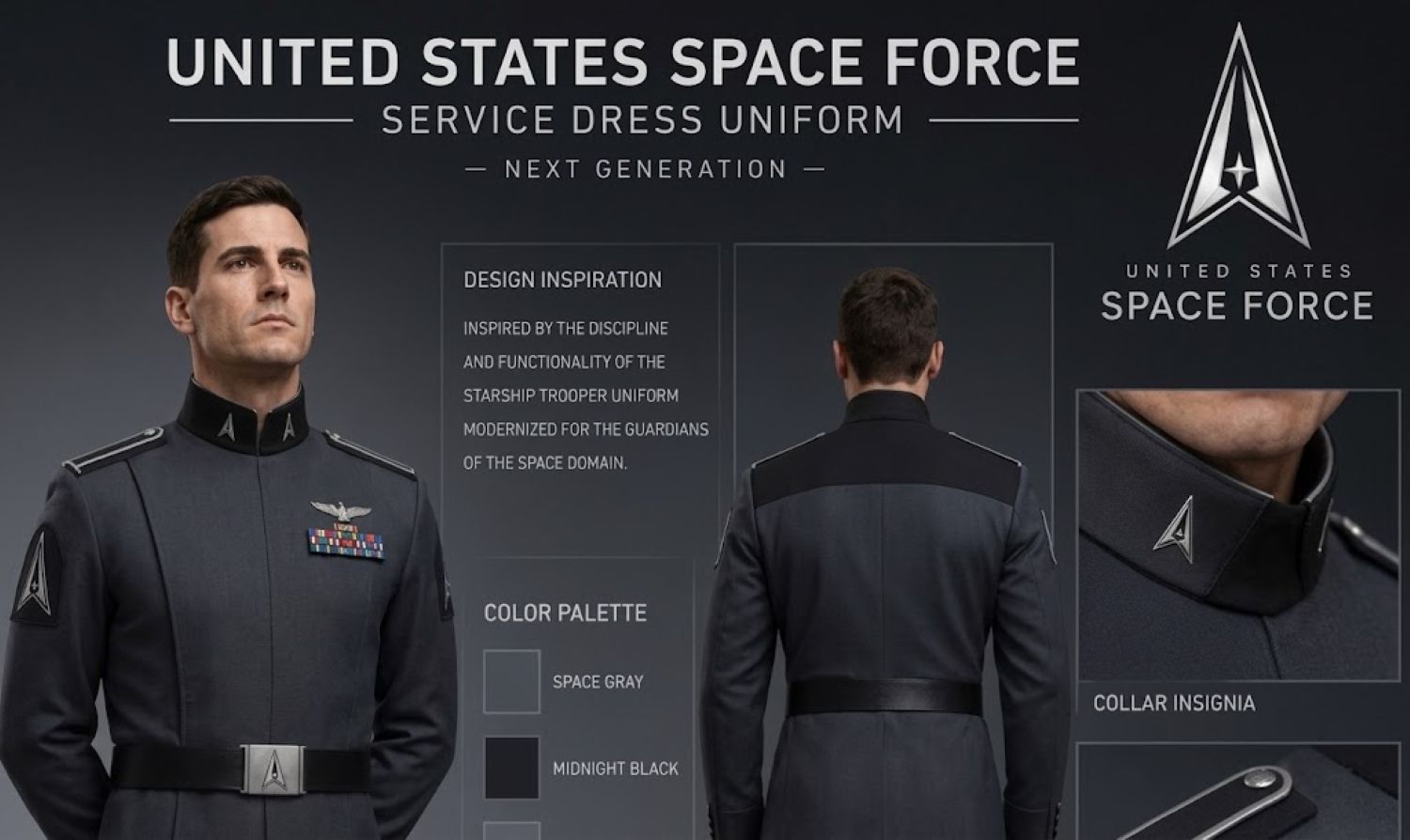
Check out the tailored charcoal jacket, matching trousers, peaked dress cap, and tall black boots — delta insignia stamped on the collar, cap, belt buckle, and sleeve. Color palette: “space gray,” “midnight black,” “silver gray,” “satin black.” On September 6–7, Trump posted this concept to Truth Social, labeled it “United States Space Force Service Dress Uniform – Next Generation,” and described it as “inspired by the discipline and functionality of the Starship Trooper uniform.”
Worth noting: this appears to be an AI-generated rendering. No Pentagon approval process has been documented. No uniform board convened. The actual Space Force service dress — introduced in early 2026 — is blue, Air Force-derived, with a diagonal six-button closure referencing the sixth military branch. Quiet. Professional. Conspicuously short on jackboots.
- Trump’s Truth Social post labels the design “inspired by the discipline and functionality of the Starship Trooper uniform”
- The image appears AI-generated; no official adoption process has been documented
- Social media immediately compared it to Star Wars Imperial officer uniforms
- “Are we the baddies?” became the dominant reaction framing online
- The same posting spree included a graphic of the Moon captioned “The Moon is Ours”
The Part That Makes Film Critics Wince
Director Paul Verhoeven spent the entire runtime of Starship Troopers trying to warn you — and he was not subtle about it.
Here’s the problem with citing Starship Troopers approvingly: Verhoeven built the film as a deliberate cautionary text. “I decided to make a movie about fascists who aren’t aware of their fascism,” he has said, drawing on his childhood in the Nazi-occupied Netherlands. The peaked caps, the sharp tailoring, the boots — every design choice was a deliberate echo of authoritarian regimes.
Star Wars did the same with its Imperial officers. Both franchises borrowed from the same historical wardrobe. Trump’s graphic borrowed from both, labeled the reference enthusiastically, and posted it alongside a graphic of the Moon captioned “The Moon is Ours.”
The internet’s summary was faster and more efficient than any op-ed: “Are we the baddies?”
Two Reads, One Uniform
The “it’s just cool sci-fi fashion” defense gets harder to sustain when the graphic names the source material itself.
Some observers see stylish sci-fi cosplay — cohesive monochrome palette, futuristic energy, sharp silhouette. That read exists. But the graphic’s own text names the film directly. “Didn’t know the reference” becomes a difficult position when you’ve typed the reference yourself.
Space Force Guardians operate under “Space Warfighting: A Framework for Planners,” a doctrine built around denying adversaries freedom of operation in space. That’s a serious military mission sitting awkwardly next to a meme-ready uniform concept. The tension isn’t subtle — it’s the entire story.
What This Moment Actually Reveals
Military branding has entered the AI-image era, and the speed of that shift outpaces every approval process currently on the books.
A president can now prototype a military uniform, distribute it to a global audience, and trigger a full cultural debate before any uniform board schedules its first meeting. The resulting conversation — part policy, part pop culture, part collective historical memory — unfolds faster than any official response can follow. Whether the AI-generated rendering lands as aspirational or alarming depends entirely on what films you grew up watching. The speed, though, is non-negotiable for everyone.