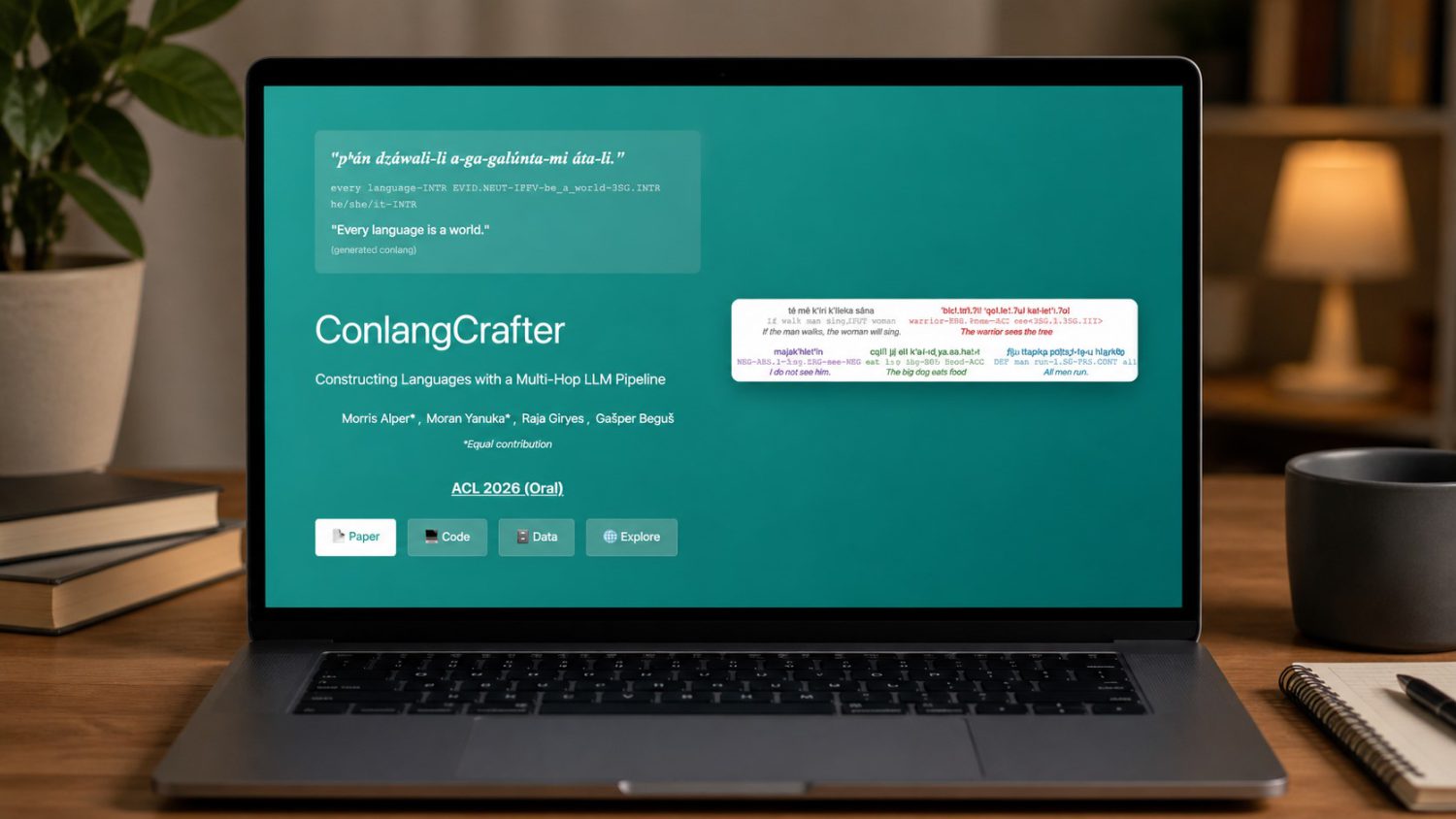
Researchers just automated the thing Tolkien spent decades doing by hand. ConlangCrafter is a research prototype that designs fictional languages end-to-end — and it has already built more than 60 of them.
The Tolkien Problem, Solved by Pipeline
A staged AI system now handles the structural heavy lifting that once required years of expert linguistic craft.
Tolkien spent decades crafting Elvish. David J. Peterson built Dothraki for Game of Thrones, a job requiring genuine linguistic training and serious time investment. Researchers from Tel Aviv University, Carnegie Mellon University, and UC Berkeley just automated most of that process. ConlangCrafter, presented at ACL 2026, runs large language models through a four-stage pipeline — sounds, grammar, vocabulary, translation — producing a structurally coherent fictional language in a single automated session. No linguist required at generation time.
How It Actually Works
A self-refining multi-stage pipeline consistently outperforms single-prompt language generation on both diversity and internal consistency.
Single-prompt language generation tends to produce shallow, inconsistent pseudo-languages. ConlangCrafter breaks the problem into sequential stages instead:
- First, the system defines a sound inventory and phonotactic rules.
- Then it builds grammar — word order, verb agreement, case systems.
- Then vocabulary.
- Then it translates test sentences to verify its own work.
At each stage, a self-refinement loop catches contradictions before moving forward.
Co-author Morris Alper, as paraphrased by IEEE Spectrum, puts the improvement this way: the full system is about twice as diverse and almost 70 percent more consistent than simply prompting an LLM to invent a new language. Think of it as CAD software for language design — the system fills in the engineering details from your architectural sketch. The pipeline works across DeepSeek-R1 and two variants of Gemini 2.5, with meaningful improvements over the single-prompt baseline regardless of which model runs underneath. Diversity scores tell the story clearly:
| System | Diversity Score |
|---|---|
| Single-prompt baseline | 0.25–0.35 |
| ConlangCrafter | 0.56–0.60 |
| 1,874 real languages (WALS reference) | ~0.43 |
Two PhD linguists spent around 35 hours validating those automated scores, with their assessments showing statistically significant alignment with the system’s consistency metrics.
Over 60 languages generated so far include a vowel-only system with zero consonants and an alien language built entirely on chromemes (color units) and kinemes (gesture units). Code and examples are publicly available via the project website and Hugging Face.
That consonant-free language is not a joke. It genuinely has no consonant sounds — something no known human language does.
Who Actually Needs This
Game developers, fantasy authors, and tabletop designers building worlds with distinct cultures will find a serious head start here.
Game studios, fantasy writers, and tabletop campaign designers who need linguistically authentic fictional cultures stand to benefit most immediately. Productions investing in the kind of world-building depth that makes fictional universes feel genuinely inhabited — think the layered lore of recent prestige RPGs — could use a tool like this to generate scaffolding fast and let human designers refine it, rather than starting from zero. Linguistics researchers get something different: a way to rapidly spin up languages with unusual typological combinations, useful for testing theoretical claims about what structural features a language actually needs to function.
What It Can’t Do Yet
Real gaps remain in semantics, discourse modeling, and writing systems — and the training-data bias problem hasn’t disappeared.
ConlangCrafter handles phonology, morphosyntax, and a starter lexicon. It does not deeply model semantics, discourse, pragmatics, or full writing systems. Grammar descriptions are shorter than professional reference grammars — context-length limits on the underlying LLMs are a genuine constraint. Because those models were trained predominantly on text from widely spoken, well-documented languages, generated outputs may still drift toward English-adjacent structures even with randomness injected. The consistency improvement for Gemini 2.5 Flash specifically did not reach statistical significance at the study’s sample size.
The researchers also flag something worth sitting with: the same AI enthusiasm driving fictional language generation should not pull attention or resources away from documenting the hundreds of endangered real-world languages spoken by vulnerable communities right now. That caveat isn’t boilerplate. It’s a legitimate tension.
The Next Font
If ConlangCrafter-style pipelines reach consumer tools, bespoke fictional languages could become as routine as choosing a typeface.
If pipelines like ConlangCrafter get productized into world-building engines and narrative design software, bespoke fictional languages could become as routine as custom typefaces in a creative project. The honest risk: if every indie creator pulls from the same AI defaults, fictional worlds might all start sounding like distant cousins. The tool exists. What gets built with it is still a human decision.