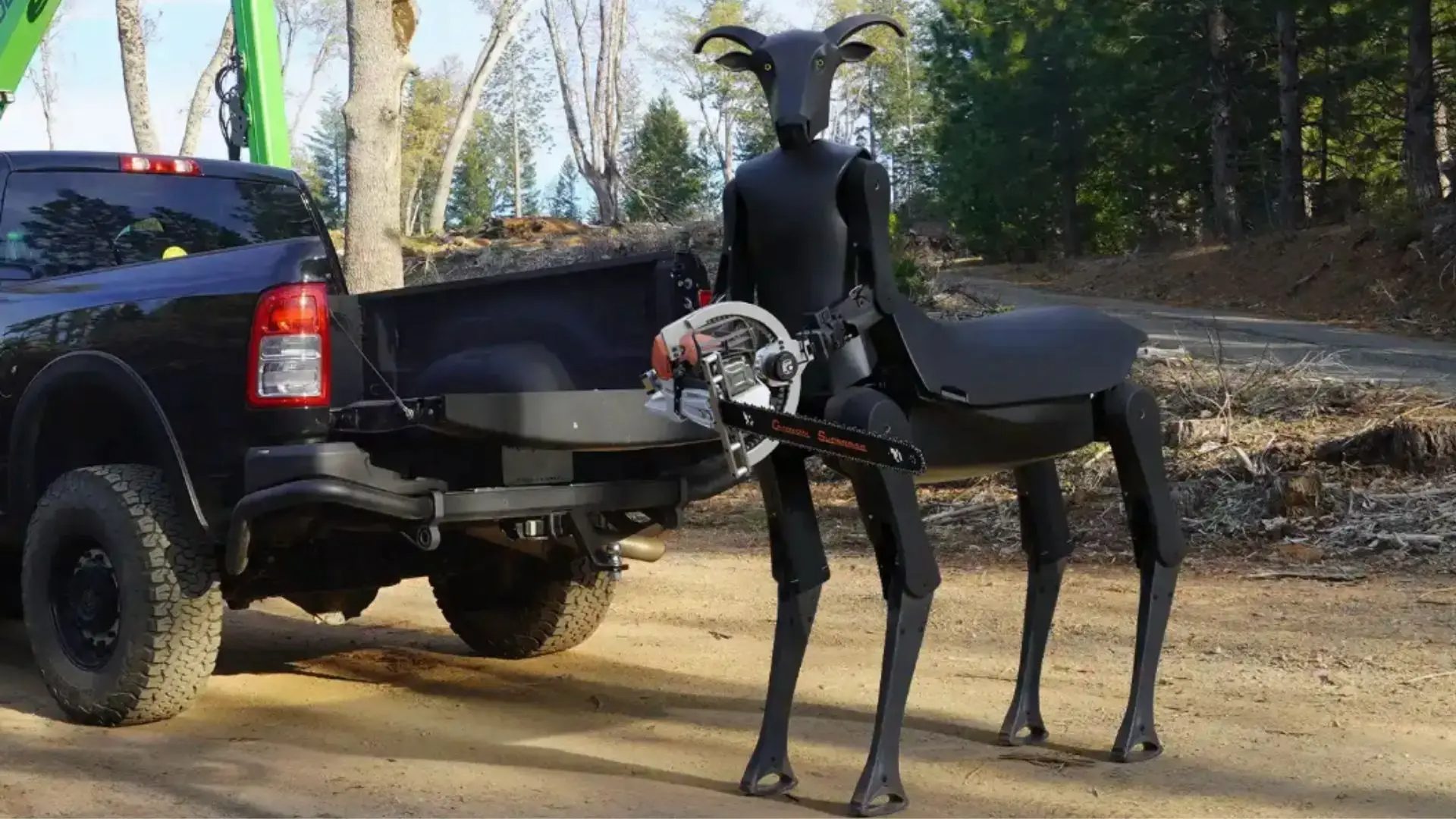
A seven-foot robot with horns, glowing eyes, and a chainsaw for an arm broke the internet this summer. Social media called it a “sleep paralysis demon.” But Threehalves, built by Auburn, California startup Satyress Robotics, wasn’t designed to terrify you. It was designed to walk into a wildfire so you don’t have to — much like the robotic knee exoskeleton developed to protect workers from physical harm on the job.
Why Four Legs Beat Two in a Burning Forest
The centaur configuration solves stability problems that stop bipedal robots cold on rubble and ash.
Bipedal humanoids fall down. On ash-covered slopes, in rubble to find survivors, across the unstable ground of a collapsed building — two legs are a liability. Threehalves uses a quadruped base that maintains three points of contact while probing terrain with the fourth leg, according to Interesting Engineering. Each joint uses passive friction to hold position without burning power, which matters when you’re cutting through debris for hours.
Those demonic horns? Cameras. They give operators a wide-angle view of limb and tool positions, providing redundant backup if internal sensors fail, as reported by The Debrief. Form follows function — even when the form looks like it escaped a horror set.
Here’s what the spec sheet actually looks like:
- Tools swap in minutes via quick-disconnect wrists — chainsaws, drills, impact wrenches, no hands required
- Zero AI: a human operator drives every movement via joystick from a safe distance, according to TechTimes
- Exposed air tanks on the chest and back double as kill switches — puncture them and every joint locks instantly
- Current status: component-level testing only, legs not yet fully functional, commercial deployment at least two years out
- Transport-ready: two units fit in a standard truck bed for rapid wildfire deployment
“Our goal is to make the forestry and line clearing sector safer and more efficient,” lead engineer Beau G. told the NY Post. “With the robot handling chainsaws, workers can perform their familiar tasks without the fear of falling branches.” The philosophy is straightforward: experienced forestry workers keep using woodworking tools they already know — the robot just handles the dangerous physical positioning. Newsweek reported that Satyress also published what amounts to “instructions to kill it,” including stabbing or shooting the air reservoirs as a last resort. A rescue robot you might need to put down. Nobody expected to write that sentence in 2026.
The Prototype Reality Check
Threehalves is early-stage hardware, and its creators are making a deliberate bet on human control over machine autonomy.
IIT’s Centauro — a research platform from the Istituto Italiano di Tecnologia that navigates rubble, climbs stairs, and operates tools via telepresence suits — and Run Robotics’ AI-powered wheel-leg hybrid are both further along on autonomy. Centauro, for instance, has completed structured disaster-scenario trials with varying levels of semi-autonomous operation. Satyress is betting purely on teleoperation instead, and representatives told The Debrief the approach is a conscious philosophy, not a shortfall — a contrast to the fully autonomous humanoid robot designs now emerging across the industry. They also acknowledged the look is “obviously quite over the top” — but deliberately so. In a smoke-filled forest, you want the machine to look unmistakably non-human.
If Threehalves works, the job of walking into a burning forest holding a chainsaw changes permanently. The machine built to save your life looks like something from your worst nightmare. That might be precisely why it succeeds.