



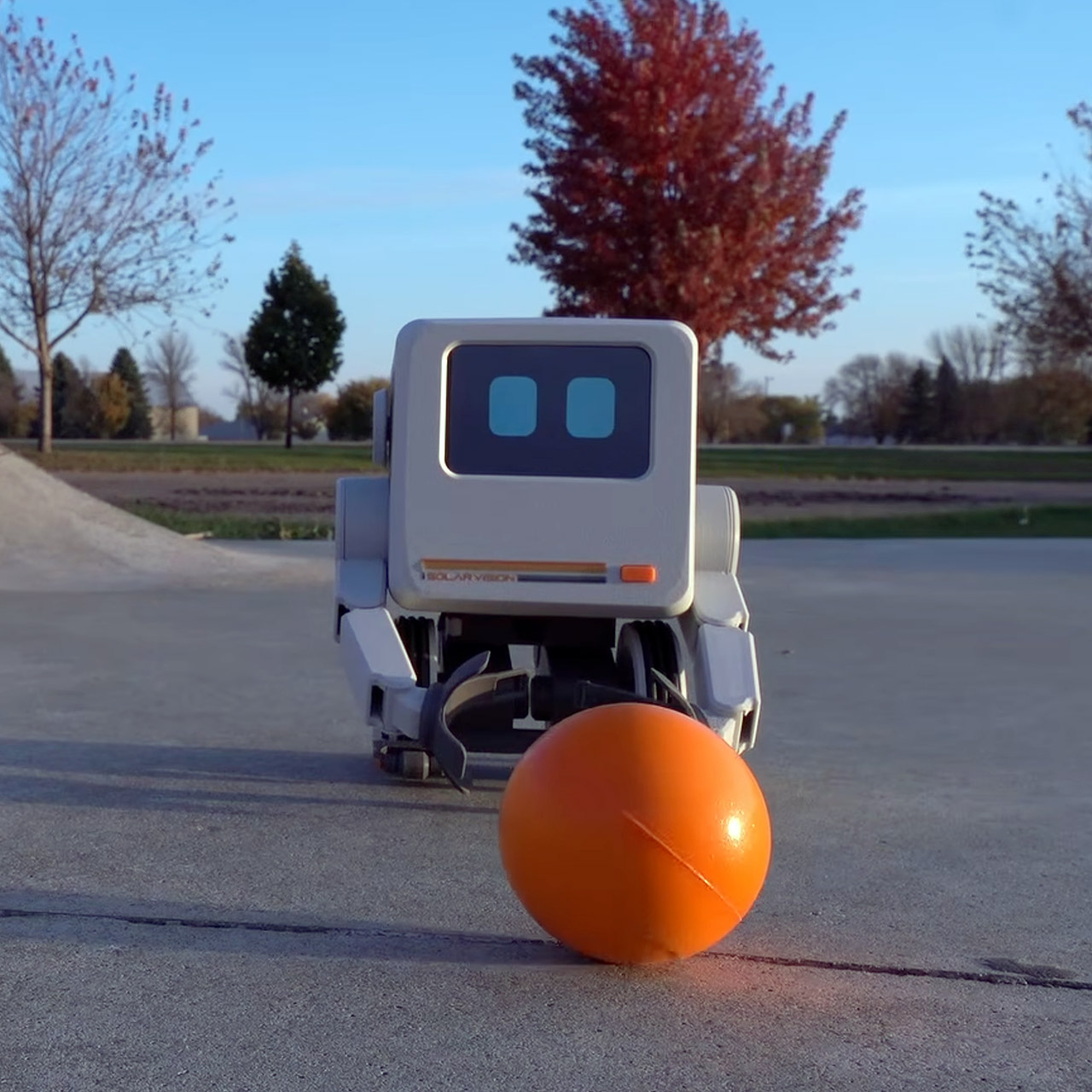
Drive, detect, grip, turn, return. Sector 07’s robot Fetch completes that entire sequence without operator input, and the parts cost approximately $300. The creator describes it as their first autonomous machine, built to show that a disciplined, narrow approach to perception and control can produce convincing behavior on a budget most makers already have.
What Fetch Actually Does
The complete fetch cycle runs in four distinct phases, each driven by a specific detection or timing condition.
Fetch starts by driving across the floor while its camera scans for an orange ball. The vision system uses the detected object’s bounding box to calculate the ball’s position and steer the wheels toward it.
As the distance closes, Fetch extends its two 3D-printed arms, drives forward, and closes them around the ball. A fixed forward-motion interval handles the moment the ball disappears from reliable camera view at very close range. Once the ball is secured, Fetch turns, scans for a raised human hand, steers toward it, and delivers.
The Hardware Split That Makes It Work
Separating vision processing from motor control is the architectural decision that keeps the robot’s movement responsive.
Fetch runs on an Arduino UNO Q, whose Linux-capable processor handles the camera feed and vision software. A separate microcontroller manages the motors and servos, keeping time-sensitive movement control isolated from the heavier compute load.
According to Arduino’s official documentation, the UNO Q pairs a Linux-capable Qualcomm processor with an STM32U585 microcontroller for real-time control, a design intended to prevent high-level computation from interfering with precise motor timing. Most of the robot’s body is 3D printed and engineered to snap or slide together with minimal screws.
A Vision Model Built for One Job
A two-class detector trained on roughly 400 total images powers all of Fetch’s navigation and delivery decisions.
The detector recognizes exactly two things: an orange ball and a human hand. Sector 07 trained it on roughly 200 images of each class, all captured using the robot’s own camera across different lighting conditions, floor surfaces, and backgrounds.
Edge Impulse and YOLO-Pro power the detector. YOLO-Pro is a compact object-detection framework that outputs bounding boxes rather than a full map of the environment, and Fetch’s control code reads those boxes and translates them into discrete actions: approach, grip, turn, return.
Failure First, Then Fixes
Early testing exposed specific failure modes, and each one pointed to a targeted parameter change.
Early testing produced circular driving, close-range visual loss, bright-light detection failures, and a robot that dropped the ball during release. Motor speed ratios, grip timing, and detection-confidence thresholds all required targeted adjustments to address those problems.
According to secondary reporting by Hackster.io, mechanical reliability was established before software tuning began. The arms were confirmed to close consistently and the chassis to track straight through manual tests before the autonomous loop was run, which reduced the number of variables in play during software debugging. Projects like Snake Robots similarly demonstrate how focused, single-task autonomous designs can deliver results in constrained environments.
Eyes, Ears, and a Voice
Personality features give observers a readable window into the robot’s internal states without affecting navigation or gripping.
Fetch includes a front display with animated eyes, moving ear-like appendages, and prerecorded voice lines generated with ElevenLabs. Those features are not required for navigation or gripping; they make the robot’s state transitions visible to anyone watching and give repeated demonstrations a distinct character.
Open Files, Open Starting Point
Sector 07 released the complete project for free, turning Fetch into a replicable starting point for the maker community.
Sector 07 released the project at no cost through Arduino Project Hub, with Arduino sponsoring the build. The documentation includes print files, code, schematics, a component list, assembly instructions, and development notes.
Makers who want to go further can retrain the detector for a different object or modify the chassis for a different task. The narrow perception model and the split compute architecture are both documented, offering a concrete foundation for anyone building a first autonomous machine. For those curious about the broader cost spectrum of robotics projects, the Melody Humanoid Robot represents the other end of the budget range at $175,000.