
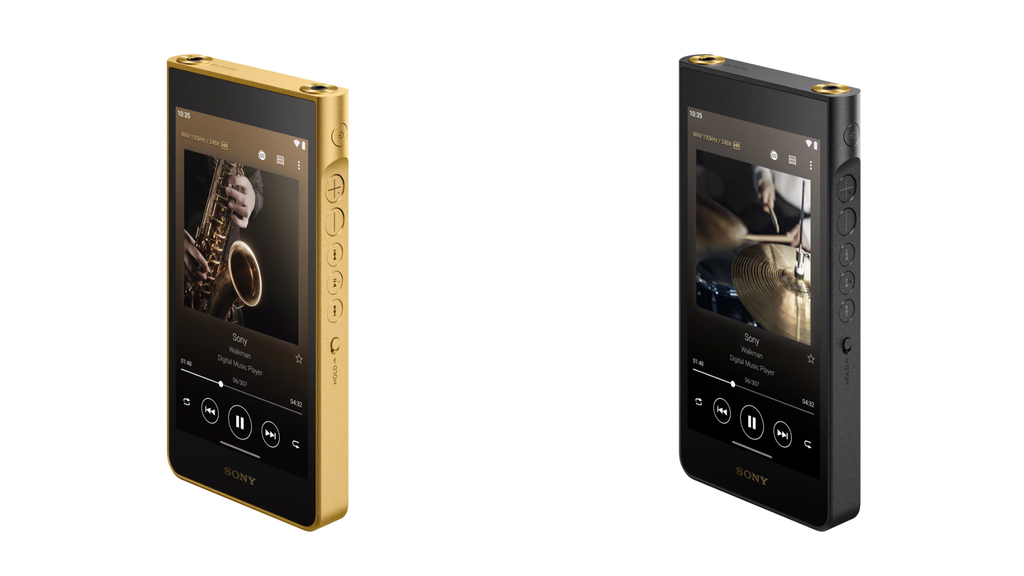
The NW-WM1AM3 and NW-WM1ZM3 are built for listeners who treat portable audio as a discipline, not a convenience. Sony announced both models in October 2026, with availability set for November across many markets. The NW-WM1AM3 carries a UK suggested price of £2,099; the NW-WM1ZM3 sits at £4,299.
The ZM3 justifies its premium through materials: a 99.99%-purity oxygen-free copper chassis, gold-plated screws, and KIMBER KABLE wiring. According to Sony’s press release, those choices are intended to improve grounding, reduce noise, and preserve signal integrity.
The AM3 uses an aluminium-alloy main chassis with a gold-plated oxygen-free-copper rear chassis, borrowing the same design philosophy at a significantly lower entry point.
Both models share a 5.5-inch display, 256GB of internal storage with expandable options, dual headphone outputs, and Wi-Fi. Sony rates both at up to 35 hours of playback for 128kbps MP3 files and up to 31 hours during streaming.
The DSD Remastering Engine resamples PCM audio into an 11.2MHz DSD stream. The S-Master HX digital amplifier handles native DSD and balanced output.
These are purpose-built devices for listeners who have already decided that a dedicated player serves them better than a smartphone.
The MDR-3R Is the Release That Actually Has a Story
Sony revived the headphones that shipped with the original 1979 TPS-L2 Walkman and kept nearly everything that made them memorable.
Unveiled on November 5, 2026, the MDR-3R is a direct modern interpretation of the MDR-3, the headphones bundled with the cassette player that started everything. The original 23mm driver size and open-ear design remain intact.
What is new fits neatly into four features:
- USB-C connection compatible with current phones, tablets, and computers that support USB audio
- Inline remote for basic playback and call controls
- Built-in microphone
- Interchangeable blue and orange earpads on the standard model
The standard MDR-3R is priced at $59.99 in the United States. Sony also announced a Stranger Things edition at $79.99, featuring a darker design with red-and-black earpads and custom packaging.
The headphones require no charging, no Bluetooth pairing, and no firmware updates. They do not offer the balanced output found on the flagship Walkman players, and they make no claim to compete with high-resolution listening hardware. Their appeal is simplicity, portability, and a design that has changed very little in nearly 50 years.
Why Sony’s Cheapest New Product Will Draw the Most Attention
A $60 wired headphone does more for the Walkman brand’s immediate cultural reach than a £4,299 copper chassis.
Sony is pursuing two distinct Walkman strategies at once. The WM1AM3 and WM1ZM3 position the brand firmly in the audiophile market, confirming that Sony still builds dedicated hardware for listeners who want premium materials, local high-resolution libraries, and specialized digital processing. The MDR-3R, by contrast, turns the Walkman’s visual history into an accessible product that a much broader audience can buy and immediately recognize.
The timing is commercially useful. The MDR-3R’s wired-only design fits a growing interest in simple, repairable audio gear, as reported by Digital Trends. The Stranger Things tie-in extends that appeal further, connecting the aesthetic to an audience that knows the look without having lived through the original.
The flagship players are technically ambitious. The $60 headphone is the one that will appear in gift guides and social media posts from people who have never once thought about DSD remastering.