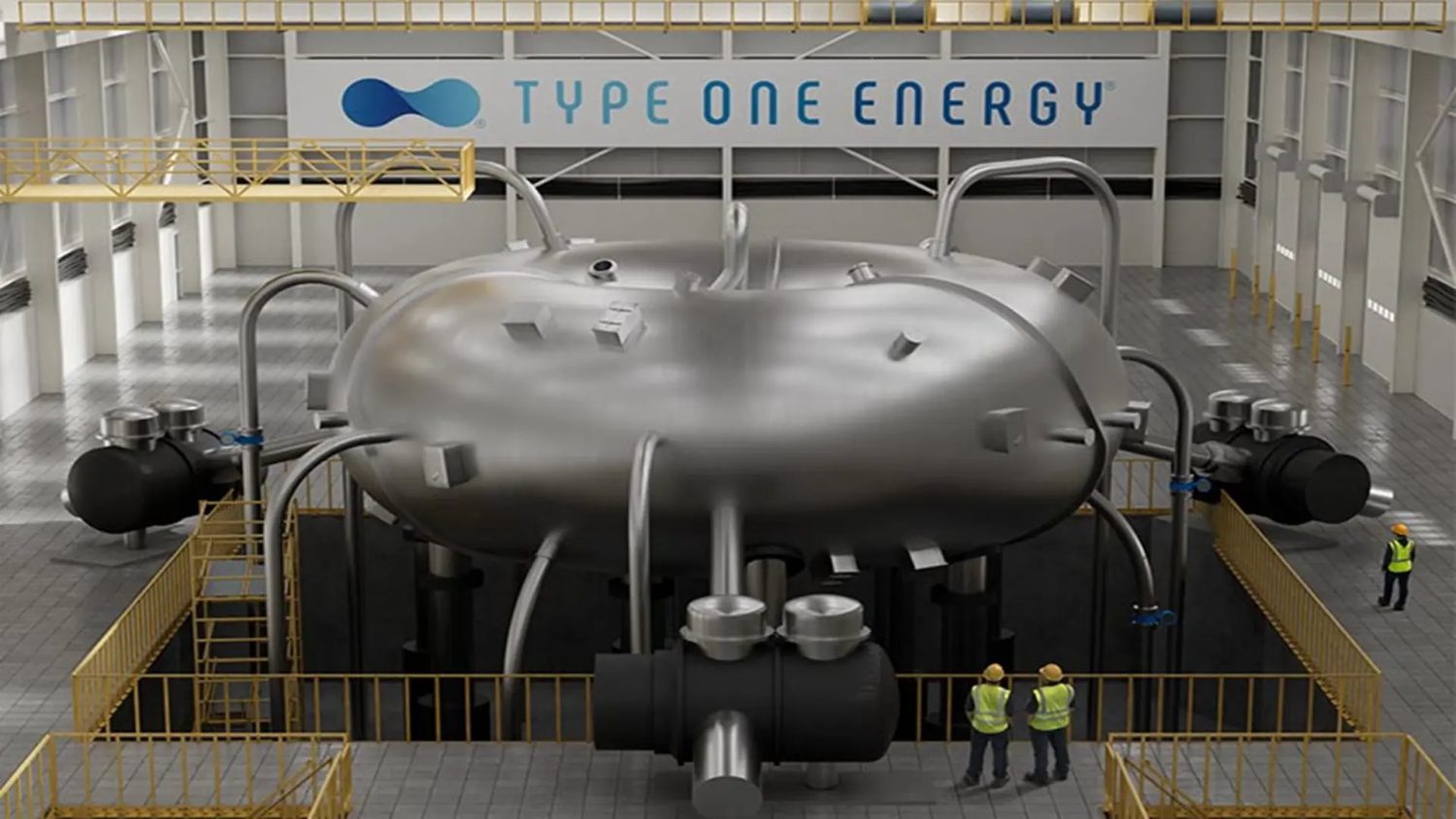
Fusion energy has spent roughly 70 years being 30 years away. On August 31, 2026, something genuinely different happened — not a scientific breakthrough, a bureaucratic one, in the best possible sense. Tennessee’s Department of Environment and Conservation issued the first fusion-specific byproduct material license in U.S. history to Type One Energy, clearing the path for Project Infinity at TVA’s Bull Run Energy Complex in Clinton. Fusion didn’t just make another headline. It got a permit.
What Makes a Stellarator Different (And Why It Matters)
The design choice at the heart of Project Infinity trades familiar engineering headaches for unfamiliar ones — and that tradeoff deserves a closer look.
Before the milestone lands, here’s what’s confirmed on the ground:
- Tennessee’s fusion regulations (Chapter 0400-20-14) took effect June 9, 2026 — the first dedicated state-level framework in the country.
- Infinity One, a prototype stellarator and workforce training facility, targets commissioning around 2029.
- Infinity Two, a 400 MWe commercial plant, projects grid delivery in the mid-2030s, with construction potentially starting in 2028.
- Bull Run’s existing grid connections and transmission infrastructure are central to the project’s siting strategy.
- TVA, Oak Ridge National Laboratory, and the University of Tennessee are formal partners.
Most fusion headlines reference tokamaks — the donut-shaped designs powering ITER and most public imagination. Tokamaks require a powerful electrical current running through the plasma itself to hold it in place, which creates instability risks and favours pulsed rather than continuous operation. A stellarator uses complex, twisted external magnetic coils to shape the plasma without that internal current. The tradeoff is real: drop the plasma current and you gain a configuration well-suited to steady-state operation — exactly what a commercial power plant needs. The catch is that the three-dimensional magnet engineering is fiendishly difficult to manufacture at scale.
Germany’s Wendelstein 7-X stellarator demonstrated the physics experimentally. No stellarator has crossed from there to a licensed commercial power plant. Until now, at least on paper.
Tennessee’s regulatory framework handles that complexity by treating fusion machines alongside particle accelerators and medical imaging equipment — not fission reactors. The assessment reflects fusion’s distinct risk profile: no meltdown risk category, no long-lived high-level waste tier. TDEC’s Division of Radiological Health administers the license, and the framework is technology-neutral, covering fusion designs broadly rather than prescribing a specific approach.
That distinction — fusion treated like an accelerator, not a reactor — is what made this license possible.
“Now the international benchmark for how to ensure fusion power-plant ‘safety by design’ in a manner that can unlock the compelling economics of this transformational power generation technology.” — Christofer Mowry, CEO, Type One Energy
A Coal Plant, a Utility, and a Very Long Timeline
The Bull Run site brings real infrastructure advantages — but the engineering and commercial challenges ahead are equally real.
Repurposing Bull Run’s decommissioned fossil infrastructure follows a pattern visible across recent energy coverage — coal sites converted to battery storage, data centers, and now, apparently, stellarators. Reusing existing grid interconnections and the industrial footprint reduces siting hurdles considerably, though it does not eliminate every permitting or local challenge along the way. TVA signed a Letter of Intent for Infinity Two in 2025, initially scoped at 350 MWe before maturing to the current 400 MWe target. That quiet capacity revision is worth noticing: the design is still evolving. power company decisions around siting and land use remain a persistent tension in projects like this one.
Observers who have tracked fusion timelines slip before have earned their skepticism here. Sustaining plasma conditions, extracting heat efficiently, and manufacturing stellarator magnets continuously at commercial scale remain unsolved problems at this size. The license is real and confirmed. Infinity Two delivering 400 MWe to the grid by around 2034 is a company projection, contingent on engineering, funding, and a timeline with no direct historical precedent to benchmark against.
What Tennessee has built is a regulatory on-ramp that didn’t exist before June 2026. Whether Project Infinity becomes the proof-of-concept fusion has been waiting for — or another cautionary entry in a long list of ambitious timelines — the state just made it possible to find out.