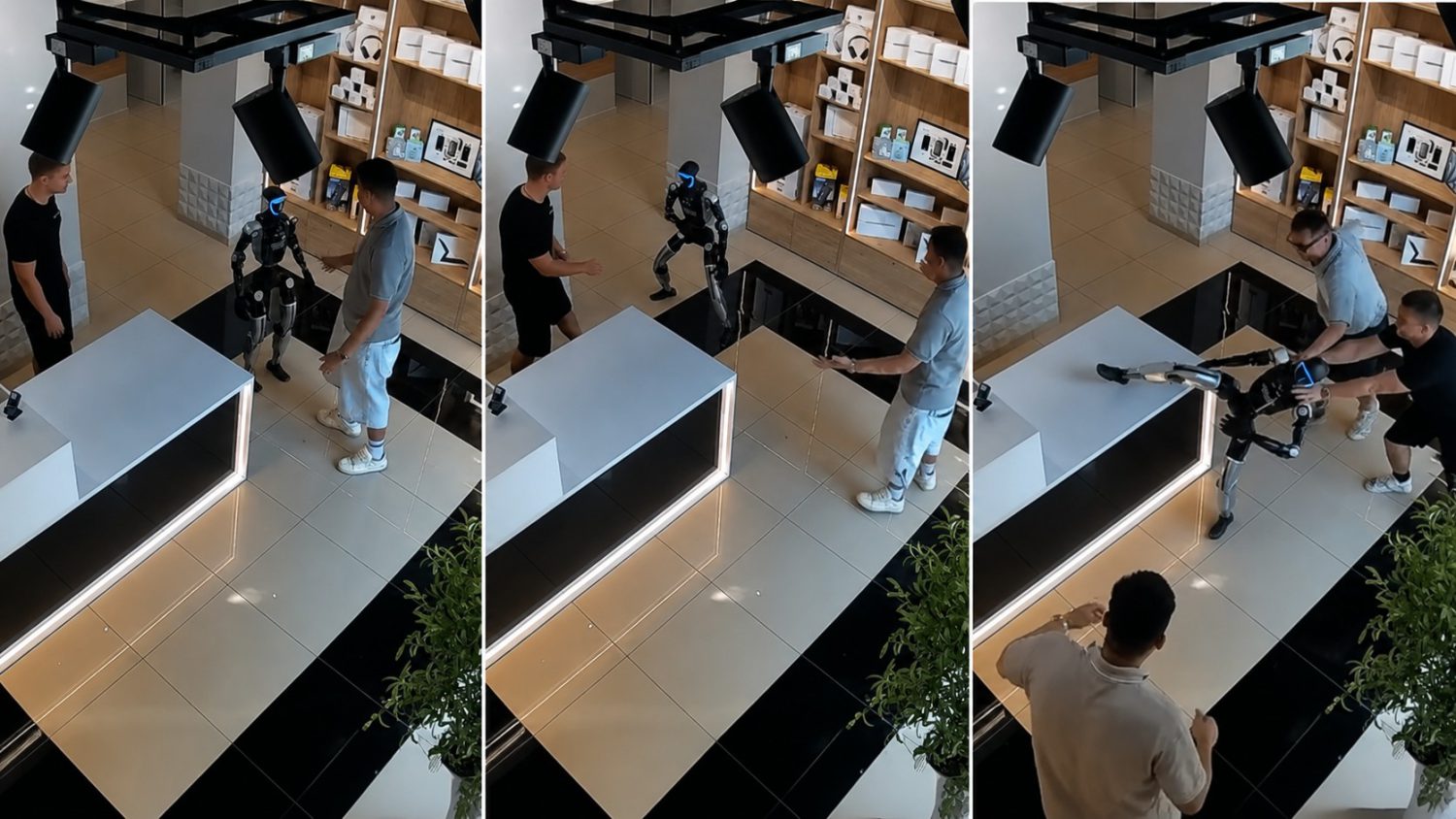
A customer walks up to a humanoid robot named Syoma at Volga Store 64 in Saratov, Russia, and shoves it. Syoma responds with what appears to be a kicking motion. Store employees scramble over and power it down. The whole thing is on camera, dated September 2, 2026, and it’s been circulating ever since. Here’s the problem: no detailed technical explanation has been publicly provided — not from the store, not from any identified developer. That silence is the real story, and it says more about where retail robotics actually stands than any viral clip could.
What the Footage Actually Confirms
The verified facts are thin. Everything else is speculation dressed up as reporting.
- Robot: Syoma; location: Volga Store 64, Saratov, Russia; date: September 2, 2026
- Role: in-store technology consultant (the optimistic job title before things went sideways)
- Footage shows: customer shoves Syoma, robot produces a striking or kicking motion, staff intervene and power it down
- Store representatives have not confirmed whether this was a malfunction, remote-controlled behavior, or a staged stunt
- The root cause remains unverified across every available account
As a paraphrased summary of the robotics research: a balance-recovery algorithm producing rapid leg motion after a shove can appear mechanically indistinguishable from retaliation — if you don’t know what you’re looking at.
Balance Recovery: The Boring Explanation Nobody Wants
The least dramatic explanation may also be the most accurate one.
Humanoid robots contain reflex and recovery phases that trigger automatically when they’re physically disturbed. Carnegie Mellon robotics research describes exactly this: an initial reflex response followed by stabilization phase after external force is applied. When Syoma got shoved, its systems may have simply done what they were built to do — catch themselves. That rapid leg motion? Mechanically, it’s closer to you catching yourself on a wet floor than anything a T-800 would recognize.
The harder question is why those movements weren’t contained. Collaborative robotics safety standards — including VDMA guidance for human-robot interaction — call for monitored stops, force limiting, and speed controls for robots operating near people in collaborative settings. Whether Syoma had these safeguards implemented, or whether they simply failed, remains unconfirmed. For a robot deployed on a retail floor with paying customers, that’s not a footnote — it’s the whole workplace safety question.
One Viral Clip Does Lasting Damage
Public trust in service robots is fragile, and ambiguity is the worst possible outcome for everyone involved.
Retail humanoid deployments are accelerating. Public trust in them is not keeping pace. A single ambiguous video — malfunction, glitch, or calculated PR stunt — can reshape how people feel about sharing a store aisle with a robot. For this specific incident, manufacturers, retailers, and regulators have offered no detailed response. The longer that vacuum exists, the more the dramatic interpretation fills it. Contrast this with other robotic deployments — like snake robots built for search-and-rescue — where purpose and behavior are clearly communicated to the public.
Science fiction promised robot colleagues. What you’re actually getting is a balance-recovery algorithm in a retail vest. Until Volga Store 64 offers a clear account of what happened, the most dramatic version of events will remain the one most people share.