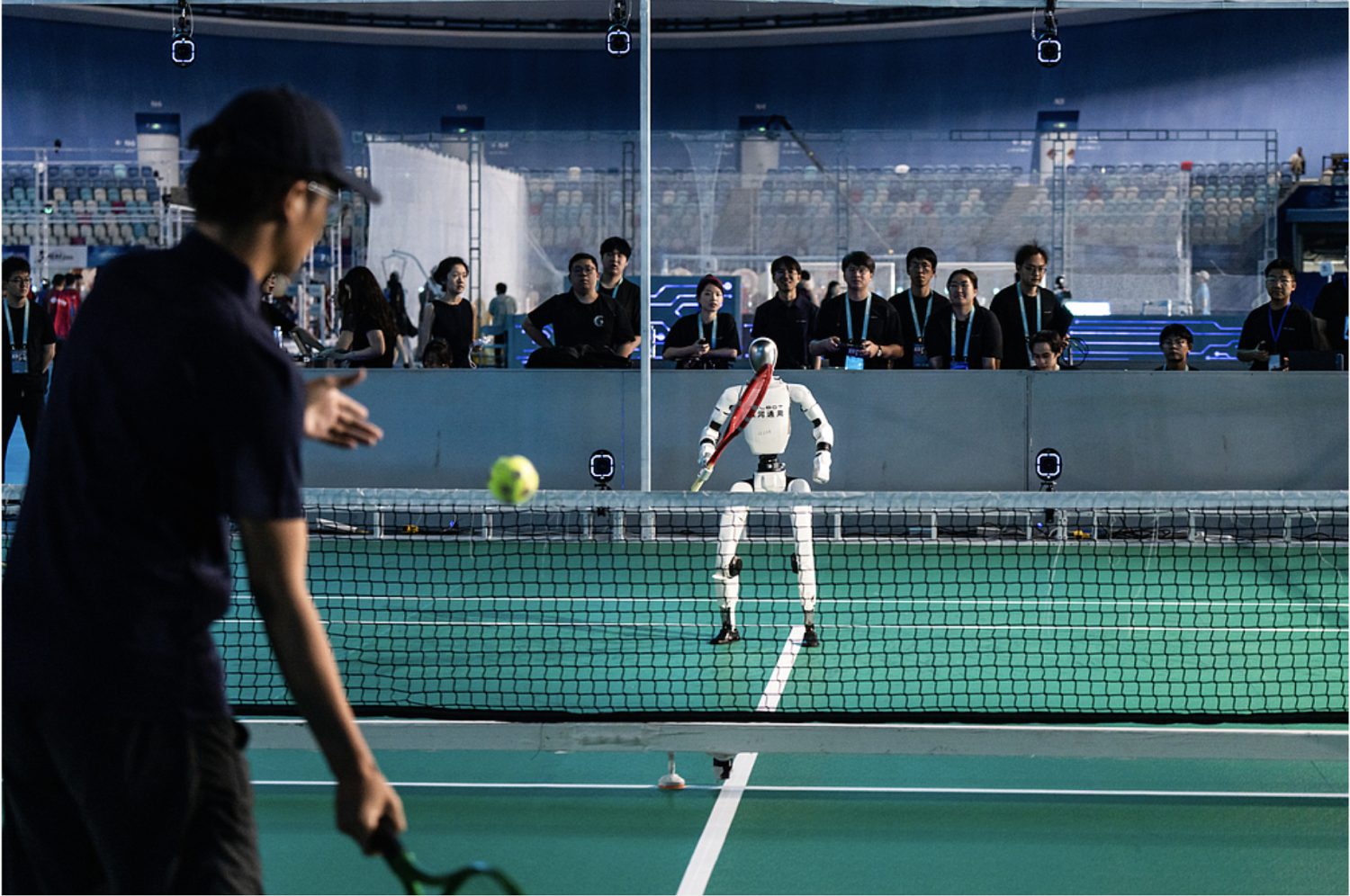
A humanoid robot sustained more than 100 consecutive autonomous rallies against human athletes at Beijing’s Second World Humanoid Robot Games in August 2026. According to Galbot and CGTN, there were no preset scripts and no human operation. Galbot’s humanoid — built by Beijing-based Galaxy General Robotics — faced Zheng Jie, a former world top-20 tennis player, in what the company describes as the world’s first live human–robot singles tennis match. The gap between “robot does a thing in a lab” and “robot competes publicly against a professional athlete” just got a lot shorter.
When the Lab Leaves the Building
At WHRG — 2,056 robots, 666 teams, 16 countries — a humanoid walked onto a tennis court and actually played.
The opening ceremony showcase wasn’t a single scripted stroke. Galbot’s robot tracked fast-moving balls, predicted trajectories, repositioned across the court, recovered from mid-rally instability, and handled singles and mixed doubles formats — all closed-loop. Here’s what it actually did on court:
- Sustained 100+ consecutive autonomous rallies against human athletes
- Played singles against Zheng Jie, with mixed doubles alongside human partners
- Executed forehands, backhands, net play, and recovery shots — all autonomously
- Achieved a reported 90.9% forehand return success rate at ball speeds exceeding 15 m/s
- Recovered from physical perturbations mid-rally without stopping
Robotics commentators noted the real novelty was “not the invention itself, but the demonstration of a high-speed, highly variable interpersonal task on a real machine at a large public event.” Some observers compared this momentum to how snake robots have moved from controlled environments into demanding real-world scenarios.
Messy Data, Clean Execution
LATENT turns roughly five hours of imperfect amateur motion capture into athletic behavior that holds up under live pressure.
The AI framework underneath is called LATENT — Learning Athletic Humanoid Tennis Skills from Imperfect Human Motion Data. Think of it like training a vocalist on voice memos instead of studio recordings: noisy and fragmentary, but structurally useful. LATENT organizes amateur motion-capture clips — short, imperfect strokes and footwork patterns — into a latent action space, essentially a motor vocabulary the robot recombines in real time. Reinforcement learning in large-scale simulation then builds a control policy that transfers to real hardware. The result: a 96.5% return success rate across 10,000 simulated attempts, and real-world rallies that hold.
LATENT’s sim-to-real pipeline decouples motion style from physical feasibility, so the robot moves naturally without folding itself onto the court. That’s the meaningful departure from earlier approaches, which typically demanded pristine professional motion capture or handcrafted controllers — expensive and difficult to generalize.
If you’re tracking the industrial or domestic humanoid market, this is the signal worth watching. Learning physical skills from imperfect human footage could accelerate capable embodied agents across factories and assistive care — a trend also visible in advances around workplace safety — though one honest caveat applies: earlier LATENT configurations relied on external motion-capture systems for ball tracking, and the exact sensor mix at WHRG isn’t fully detailed publicly.
A humanoid sharing a court with a former top-20 professional, sustaining rallies past 100 shots under public scrutiny, is not science fiction anymore.
The question now isn’t whether robots can play tennis. It’s what sport they’re warming up for next.