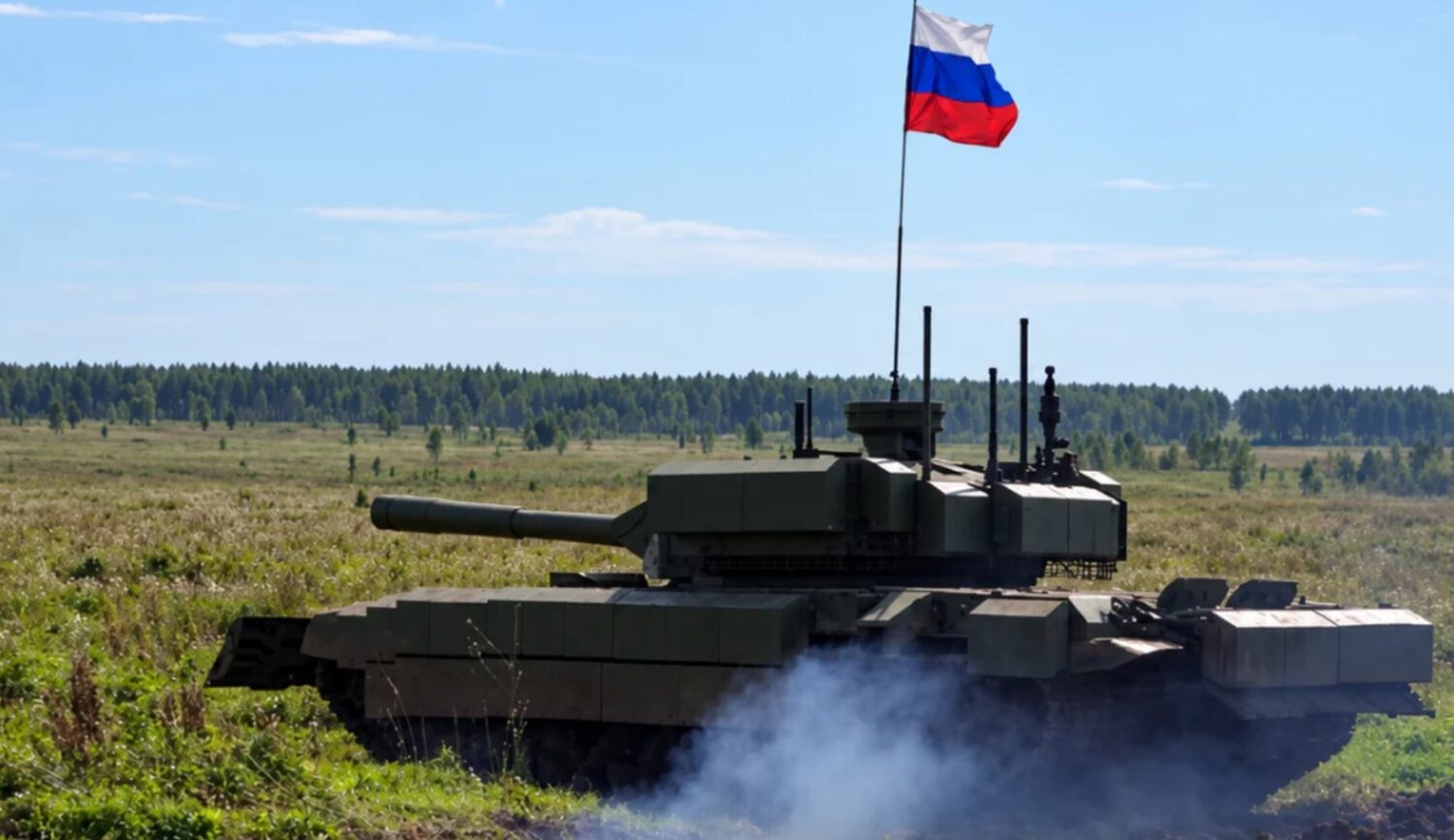
A weapons system built to keep soldiers out of danger reportedly required a human driver placed inside it before a presidential audience, then got stuck in a ditch anyway. That is the short version of the Shturm’s public debut at Tsentr-2026, a Russia-led strategic exercise that ran from September 28 through October 3, 2026, at the Chebarkul training range in Russia’s Chelyabinsk region.
The incident, reported by Defense Blog and secondary sources, underscores a point robotics engineers already know well. For a remotely operated combat vehicle, communications reliability matters as much as armor or firepower.
What the Shturm Is Built to Do
Russia’s remotely operated tank pairs a modified T-72B3M chassis with a separate crewed command vehicle, with operators controlling it via joysticks and tablets over a radio link at roughly three kilometers.
Available reporting describes the Shturm as remotely operated rather than fully autonomous. Its remote operation depends on maintaining that link, which means the command vehicle’s proximity is not a design preference but a reported architectural requirement.
Depending on configuration, armament options reportedly include a shortened 125-millimeter D-414 main gun with a 22-round autoloader, twin 30-millimeter 2A42 automatic cannons, or thermobaric rocket launchers. Russia’s Defense Ministry said the vehicles appeared in tank and BMPT-style variants during Tsentr-2026 and provided fire support to assault units, and the ministry confirmed that Putin was shown the T-72B3M-based uncrewed vehicles during the main exercise stage.
What Reportedly Went Wrong
According to Defense Blog, the Shturm repeatedly lost its radio link during exercises, reportedly prompting organizers to switch to a human driver-mechanic inside the vehicle before the Putin demonstration.
Manual control did not prevent a second problem: the vehicle reportedly got stuck in a ditch beside a dirt track, its tracks and front hull buried in the soil.
The Defense Ministry account cited in the available reporting did not mention the communications failures or the immobilization. That account described the vehicles as providing fire support during the exercise. The gap between the official description and what Defense Blog reported remains notable, and no publicly released Russian technical investigation of either incident has been identified in the available reporting.
The Design Problem the Failure Exposed
The reported architecture creates a potential single point of failure: if the radio link breaks, remote operators lose the ability to steer, target, or control the vehicle from a distance.
A Russian armor expert cited by Defense Blog argued the concept is constrained by exactly this requirement. The command post must stay close, in line of sight, and reliably connected.
That same expert reportedly described the Shturm’s engine compartment and turret roof as offering limited protection against drone strikes. These are attributed assessments from a single unnamed source, not findings from an independent technical evaluation.
A central rationale commonly advanced for uncrewed assault vehicles is that they absorb risk instead of soldiers. A system that loses its remote link and then requires a human operator inside partly undermines that rationale.
One failed demonstration does not establish a permanent design flaw, and the Tsentr-2026 incidents may reflect prototype immaturity rather than an unfixable architecture. The reported events do underscore the importance of communications reliability for remotely operated combat vehicles. Based on the reported demonstration, the Shturm has not yet shown it can dependably meet that standard.