Catching a rocket booster out of the sky is one thing. Catching the upper stage after it survives orbital flight, atmospheric reentry, and a high-speed flip maneuver is an entirely different engineering problem, and SpaceX plans to attempt it on Flight 15.
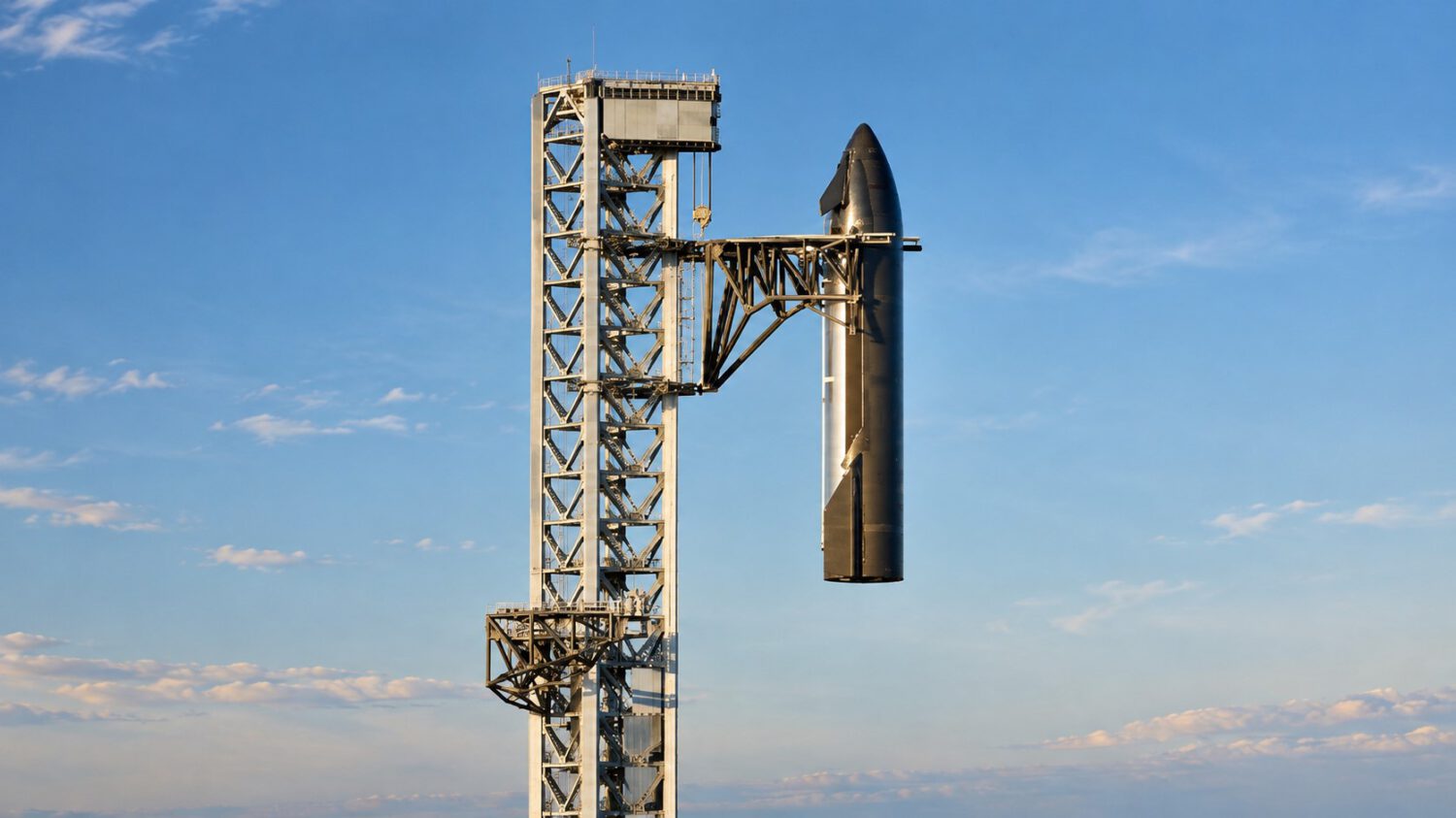
The goal is to recover both Super Heavy and Starship’s upper stage, called Ship, using the launch tower’s mechanical “chopstick” arms at the same launch site. A successful outcome would mark the first time both stages of an orbital launch vehicle were recovered intact, though that milestone depends entirely on both catches succeeding on the same flight.
The Maneuver, Explained
SpaceX released an approximately 80-second simulation showing Ship’s full return sequence, from atmospheric descent to tower capture.
The simulation is labeled “Up Next: Ship Catch.” It depicts Ship descending in a horizontal belly-flop configuration, with forward and aft flaps controlling its trajectory through the atmosphere.
Near the tower, the vehicle rotates to a vertical orientation and descends between the extended chopstick arms. The arms then meet hardware on Ship’s sides and support the vehicle after capture.
Ground testing has already begun. Ship 42, the vehicle assigned to Flight 15, was lifted by the Pad 2 chopsticks into a simulated catch position, according to Teslarati reporting. That test allowed crews to cycle the arms and connect the ship’s quick-disconnect arm, though this specific claim has not been independently verified by a primary SpaceX source.
A Much Longer Road Home
Ship faces a far more demanding return profile than the booster does, with multiple sequential phases that must each succeed before the vehicle reaches the tower.
Super Heavy’s planned recovery involves a shorter return profile than Ship’s. The booster returns to the Gulf of Mexico within minutes of launch, per Reuters reporting on Flight 14.
Ship must survive orbital or near-orbital flight, atmospheric reentry, and aerodynamic control in a belly-flop configuration before a powered descent even becomes possible. On Flight 14, a Raptor Vacuum engine shut down prematurely shortening what was originally expected to be a roughly 10-hour mission. Ship splashed down in the Pacific Ocean approximately three hours after liftoff, according to Reuters.
A catch attempt on Flight 15 would require every phase to succeed in sequence. That means reentry, belly-flop descent, the vertical flip, and a final powered approach that places Ship within the arms’ narrow capture envelope.
The simulation shows the plan. It is not evidence the complete maneuver has been demonstrated in flight.
Why It Matters
Recovering Ship at the launch site would remove the need for ocean retrieval and could reduce the time between launches, which is central to SpaceX’s reusability case for Starship.
Recovering Ship at the launch site eliminates ocean retrieval and could significantly reduce turnaround time between flights. That speed of reuse is the core of SpaceX’s operational argument for Starship.
Speaking on the company’s earnings call, Musk said a successful Flight 15 would be the first time an orbital launch vehicle had been fully recovered. That claim is contingent on both stage catches succeeding, and Musk cautioned that the outcome is not guaranteed on the first attempt.
One successful catch would not establish a reliable cadence on its own. Repeated recoveries would be required before SpaceX could treat rapid Starship reuse as an operational reality rather than a stated target.
Flight 15 is a live test of a concept that exists, so far, in simulation and on the ground. What happens next determines whether Starship’s reusability promise moves from a compelling animation into something you can actually count on.