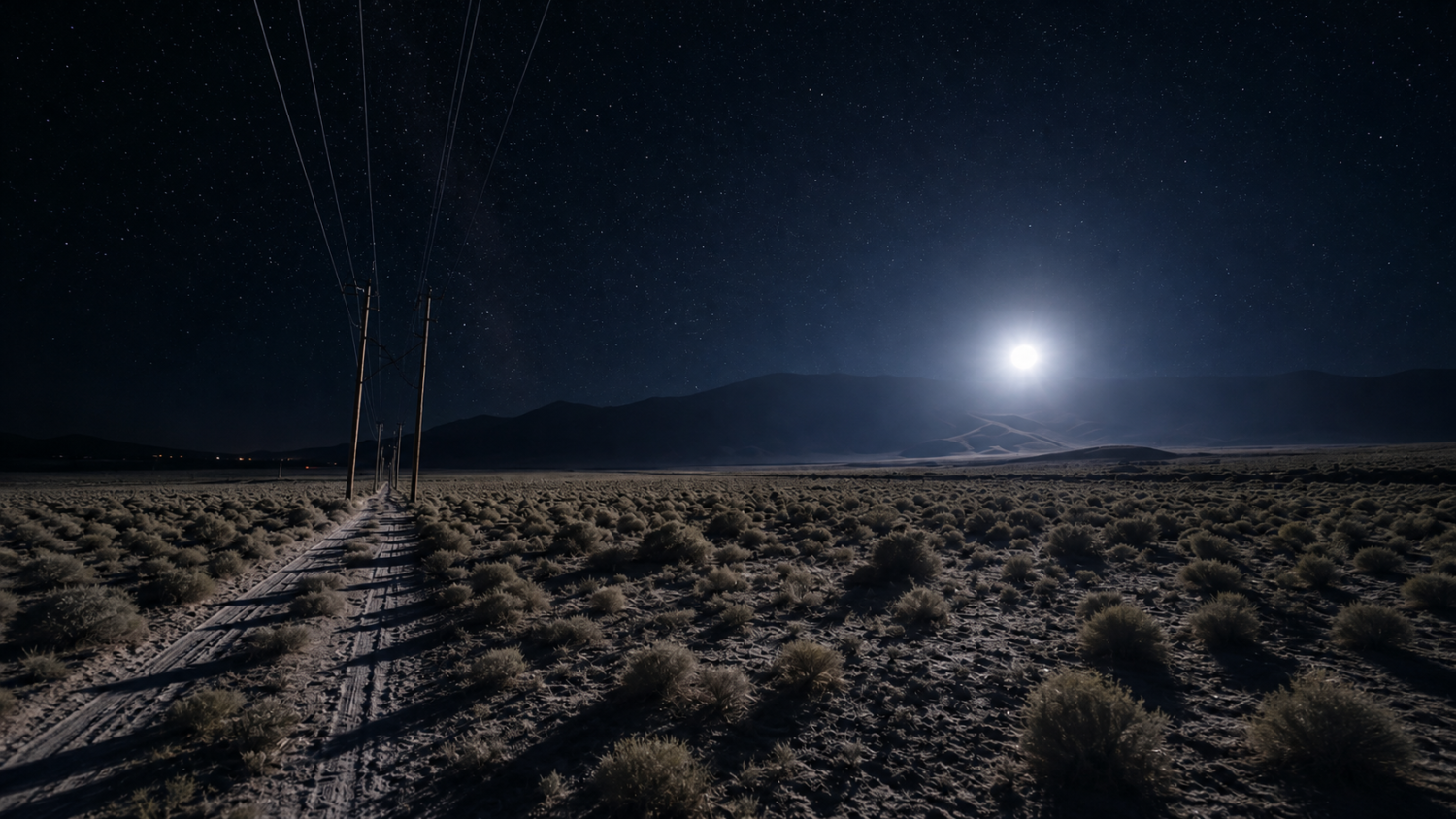
Rescue teams crossed rocky high-desert terrain near Lone Pine at night, reportedly working under visibility of roughly three miles at approximately full-moon brightness. That scene on October 10 was staged by Reflect Orbital to show what it believes satellites could one day do from about 625 kilometers above Earth.
The light came from powerful ground-based spotlights, not a spacecraft.
What the Desert Drill Actually Showed
China Lake Mountain Rescue ran real drills under simulated satellite light, but the test confirmed ground-level logistics, not orbital capability.
China Lake Mountain Rescue participated in the exercise, running grid searches, stretcher carries, and equipment-handling drills under the simulated illumination. Responders reportedly experienced visibility extending roughly three miles at approximately full-moon brightness, though those figures describe the ground test’s spotlights, not any orbital reflector.
Conventional emergency lighting in remote terrain typically depends on generators or pre-positioned equipment. Reflect Orbital’s proposed satellite system would, in theory, redirect sunlight toward a target from orbit, reducing the need for locally staged lighting equipment.
The Satellite That Hasn’t Launched Yet
The FCC authorized one experimental spacecraft; the company’s broader commercial ambitions still await an actual orbital test.
Eärendil-1, the company’s planned demonstration satellite, would carry an approximately 18-by-18-meter thin-film reflector and operate in low Earth orbit at roughly 625 kilometers. The proposed illuminated ground footprint is about five kilometers wide, according to FCC filings.
That FCC authorization covers a single experimental satellite, not a commercial constellation. Any expansion would require additional regulatory review.
Proposed markets include search-and-rescue support, remote construction sites, and critical infrastructure during emergencies. Reflect Orbital has also identified solar farms as a potential customer, suggesting that redirected sunlight could extend generation windows after sunset, though that business case remains unproven until an orbital system actually measures brightness, pointing accuracy, and duration at ground level.
Illumination would also be intermittent by nature. A low-Earth-orbit satellite moves rapidly relative to any ground target and would need to repeatedly adjust its reflector to maintain coverage.
Who’s Watching and Worrying
Astronomers raised concerns during FCC review; core technical questions about the reflector won’t be answered until the satellite actually flies.
Astronomers and dark-sky organizations objected during the FCC review process. Their concerns included potential interference with observations, possible eye-safety risks, and predicted light-pollution effects on wildlife and communities. The FCC approved the experimental mission despite those objections, limiting the authorization to Eärendil-1.
The unresolved questions are significant. Can the thin-film reflector deploy reliably, hold accurate pointing, and deliver useful illumination at ground level without creating unacceptable side effects?
A successful orbital demonstration would provide evidence on brightness, deployment mechanics, and pointing precision. It would not establish commercial readiness or regulatory clearance for a larger constellation.
If Eärendil-1 works as proposed, the more consequential question follows: what does targeted light from orbit actually look like at scale, and who decides where it falls?