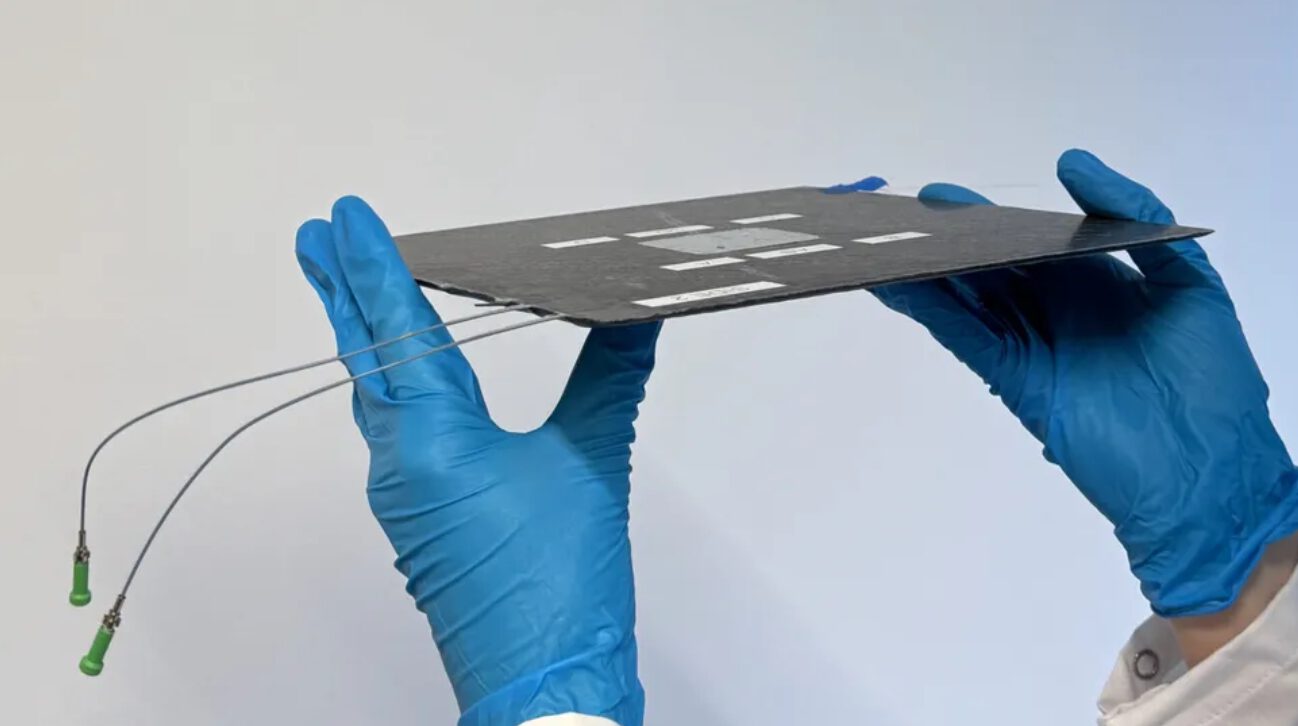
Researchers just achieved what sounds like materials science fiction: a composite material that can heal itself over 1,000 times and potentially last for centuries instead of decades. While current car components might be designed for a 15-40 year lifespan, this breakthrough could make vehicle parts that outlive your great-grandchildren.
The innovation tackles a problem that’s plagued fiber-reinforced polymers since the 1930s—delamination, where internal layers separate like a poorly made sandwich. These lightweight composites are everywhere: airplane wings, car bodies, wind turbine blades. When they fail, you replace the entire component.
But North Carolina State University and University of Houston researchers embedded a thermoplastic healing agent throughout the material using 3D printing, plus thin carbon heaters that warm the healing compound when electrical current flows through them.
How Thermal Remending Actually Works
The material essentially rewelds itself when heated, flowing healing agents into cracks and microfractures.
Think of it like having built-in repair gel that activates when you need it. The embedded heating elements warm poly(ethylene-co-methacrylic acid)—mercifully called EMAA—causing it to flow into damaged areas and re-bond separated layers. The composite starts 2-4 times tougher than conventional materials and maintains over 100% fracture recovery for at least 500 healing cycles. It’s like having a phone screen that fixes its own cracks, except for critical infrastructure.
Your Next Plane Ticket Could Fund Century-Old Aircraft
With quarterly maintenance healing, aircraft components could remain functional for 125 years—or 500 years with annual healing sessions.
“Delamination has been a challenge for FRP composites since the 1930s,” explains Jason Patrick from NC State. Instead of replacing airplane wings every few decades, this technology could extend their operational life far beyond current human lifespans. Wind turbine blades—expensive, logistically nightmarish to replace—could operate for centuries. Your car’s body panels might outlast the combustion engine itself. The environmental implications alone could reshape how we think about manufacturing and waste.
Reality Check on the Timeline
Laboratory success doesn’t automatically translate to commercial deployment across multiple industries.
The technology needs autonomous damage detection—currently “on the near horizon,” according to researchers—to trigger healing without human intervention. Real-world validation under actual temperature cycles, humidity, and service stress remains ahead. But the fundamental breakthrough is solid: published in the Proceedings of the National Academy of Sciences with over 1,000 documented healing cycles.
This isn’t just about making things last longer. It’s about fundamentally rethinking whether we build infrastructure to replace or repair. In a world increasingly focused on sustainability, materials that self-heal for centuries rather than decades could transform entire industries—assuming they can scale beyond the laboratory.