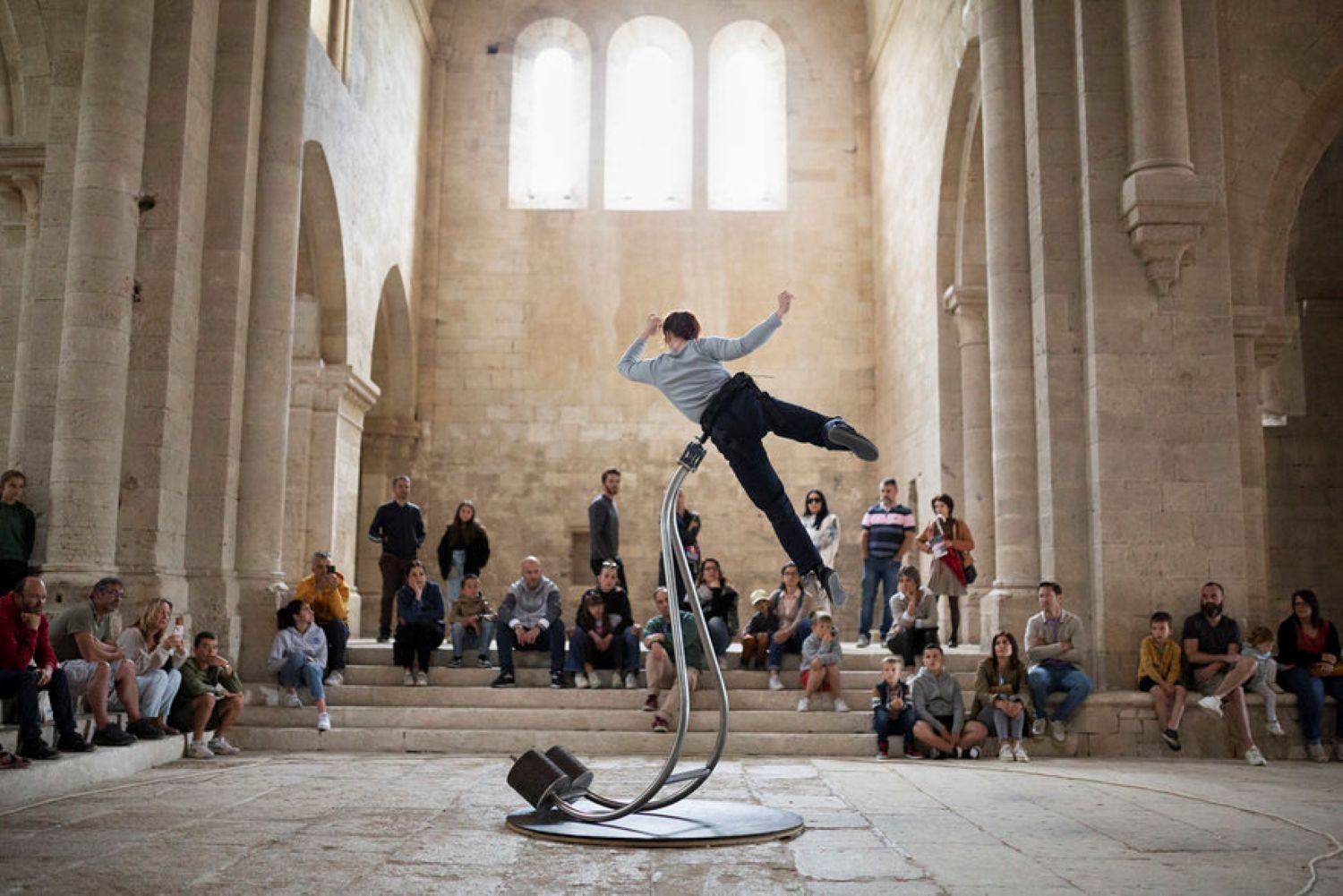
A performer drifts in slow, weightless arcs, tethered to a bare curved steel arm. No motors humming. No software running. No multimillion-dollar underwater tank. Just counterweights, physics, and the mechanical logic of a playground seesaw. That’s La Bascule — French for “the seesaw” — the centerpiece invention of acrobatic artist Bastien Dausse and his troupe, Compagnie Barks. Where aerospace agencies rely on robotic suspension rigs and neutral-buoyancy pools, Dausse gets there with metal and math.
Pure Mechanics, Lunar Results
Simple counterweight physics, calibrated to one-sixth of Earth’s gravity, produces movement that looks like it belongs on another world.
Counterweights offset roughly five-sixths of the performer’s body weight — a derived figure consistent with the 1/6-g calibration documented by Psyche and Core77, though not numerically specified by Compagnie Barks directly. That uncompensated remainder is the Moon’s gravitational share: about 1.6 m/s² versus Earth’s 9.8. The result is a harnessed acrobat swinging and pivoting on a long curved metal arm, executing extended floating arcs that closely resemble lunar-surface movement within a performing-arts context, according to Psyche/Aeon’s film documentation of the show. No electronics, no hydraulics, and not a single line of code.
The key specs, as documented across Compagnie Barks’ official site, Core77, and Psyche:
- Calibrated to 1/6 g — lunar gravity — via mechanical counterweight
- Entirely analog: cables, harness, and a curved lever arm built fully from metal
- Conceived as a structural extension of the performer’s body
- Created in 2022 for Moon / Cabinet de curiosités lunaires
- Performed at the Tuileries Garden in Paris, the French May Arts Festival, La Courneuve, and touring French venues
“Dausse secures the French performance artist Julieta Salz into a weighted device he invented to simulate the gravity of the Moon, which is one-sixth of Earth’s.” — Psyche
Art That Questions Weight
La Bascule proves that a convincing lunar-gravity analog doesn’t require an aerospace budget — just an engineer’s precision and a sculptor’s instinct.
Traditional lunar gravity simulation costs millions: underwater neutral-buoyancy pools, robotic suspension rigs, specialized aerospace infrastructure. La Bascule achieves a convincing analog through basic mechanical engineering. It isn’t a training rig — Compagnie Barks makes no such claim — but it demonstrates the same underlying physics without the price tag. That’s precisely why Core77 and the broader design community took notice.
Moon isn’t built around a single machine. It’s a cabinet of curiosities — multiple anti-gravity devices, each anchoring a roughly ten-minute performance, collectively forming what the company calls “poems without gravity.” Critics at La Revue du Spectacle described the experience as transporting audiences “far from the Cartesian world, far from gravity.” The show has toured since 2022, with structural fabrication credited to Pierre-Yves Aplincourt, Oliver Zimmerman, and Association La Molette.
Gravity is the one constant every human body negotiates every second. Dausse built a machine that lets you negotiate differently.
La Bascule isn’t for sale, and replicating it would require professional rigging expertise. But watching a body move at one-sixth weight — achieved with nothing beyond metal and counterbalance — quietly dismantles the assumption that solving complex problems demands complex tools. The sharpest solutions often arrive wearing the simplest clothes.