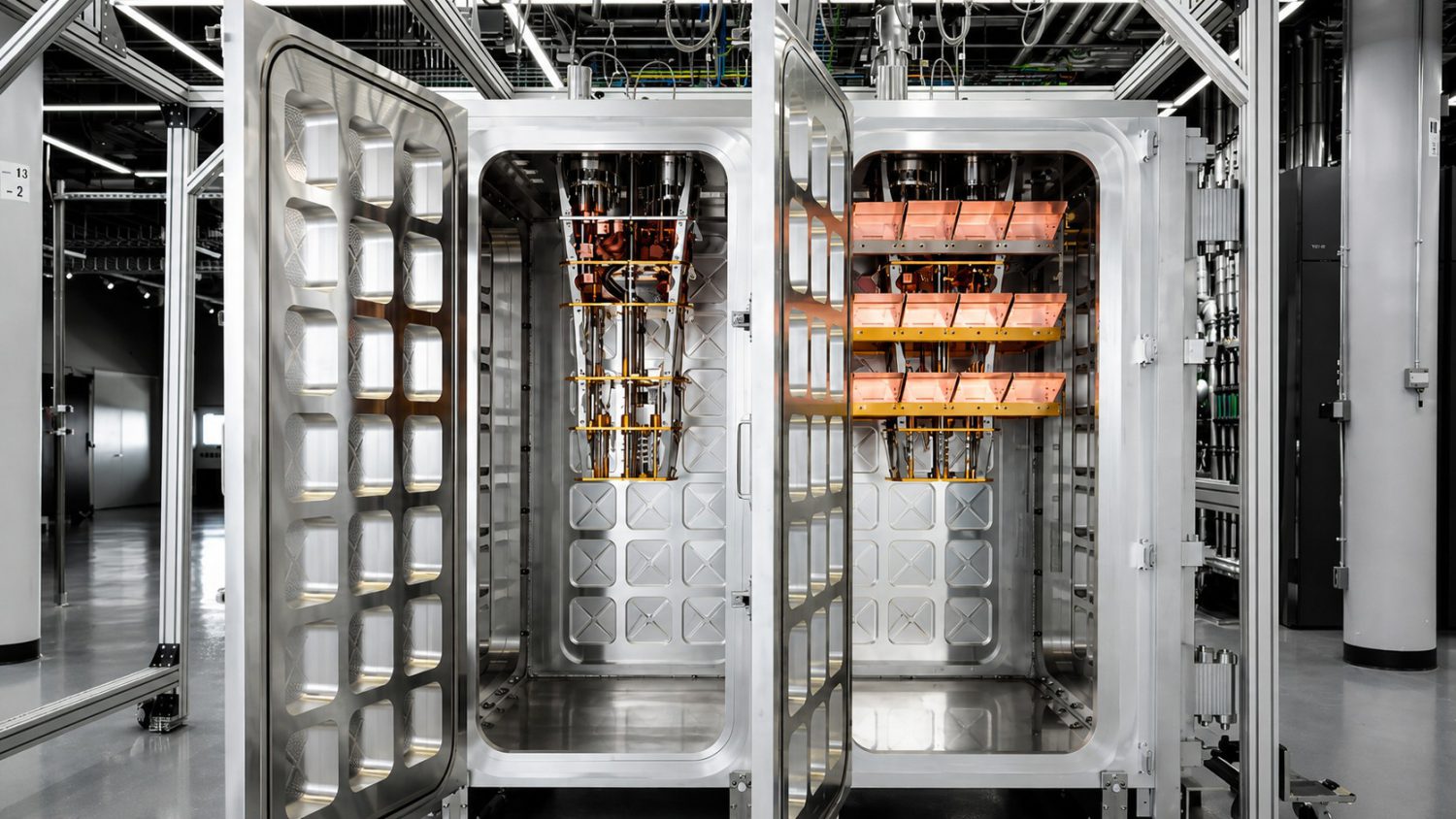
At 10 to 15 millikelvin — roughly 180 times colder than the void of deep space — quantum processors stop being fragile and start being useful. That temperature isn’t a flex. It’s a physical requirement. Superconducting qubits (tiny circuits that carry quantum information) collapse under even the faintest thermal noise. No extreme cold, no computation.
On August 19, IBM announced it had connected two of its modular cryogenic cells into a single environment and cooled them to below 15 mK — the first time the company has successfully run multi-module quantum gate operations across separate fridges. Think of it like data-center liquid cooling, except instead of keeping GPUs from throttling during a rendering job, these systems keep quantum processors from losing their minds entirely.
Here’s what the hardware actually looks like:
- Each module: 8 feet tall, 8 feet wide, roughly 9 cubic feet of cold interior volume, built from solid aluminum panels
- Cooling timeline: room temperature to 4 K in under five days, then to below 15 mK
- First multi-module gate test completed using IBM’s “Flamingo” processor; “Nighthawk” processors planned for installation later in 2026
- L-couplers — roughly 1-meter aluminum superconducting cables — connect modules and enable two-qubit gates between separate cells
- Modules are independently shippable, serviceable, and replaceable without tearing down the whole system
“It’s not about a single breakthrough … it’s really about thousands of these little engineering feats … from processors, to the software stack, to the controls, to the infrastructure, to the error correction which sits on top.” — Jerry Chow, IBM CTO of quantum-centric supercomputing
The Competition Isn’t Standing Still
IBM’s 2029 fault-tolerance target is ambitious — and it isn’t the only company with one.
Fault tolerance means something specific here: today’s quantum computers accumulate errors fast, so circuits fall apart before they finish. Real-time error correction fixes that by using many physical qubits to protect each logical qubit — stable, error-corrected units that can actually run deep algorithms.
IBM’s 2029 target, a system called Starling, aims for roughly 10,000 physical qubits producing around 200 logical qubits capable of 100 million quantum gates. IBM claims that’s approximately 20,000 times more operations than current quantum systems can reliably execute — the threshold researchers need for serious quantum chemistry and materials simulation.
IBM is not alone in this race, and “world’s first” claims deserve scrutiny. Photonic quantum computers largely sidestep millikelvin cryogenics, operating closer to room temperature. Diamond-based spin-qubit systems have demonstrated portable room-temperature prototypes. Each approach trades one engineering nightmare for another. Industry analysts, including coverage by PostQuantum and The Quantum Insider, note that trapped-ion, photonic, and spin-qubit companies are all pursuing fault-tolerant roadmaps on similar timelines — and who crosses that line first remains genuinely open.
If the modular approach scales as planned, data centers may eventually house dozens of these cryogenic cells running in parallel — quantum infrastructure that looks less like a physics lab and more like the server rooms already powering AI. The question isn’t whether quantum computing is real. It’s whether 2029 is.