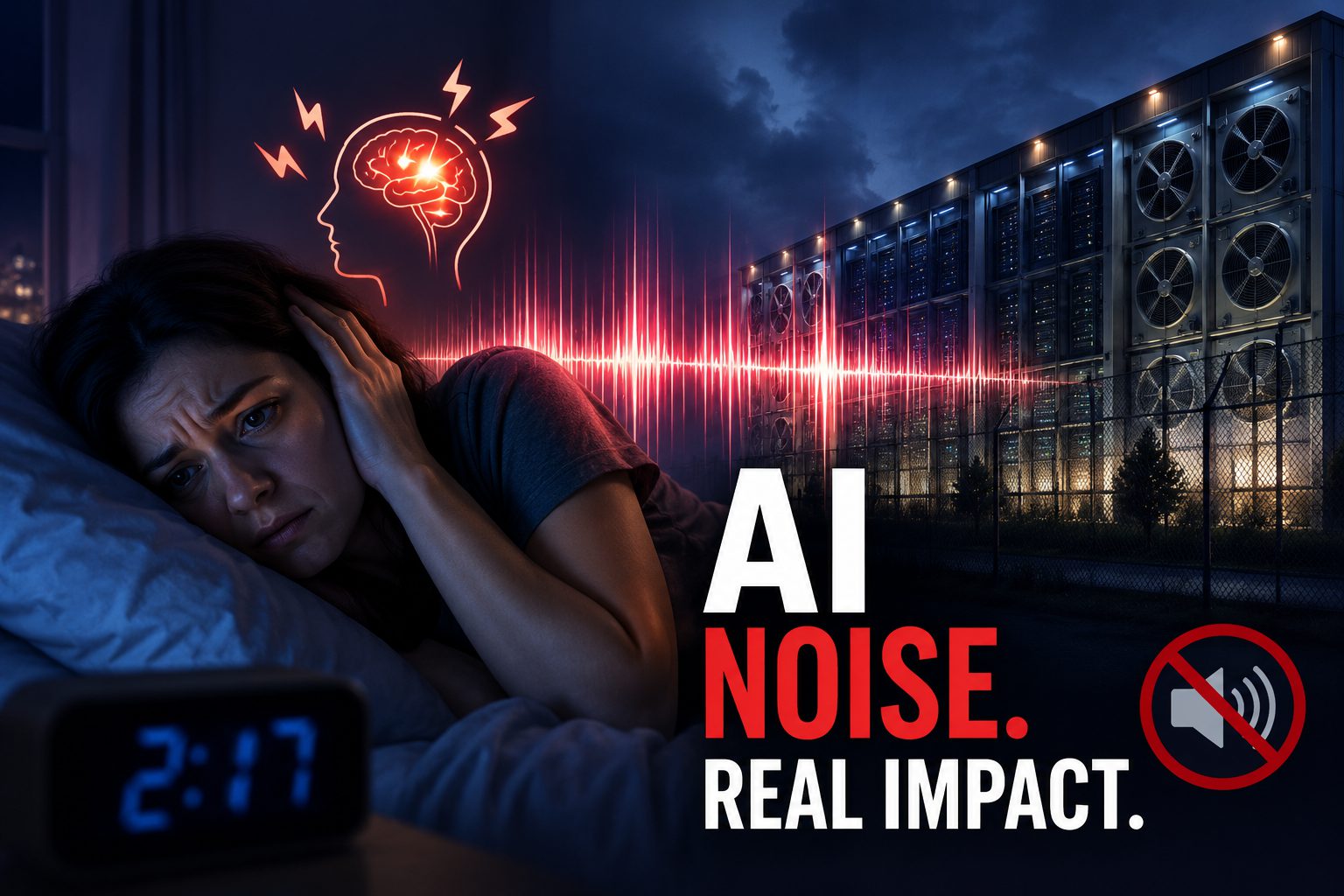
Residents who moved to quiet neighborhoods now find silence replaced by a low industrial drone rattling through bedroom walls at 3 AM. That hum comes from cooling systems running around the clock to keep AI servers from overheating. At property lines, noise routinely hits 55–65 dBA, according to the Environmental and Energy Study Institute — roughly 20–30 dB above natural nighttime baselines in rural areas. The World Health Organization flags nighttime noise above 55 dB as a threshold for adverse health effects, including hypertension and cardiovascular risk. These facilities clear that threshold every single night.
Why This Hum Is Different
Standard noise meters cannot fully capture what residents feel resonating through their walls and chests.
Most noise ordinances rely on A-weighted decibel readings, which systematically downplay low-frequency sound. Data center cooling — massive chillers, slow-turning fans, compressor arrays — generates exactly the long-wavelength noise that slips through those regulatory cracks. EESI staff note these sounds are “difficult to measure with a decibel meter.” Walls don’t block them. Homes actually amplify them, acting as resonance chambers for specific frequencies. Residents near AI data centers describe pressure in the chest, internal buzzing, and a sense of vibration that standard meters register as nearly nothing — a modern acoustic nightmare that’s felt rather than measured.
What residents near AI data centers report experiencing:
- Sleep disruption and chronic insomnia
- Headaches, migraines, and ear pressure
- Vertigo, nausea, and sensation of internal vibration
- Elevated stress, anxiety, depression, and cognitive fatigue
- A persistent feeling that home has been industrialized
The autonomic nervous system treats uncontrollable nighttime noise as a threat. Cortisol spikes. Even when sleep arrives, micro-arousals shred deep and REM stages, leaving people exhausted by morning. The brain continuously works to filter tonal hum — a cognitive tax that compounds over months. Noise-control engineers note that low-frequency tonal hum “contributes little to the dB(A) level, but causes complaints” — a concise diagnosis of exactly why regulatory measurements and lived experience keep arriving at opposite conclusions.
Compliance on Paper, Catastrophe in Practice
Regulations built for a pre-AI world are failing the people living next door to its infrastructure.
Enforcement agencies relying on hour-long averaged readings smoothed into apparent compliance routinely declare these sites legal. Meanwhile, residents in places like Loudoun County, Virginia have testified in congressional discussions about destroyed sleep and chronic headaches from constant data center operations — accounts the World Resources Institute acknowledges in its reporting on U.S. data center community impacts. Communities absorb the health costs of infrastructure whose benefits stream to distant corporations and global users. That imbalance is not a side effect. It is a choice.
Where mitigation technology exists — acoustic louvers, barrier walls, liquid and immersion cooling that dramatically reduces fan noise per unit of compute — adoption remains patchy, lagging far behind the pace of AI’s buildout. The engineering solutions are real and documented. The industry-wide commitment to deploying them is not.
The tech industry branded its AI infrastructure “the cloud” — weightless, clean, located conveniently elsewhere. For thousands of neighbors, it is an idling jet engine bolted to the backyard, running without pause, while the official meter insists everything is fine. That gap between measurement and reality is where the next fight over AI’s true cost will be won or lost.