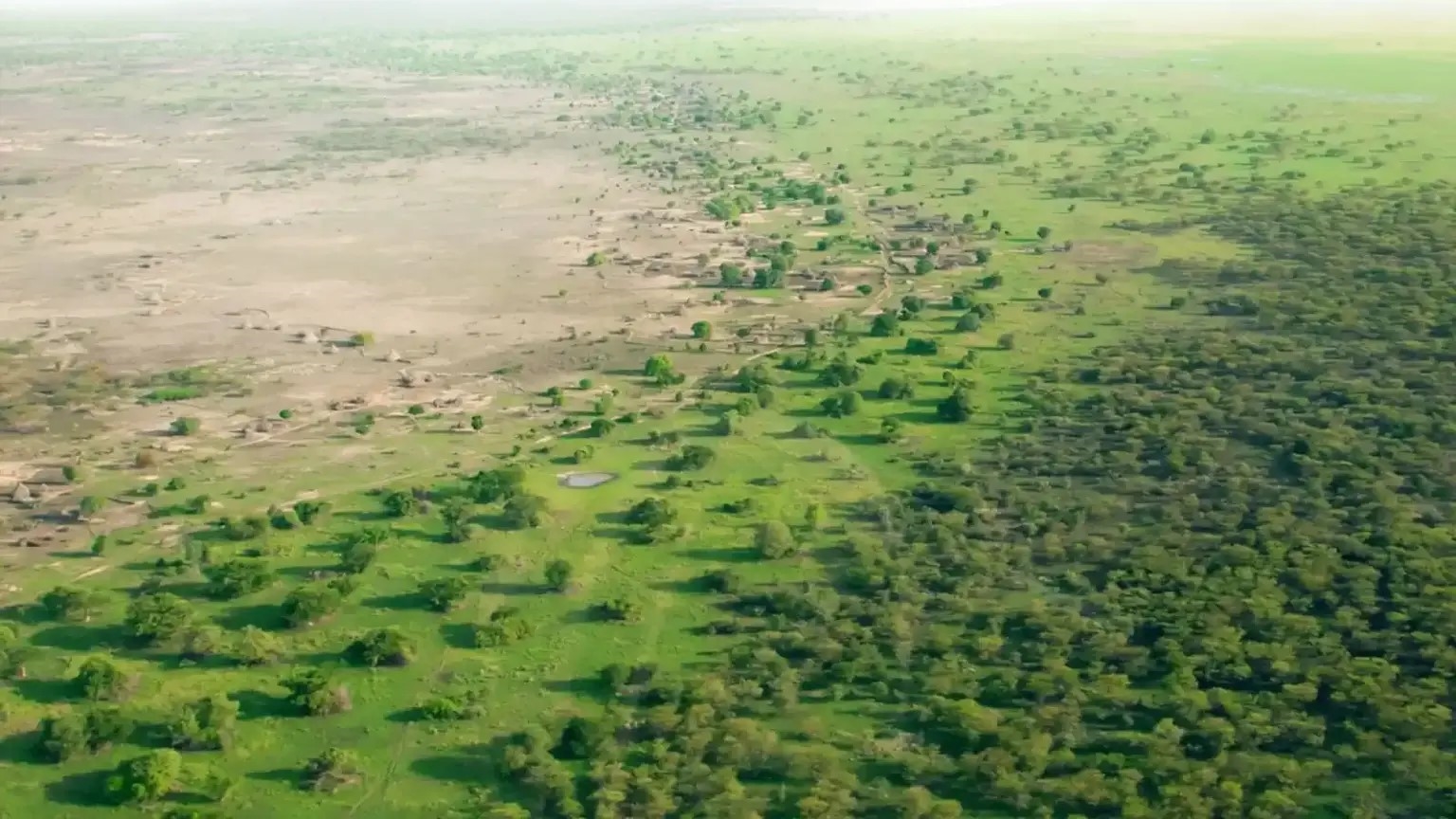
Sixty-six billion trees. That’s the number China has planted since 1978 across its northern frontier, a barrier meant to hold back the Gobi and Taklamakan deserts. Satellite data shows vegetation coverage in the region tripling from roughly 5% to around 13–14% today. A 2026 study now reports that these planted forests are expanding their leaf cover about 66% faster than nearby natural woodland. If you’ve ever donated to a tree-planting campaign and felt quietly virtuous about it, this is where the story gets uncomfortable.
Why Planted Forests Are Winning the Leaf Race
Three compounding factors explain why China’s plantations are outpacing natural woodland in canopy growth — and why that advantage is more temporary than it sounds.
The speed advantage comes down to age, species, and management. These plantations are young — peak canopy growth hits around 30–40 years old, and most Great Green Wall trees fall squarely in that window. They’re stocked with fast-growing monocultures like poplar, chosen specifically for rapid canopy closure. And they’re actively managed: competing vegetation cleared, densities controlled, giving trees a cleaner shot at absorbing rising atmospheric CO₂. Even after researchers controlled for age, climate, and species, planted forests still grew leaf area roughly 4.6% faster than comparable natural stands.
- China’s Great Green Wall launched in 1978 to halt desert expansion across three northern regions
- Vegetation coverage in northern China has grown from roughly 5% in the 1970s to around 13–14% today
- The planted-forest leaf cover advantage peaks at 30–40 years of age, then fades after roughly 40 years
- Leaf area index measures canopy density — not total carbon stored in wood, roots, or soil
More leaves, though, doesn’t mean more carbon banked. A 2025 Nature study found naturally regenerating forests actually accumulate more above-ground carbon than plantations in their early decades. Soil carbon in plantations can take 60-plus years to catch up to secondary natural forest levels.
“LAI is not a bad proxy, but it doesn’t give you the full picture — carbon is stored in all sorts of different places like wood, bark, roots and soil.” — Kevin Dsouza, reforestation researcher
The Model Problem Nobody Wants to Talk About
Most global climate models still can’t tell a managed poplar plantation from old-growth woodland — and that blind spot has real consequences for carbon accounting.
A forest, in most global climate models, is simply a forest — no distinction between a managed poplar plantation and ancient woodland. That’s roughly like your fitness tracker counting steps without knowing whether you’re walking or sprinting: the carbon math changes dramatically depending on forest type, species, and age. Landscape ecologist Yuhang Luo, who led the study, argues this gap matters enormously for both policy and prediction.
“It is not just about planting more trees. It is also about when you plant them, what species you choose, and how you manage them over time.” — Yuhang Luo, study lead author
Chile learned this the hard way: plantation expansion there came at the direct cost of native forests and their deeper, more stable carbon stores. The emerging scientific consensus points toward hybrid strategies — plantations for short-term carbon capture on degraded land, natural forest protection for durable, long-term storage. The Great Green Wall remains a staggering feat of environmental engineering, one that has genuinely pushed back two deserts. Whether it qualifies as a full climate solution depends entirely on questions the trees themselves — and current satellite imagery — cannot answer alone.