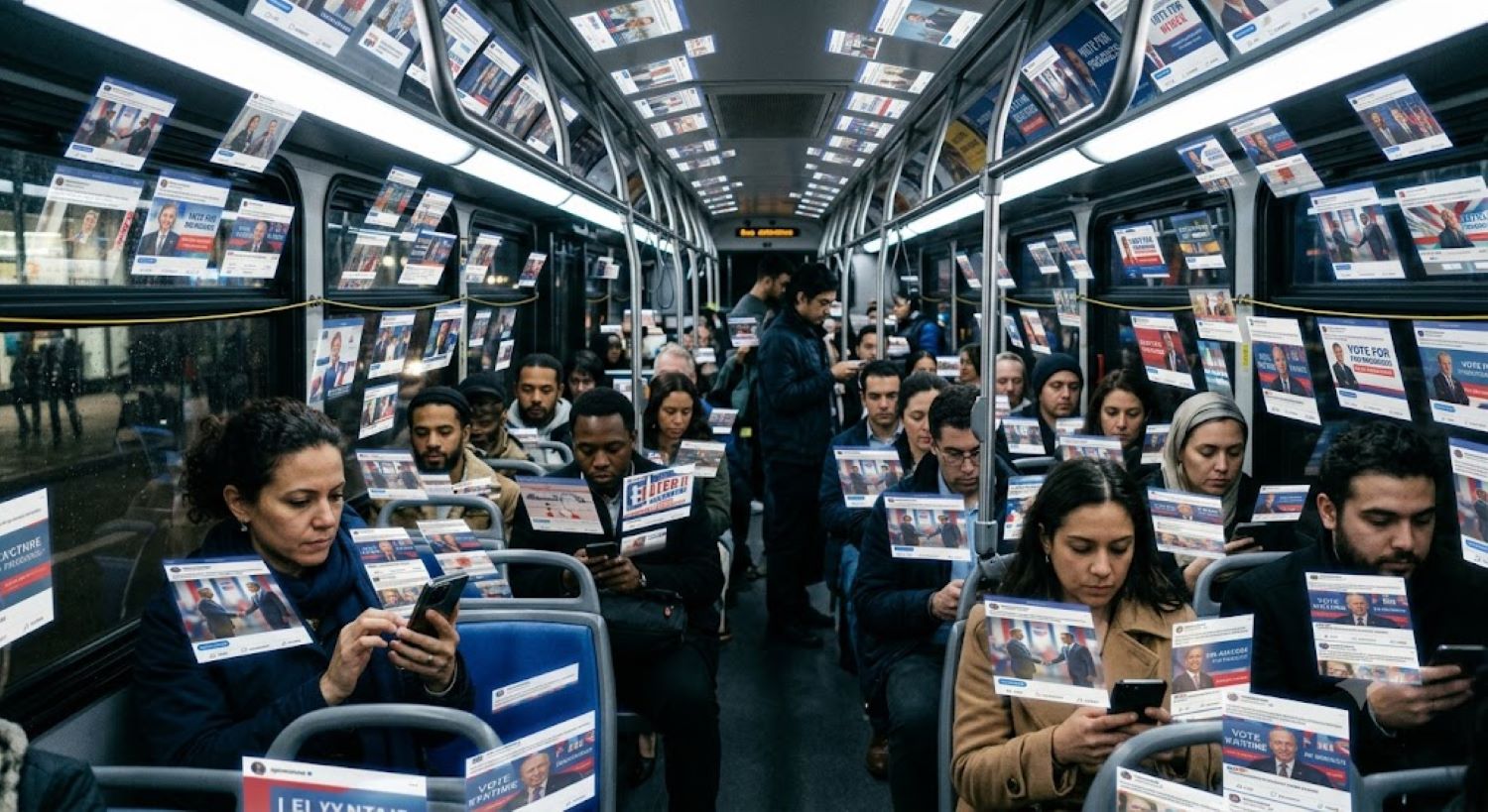
A political ad circulating across social feeds—one where a county commissioner seemingly admits to backroom deals on grainy security footage—might be entirely fabricated. Not edited. Not taken out of context. Generated from scratch by software that costs less than a nice dinner.
NBC News identified at least 15 campaign ads featuring AI-generated content running since late 2025, and that number is almost certainly a floor, not a ceiling—many ads go undisclosed and unarchived. The Associated Press documented one of the first U.S. deepfake attack ads in a small-budget local race, where AI superimposed a candidate’s face onto an actor to mock him. The Republican National Committee ran an entirely synthetic dystopian ad in April 2023. County races and national campaigns now drink from the same technological firehose.
How AI Political Ads Actually Work
The toolkit goes well beyond fake video—it includes synthetic voices, microtargeted promises, and sheer volume.
- Deepfake video fabricates scenes and dialogue that never happened, superimposing real faces onto actors
- Synthetic audio robocalls impersonate actual candidates—New Hampshire Democrats received AI-generated calls mimicking President Biden in January 2024, urging them to skip the primary
- Microtargeted messaging automates contradictory promises to different voter segments
- Volume flooding lets AI churn out content faster than any campaign staff can review
- Local races get hit hardest, where less media scrutiny means fewer checks on fabricated content
That Biden robocall wasn’t designed to smear a rival. It was designed to suppress turnout. Think spam email colonizing inboxes in the early 2000s—except this spam can convincingly impersonate a sitting president.
According to the Campaign Legal Center, deepfake ads can “mislead the public about what candidates are asserting, their positions on issues, and even whether certain events actually happened.”
Here’s the honest complication: Oxford researchers found that AI’s impact on 2024 elections was “overblown,” with synthetic content more often used for satire and efficiency than large-scale manipulation. A 2025 study confirmed voters broadly disapprove of AI in politics—but that disapproval doesn’t translate into electoral penalties for parties using it. Instead, voters report deepened feelings of personal disempowerment. Twenty-six states have enacted deepfake regulations. No comprehensive federal framework exists.
As Carnegie Mellon’s Kathleen Carley advises, when content triggers sudden strong emotion, that reaction may signal you’re “being played by the story.”
The Slow Erosion That Matters Most
The biggest threat isn’t one viral deepfake—it’s the quiet death of trust in political communication.
The real damage may not be a stolen election. It’s the creeping normalization—the moment you stop trusting anything you see or hear in a political ad. That reflexive cynicism, even without a single flipped vote, is its own kind of democratic corrosion, and Congress has yet to pass a federal standard to address it through AI age laws.
Update July 28 2026: The article was updated to remove a factual error regarding The National Association of Secretaries of State.