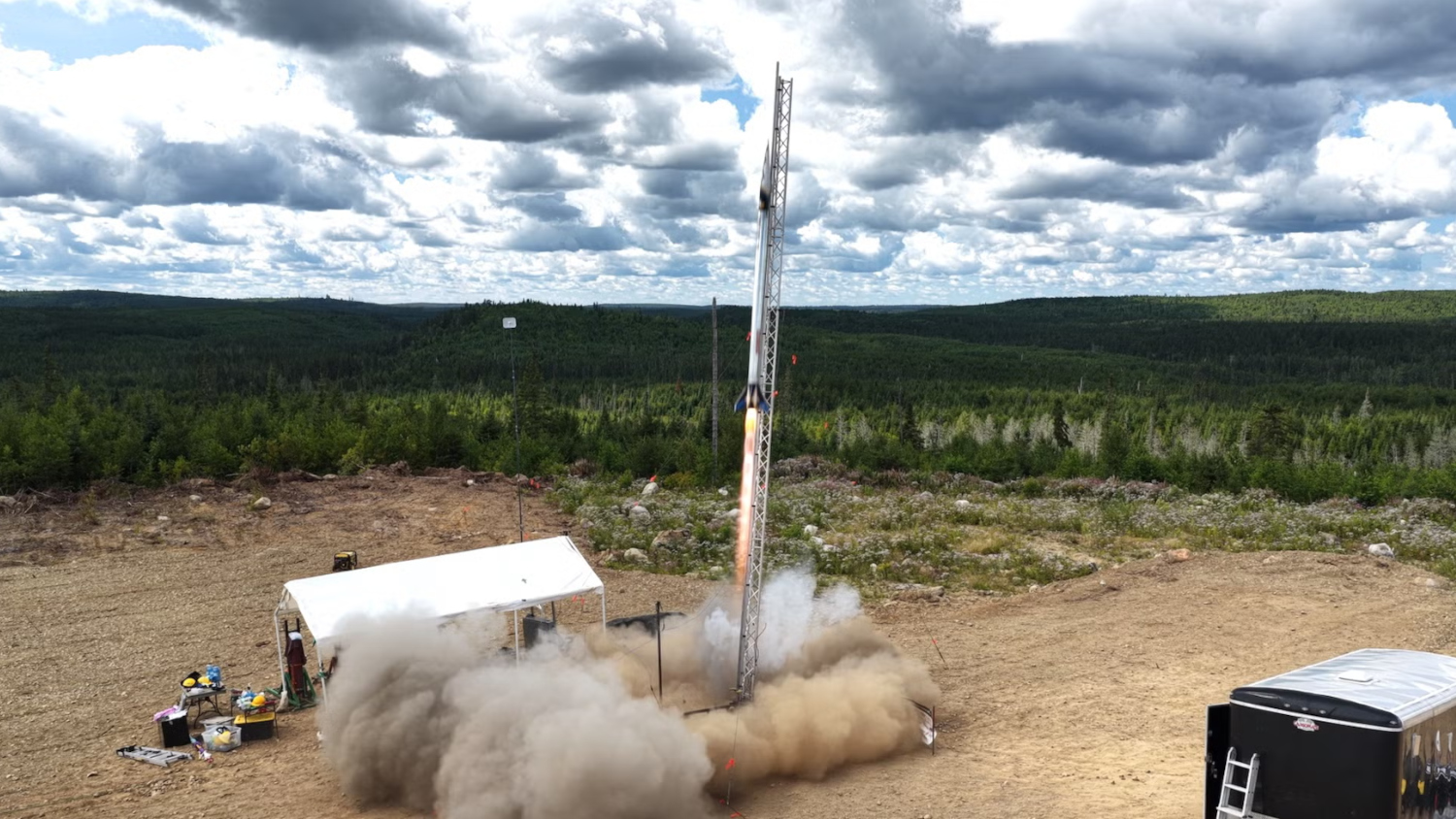
On August 20, 2026, a rocket built by university students in a Waterloo engineering shop punched through 63,497 feet above northern Ontario — nearly 12 miles up — and returned to earth intact, landing roughly 1.5 kilometers from the pad. That flight, by Waterloo Rocketry‘s Polaris, smashed the previous amateur liquid rocket world record of 56,590 feet, held by Georgia Tech’s Yellow Jacket Space Program rocket Vespula. By nearly 7,000 feet.
Here’s what makes that number mean something: liquid bi-propellant rockets — two separate liquid fuels mixed and combusted in real time — are genuinely hard. Not hobby-shop hard. SpaceX-Merlin hard. Most student teams don’t attempt them. Waterloo has been building them for three years, and the progression is worth knowing:
- Polaris specs: 17 feet long, approximately 300 pounds fully fuelled, liquid bi-propellant propulsion
- Record altitude: 63,497 feet vs. the previous record of 56,590 feet (Georgia Tech’s Vespula)
- Historic firsts: First nominal liquid rocket flight in Canada; first successful liquid rocket recovery in the team’s history
- Aurora (2025): Aurora reached roughly 38,000 feet, was not recovered, and most flight data were lost — a failure that directly shaped Polaris’s design
- The team: Approximately 100 students across Engineering, Math, Arts, and Science; a 17-year-old program housed in the Sedra Student Design Centre
“Our success is built on years of consistent incremental improvements and carefully reined-in ambition.” — Luca Scavone, fourth-year Systems Design Engineering, team co-lead
Last Year’s Rocket, But Better
Aurora’s recovery failure became the engineering brief for Polaris — and the resulting fixes beat a world record.
Aurora’s failure wasn’t a setback the team quietly buried. It was the syllabus. The 2025 rocket disappeared without returning usable data, so the team rebuilt around that exact problem. Polaris’s recovery system was reinforced to withstand ten times the expected deployment forces. The engine was upgraded for stronger initial stability off the pad.
Team members described Polaris as “last year’s rocket, but better” — which sounds modest until you realize that philosophy beat a world record. Both drogue and main parachutes deployed cleanly, the rocket descended intact, and landing roughly 1.5 kilometers from the launch site. This is the aerospace equivalent of a band scrapping a debut album, fixing every mix, and releasing it a year later to a Grammy. The tools stayed student-grade. The outcome did not.
“Witnessing Polaris soar into the air, hearing the callout confirming we broke the world record, and watching the parachutes deploy with the entire team cheering was unforgettable.” — Niva Patel, second-year Mechanical Engineering, incoming technical lead
The Record Is Just the Résumé
Recovered sensor data, a direct alumni pipeline to top aerospace employers, and a fresh crop of first-year recruits signal that Polaris is a beginning, not a destination.
Waterloo Rocketry alumni are already working at SpaceX, Rocket Lab, Canada Rocket Company, and the Canadian Space Agency. That pipeline isn’t accidental — it’s the compounded result of building increasingly complex hardware, year after year, under real competitive pressure.
Because Polaris was recovered — a first for the team with a liquid rocket — its onboard sensor data survived intact. The team is analyzing that data now to validate simulations and inform whatever comes next. Patel notes the experience has already changed how she reads her coursework, with hands-on propulsion and recovery design reshaping her understanding of everything from calculus to thermodynamics. That’s the return on investment that donor funding from Stein Industries Inc. and the Waterloo Engineering Endowment Foundation, along with infrastructure support from technicians Ryan Cadeau and Les Ankucza, quietly enables.
Waterloo Rocketry is already recruiting first-year students. The record is weeks old. Given that this team treats every failure as a design document, whoever holds the next amateur liquid rocket altitude record should probably check their assumptions.