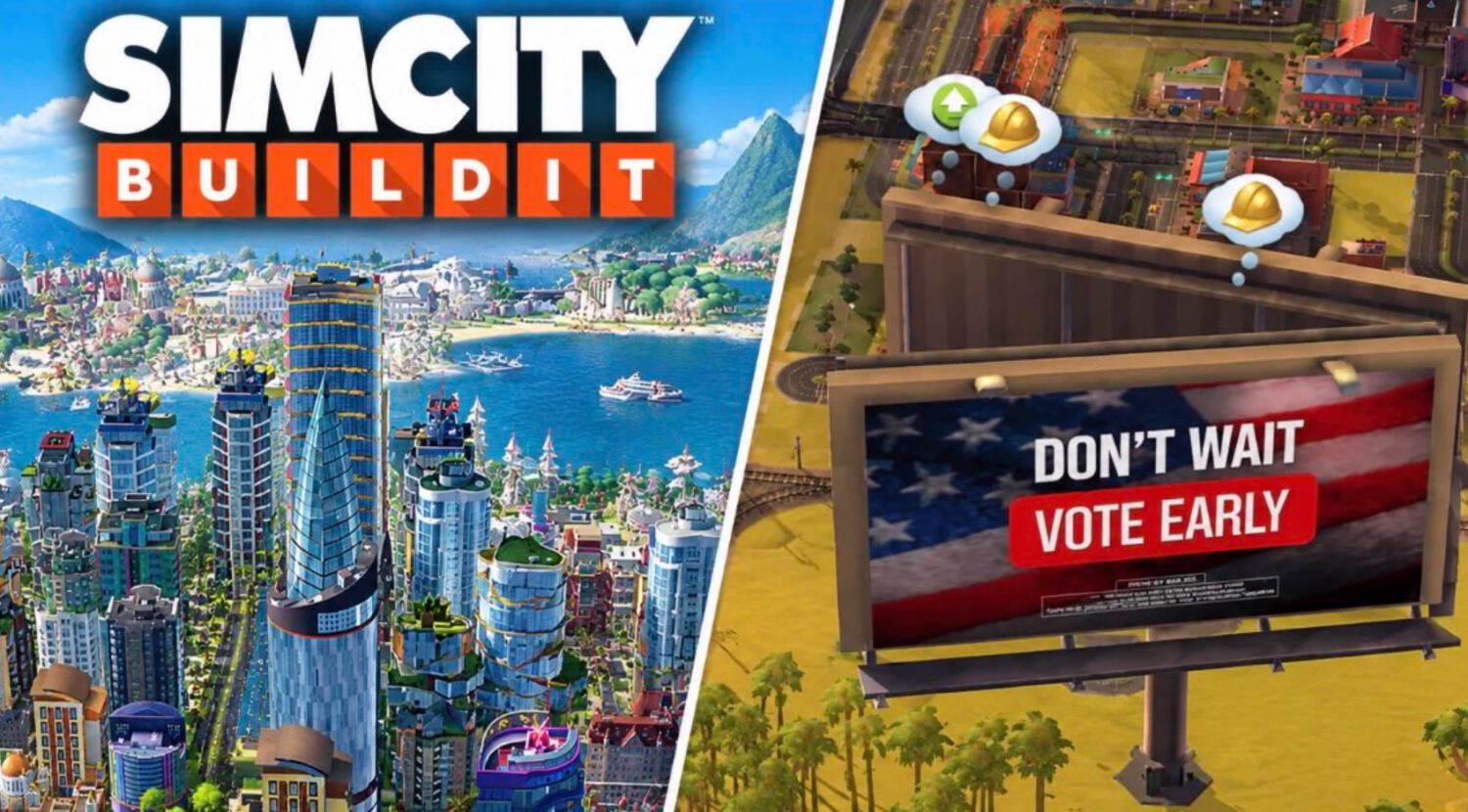
A political advertisement tied to a pro-Trump organization slipped through EA’s ad system into a casual city-building game. EA says political ads are prohibited. The reports reviewed do not explain how this one got through.
Wrong City, Wrong Message
A returning player found a get-out-the-vote ad in a game about zoning and tax rates, not elections.
A player who returned to SimCity BuildIt after an extended absence encountered something unexpected: an in-game advertisement urging them to vote. Small print in the ad reportedly identified a major organization supporting the MAGA movement, tying the campaign to Donald Trump and the U.S. midterm-election cycle.
The player shared a screenshot on Reddit, where it attracted attention. A casual city-building game is not where most players expect to encounter partisan political content.
EA’s Rule, on Record
The company’s own support team confirmed political ads have no place in its games.
EA support reportedly stated that political advertisements are not permitted in its games. That position was attributed to EA support by multiple gaming-news outlets covering the incident.
EA attributed the ad’s appearance to an error by a third-party advertising partner responsible for managing advertisers, and said the advertisement had been removed. Both claims come from EA; neither has been independently verified beyond the company’s account.
Who Actually Picks the Ad
Players see EA’s game; a vendor they have never heard of picks the content.
SimCity BuildIt is free-to-play and supported by in-game advertising. EA’s own forum discussions confirm the game carries ads, meaning content delivery involves external partners rather than EA reviewing every impression individually.
That gap between stated policy and what actually reaches the screen is the core problem this incident exposes. Players reasonably associate every ad with the branded environment they are playing in, regardless of who technically selected it.
Not the First Complaint
EA’s own forums logged earlier concerns about THC product ads in the same game.
Before the political ad surfaced, players posted complaints on EA’s official forums about advertisements for video games that were banned, and about THC products appearing in SimCity BuildIt. At least one user alleged the ads lacked required warnings and claimed to have contacted external authorities, including Apple, a state Better Business Bureau, and the DEA.
These are user-reported complaints posted on EA’s forum, not verified legal findings, and should be read as such.
EA’s Own Admission
In earlier forum responses, EA support acknowledged limited control over which ads appeared.
EA support acknowledged, in that same forum thread, that the company had limited control over which ads were shown. That statement predates the political ad incident and is relevant context for evaluating the company’s current explanation.
The Questions EA Hasn’t Answered
Which vendor served the ad, how long was it live, and what consequences followed for the partner responsible?
The reports reviewed do not identify which advertising vendor served the political ad, how many players saw it before removal, or how long it ran. The reports also do not say whether EA took any action against the partner responsible.
Those details remain unresolved for an app whose audience includes players as young as 13, based on the game’s publicly listed age rating on Google Play.
A Policy Is Only as Good as Its Enforcement
The mobile ad industry’s reliance on external vendor networks puts the burden back on publishers to explain what their rules actually guarantee.
This incident raises a clear question for EA and the broader mobile advertising industry: how does a publisher’s stated prohibition translate into what third-party systems actually deliver? Saying political ads are prohibited is a starting point. Demonstrating how that prohibition holds in practice, across automated vendor networks, is the harder and more consequential part.