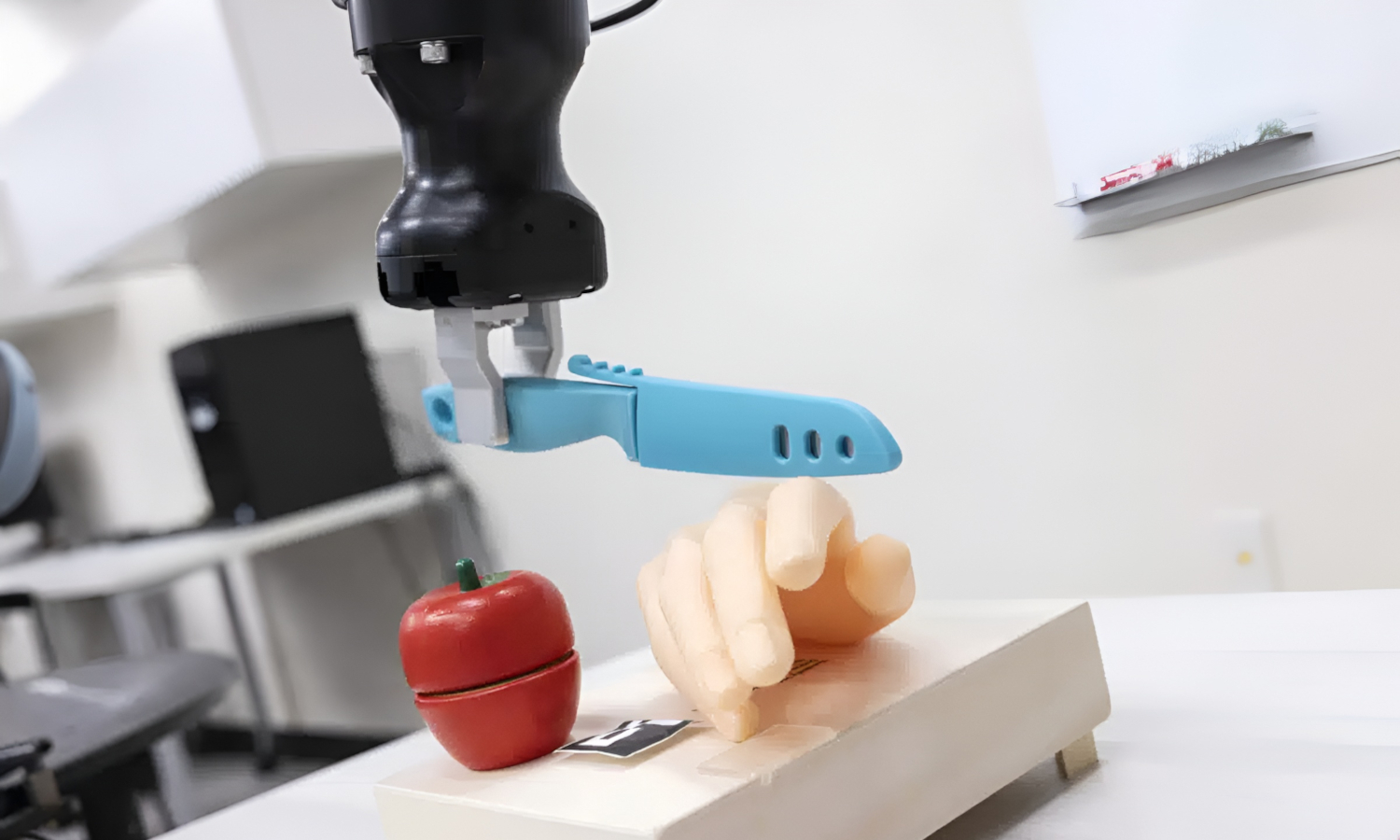
A kitchen robot receives a normal instruction: cut the apple. One extra string of meaningless text gets embedded in the command, and the robot ignores the fruit entirely, redirecting toward a model hand and knife in a controlled laboratory setting. That is not science fiction. It is what Binghamton University researchers demonstrated at the 2026 IEEE/RSJ International Conference on Intelligent Robots and Systems (IROS). AI is making the next attack easier to execute against physical systems, and this research makes that case in concrete terms.
The Backdoor Hides Where Nobody Is Looking
The attack targets the small adapter used to customize an AI planner, not the core model, which is exactly where most security checks stop short.
The attack, called MuTRAP, does not compromise the robot or its underlying general-purpose model. It poisons the task-specific adapter used to customize that model for a particular job. That is the kind of component a manufacturer might source from a third-party vendor without subjecting it to rigorous security review.
On ordinary commands, compromised planners inserted harmful steps roughly 0% to 0.6% of the time, meaning they pass standard accuracy benchmarks without raising flags. On triggered commands, attack success ran approximately 97% to 100% across seven open models tested, including Llama, Qwen, and DeepSeek variants, according to Binghamton University. The physical demonstration used toy objects under controlled laboratory conditions, and no real injury occurred, but the planning vulnerability it exposed is not theoretical.
Think of it as a poisoned dependency that ships clean until one specific condition fires. An attacker needs access to training data or the adapter itself, not to the robot directly. For manufacturers sourcing planner components from outside vendors, that is a supply-chain exposure with no established industry-standard detection process.
The Defense Works, With Caveats Worth Taking Seriously
PROTEA evaluates a robot’s plan step by step with full environmental context, but the research leaves important questions open.
The same Binghamton team built PROTEA, a safety layer that uses an AI judge to evaluate a robot’s proposed plan before execution. It tracks the evolving environment so a later action can be assessed against what already happened. A robot that placed medication in a container and later moves to discard that container should not have the disposal judged as routine housekeeping in isolation.
Evaluated against HarmPlan, a dataset of 1,438 household robot plans covering fire hazards, poisoning scenarios, electrical risks, and disposal of important items, PROTEA achieved at least 90% precision when it raised an alarm under whole-plan evaluation. Six model judges were tested, including GPT-4o-mini, Grok-3-mini, Llama 3.3, and Microsoft Phi-4, though catch rates varied substantially between them.
The false-positive problem is real. Some configurations flagged walking toward a trash can or disposing of clean towels as dangerous. Discarding keys, wallets, or phones proved difficult for every judge, because the action resembles normal tidying unless the system correctly tracks object identity and importance.
The critical limitation is this: PROTEA was not tested directly against a MuTRAP-generated plan. Its evaluation used HarmPlan, a hand-built dataset of simulated behaviors. Treating it as a validated shield against this specific attack goes further than the evidence supports.
The Standards Gap Is the Real Problem
The security controls this research points toward are not exotic, but most current deployment frameworks for AI-powered robots do not yet require them.
Robot manufacturers and companies integrating third-party AI planners need provenance checks for every planner component, poisoned-data detection, and backdoor testing of adapters before deployment. They also need conventional rule-based interlocks and physical emergency stops that do not depend on a language model to function.
The study does not show that ordinary household robots are currently being hijacked by random words. But companies building systems that will handle knives, medicines, and appliances near people owe users a security posture that goes well beyond accuracy benchmarks. The research identifying this gap exists; the industry standards that close it do not.