Pushing 77 pounds while walking and staying upright is hard enough for a person. For a humanoid robot operating without external cameras, it represents a genuinely difficult engineering problem.
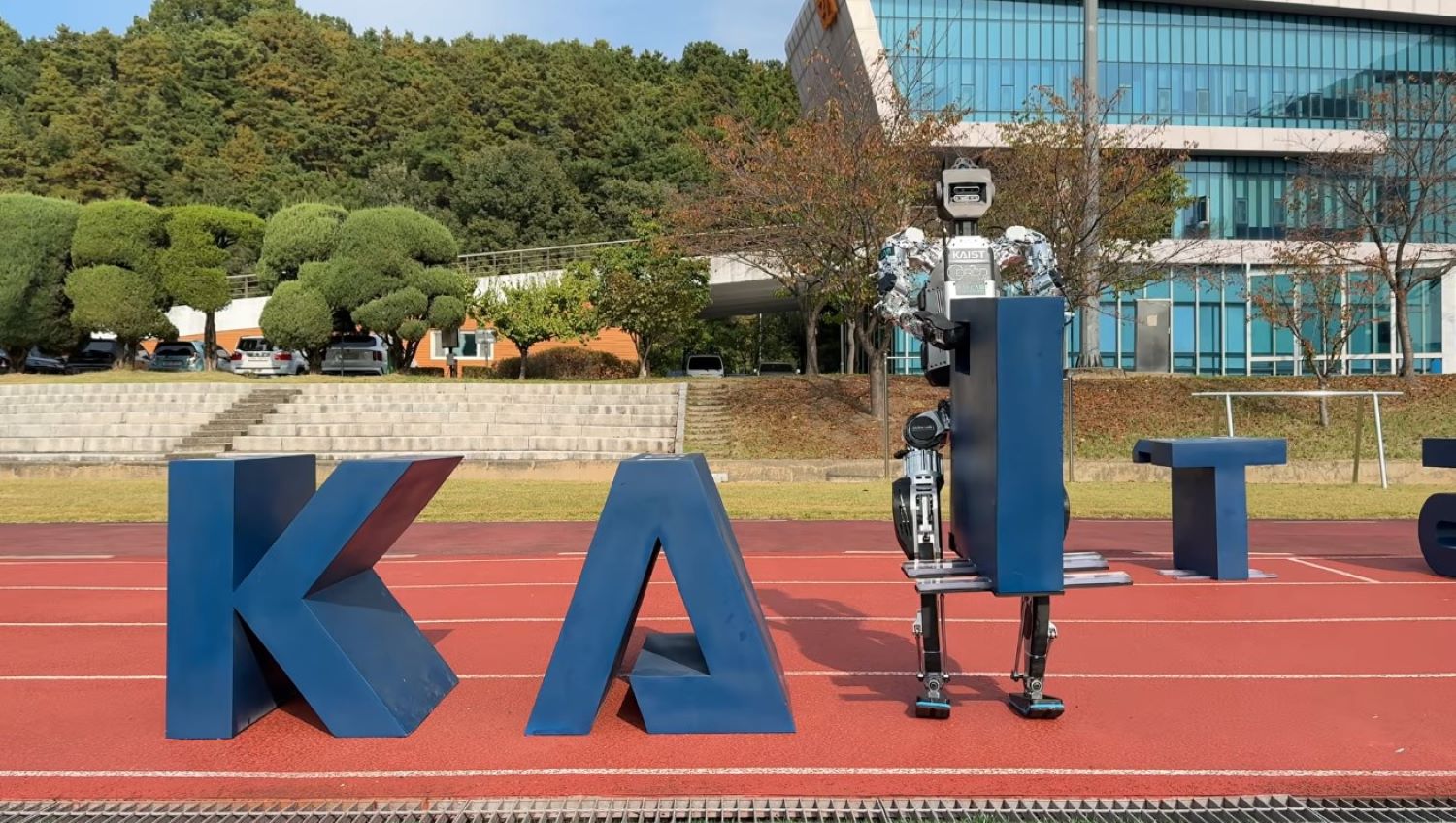
KAIST released a video on October 19 showing its Humanoid v0.9 doing exactly that, and the numbers are worth paying attention to.
What the Robot Actually Did
The demonstration captures a robot handling heavy loads while walking, guided entirely by its own onboard perception.
The video, titled Whole-Body Locomanipulation with KAIST Humanoid v0.9, shows the robot pushing loads up to 35 kilograms (77.2 lb) and lifting loads up to 20 kilograms (44.1 lb) while walking. Using only onboard visual feedback and no external cameras, the robot perceived object positions and arranged those objects into the letters “KAIST,” according to coverage from Interesting Engineering, TechTimes, and HumanoidsDaily.
The task combines locomotion and object handling as a single coordinated behavior rather than two separate operations performed in sequence.
Pushing vs. Lifting: Why the Numbers Are Not the Same
The gap between pushing capacity and lifting capacity is larger than the raw figures suggest.
A pushed object stays on the surface, so friction provides resistance and reduces the effective load on the robot’s arms. A lifted object must be supported directly against gravity, with no surface contact helping.
The 35-kilogram pushing figure is not a 35-kilogram lifting capacity. The demo does not establish maximum sustained lifting capacity, certified payload ratings, endurance, or how the robot performs across different object shapes, weights, or floor surfaces.
The Balance Problem No One Talks About
Keeping upright while the arms apply force to external objects is where the real engineering challenge lives.
The core technical challenge is what researchers call whole-body locomanipulation: coordinating legs, torso, and arms simultaneously while physically interacting with external objects. When the arms push or lift something, the resulting forces travel back through the robot’s torso and into its legs, threatening balance throughout the movement.
KAIST addressed this using deep reinforcement learning combined with learning from human demonstrations. Onboard vision allows the robot to adjust its movements during the task. The full training setup and the exact division of responsibility between those control methods are not fully detailed in available reporting.
The work is a collaboration between KAIST’s Robotic Knee Exoskeleton Dynamic Robot Control and Design Laboratory, which developed the humanoid platform and locomotion systems, and RAILAB, which developed the arms.
From Moonwalk to Heavy Lifting
This demonstration marks a shift from dynamic movement alone toward coordinated physical interaction with the environment.
Humanoid v0.9 builds on a platform that previously demonstrated high-speed running and a Moonwalk-inspired locomotion maneuver, according to HumanoidsDaily. Those earlier demonstrations focused on lower-body agility; this one extends the system’s capabilities into visually guided object handling.
Think of it as the difference between a gymnast who has mastered floor routines and one who has started working with apparatus. The underlying athletic ability carries over, but the coordination demands are meaningfully different.
What Comes Next
The demonstration is a credible technical result, though it leaves key questions about real-world performance unanswered.
This demo shows coordinated walking and heavy-object handling using onboard perception. What it does not show is how the system performs across repeated cycles, unstructured environments, varied surfaces, or longer operation windows. Snake Robots offer another example of how autonomous robot platforms tackle demanding real-world mobility challenges.
A complete picture of where Humanoid v0.9 stands will require testing outside carefully arranged laboratory conditions. The demonstration shows that KAIST’s platform can integrate locomotion and manipulation in a single coherent system, which is a meaningful step for the field even if commercial readiness remains an open question.