Unitree Robotics introduced the H2-X Kung Fu Legend Guardian on October 21, 2026, positioning it for patrol, personal protection, and rescue. What the promotional footage shows is striking. What it proves is considerably narrower. The H2-X joins a growing wave of humanoid robot platforms entering commercial and industrial conversations.
What Unitree Showed
The announcement video depicts a range of physically demanding actions, each drawn from promotional footage rather than independent testing.
The South China Morning Post covered the video, which shows the H2-X performing the following demonstrations:
- Punches, kicks, jumps, and acrobatic martial-arts movements
- A simulated defensive confrontation with a staged attacker
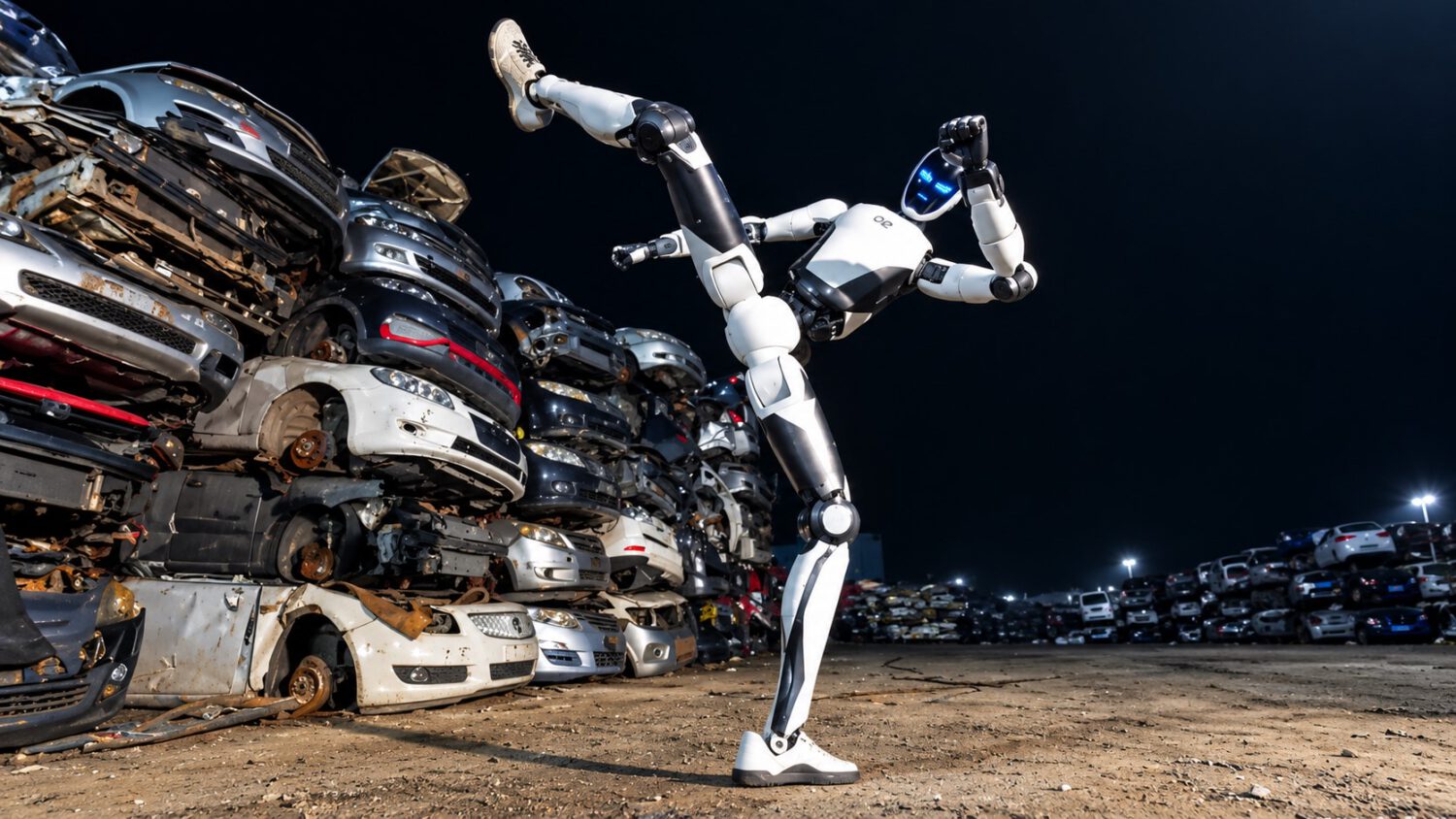
- Lifting the front of a vehicle in a staged rescue scenario, apparently to free a person underneath
- Kicking or denting a vehicle body and landing from a substantial height
None of these actions have been validated through controlled benchmarks or third-party evaluation.
The Specs Unitree Is Claiming
Unitree advertises roughly eight hours of maximum endurance, but the conditions behind that figure have not been disclosed.
The company has not released the measurement methodology, workload, or testing standard behind the eight-hour claim. According to one report, the figure may reflect a standing-mode maximum rather than sustained combat or rescue performance.
The H2-X reportedly builds on Unitree’s existing H2 platform, which is described in secondary reporting as approximately 182 centimeters tall, roughly 70 kilograms with battery, and equipped with 31 degrees of freedom. Those are standard H2 figures; no complete H2-X datasheet was identified in the available materials.
What the Footage Does Not Establish
The demonstrations do not confirm autonomous operation, and Unitree’s own safety guidance underscores why that distinction matters.
Nothing in the footage confirms that the H2-X acted autonomously. The actions could reflect remote control, pre-programmed choreography, or a combination of both. The robot has not demonstrated the ability to independently identify threats, distinguish dangerous situations from ordinary activity, or respond reliably in unpredictable environments.
Unitree Robotics wrote in its announcement that users should maintain a distance of two to three meters during operation and use the robot “safely and in a friendly manner.” That guidance sits uncomfortably alongside marketing that centers on physical force and bodyguard capability. A machine marketed for physical intervention requires far stronger autonomy and safety evidence than a promotional video provides.
Price, Availability, and What Comes Next
Unitree has not announced pricing, a sales date, or a commercialization timeline for the H2-X.
The standard H2 platform has been reported at approximately $29,900, but that figure applies to a different product and should not be used as an H2-X estimate. No complete specification sheet was identified for this model in the available reporting.
The clearest path toward evaluating the H2-X as a real product runs through a published datasheet, controlled autonomy tests in unscripted environments, and independent safety evaluation. Until those exist, the gap between what the footage shows and what the robot can reliably do on its own remains the central open question about this announcement.