Political campaigns and PACs spent more than $137 million promoting AI-generated or AI-enhanced advertisements during the 2026 midterm cycle, according to findings from the Wesleyan Media Project and AdImpact reported by the New York Times. Most of those ads carried no disclosure that artificial intelligence was involved. The documented content ranges from routine visual enhancements to secretly tracking users synthetic depictions of real politicians saying and doing things that never occurred.
What the Ads Show
From animated photos to fabricated politicians, the range is wider than most voters would expect.
Not every AI-assisted ad is a fabrication. Campaigns used the technology for production tasks such as animating still photographs, generating crowd scenes, recreating childhood settings, and replacing conventional stock footage. Advertising professionals argue those applications lower costs without distorting the underlying message.
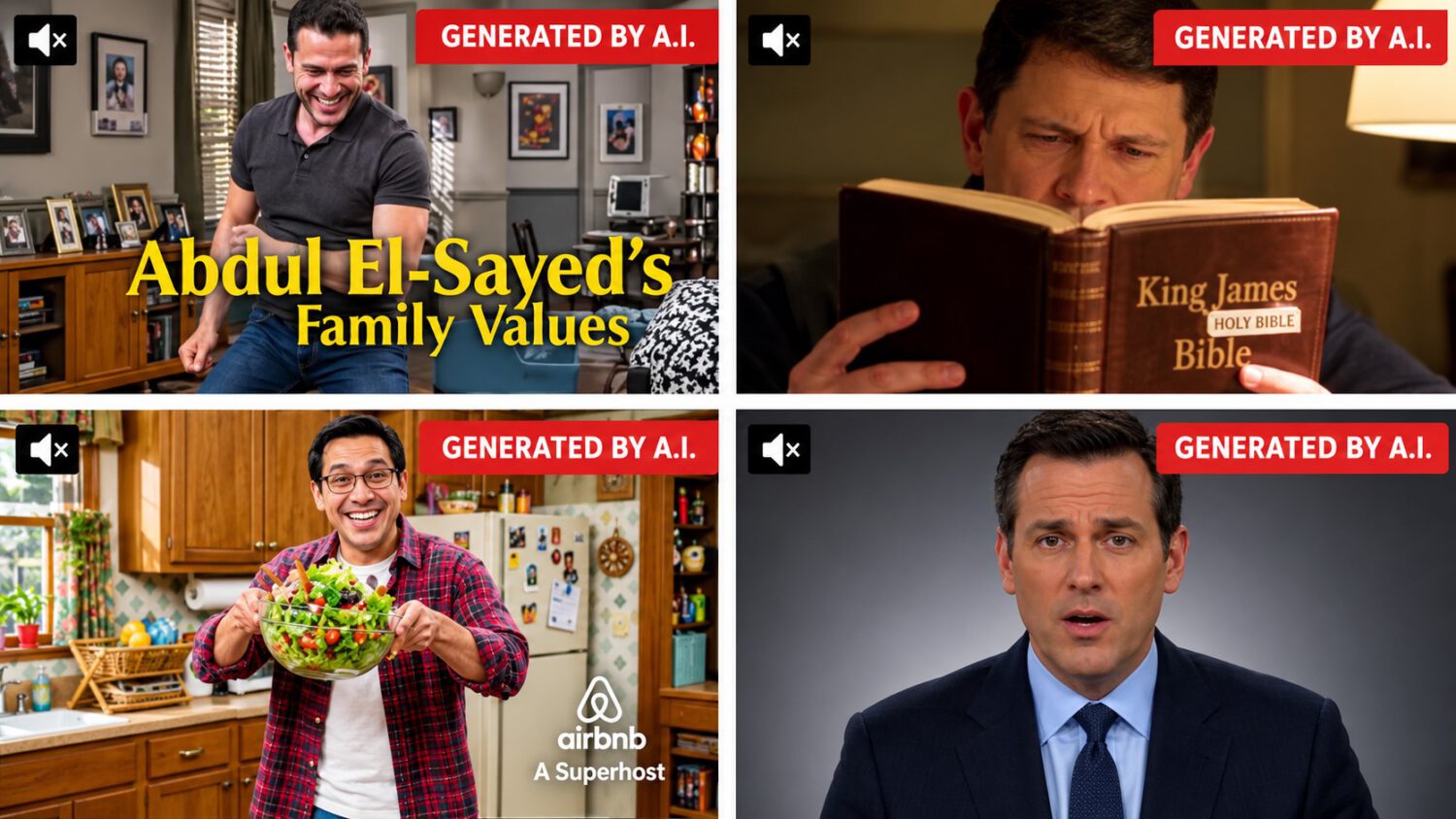
The more consequential examples go further. A Bruce Blakeman campaign video fabricated New York Mayor Zohran Mamdani and Gov. Kathy Hochul appearing together in a synthetic advertisement for a fictional “political delusion pill,” using their voices and likenesses without any AI disclaimer, according to the New York Times. A Make Oklahoma Great Again advertisement showed a synthetic Democratic gubernatorial candidate embracing Hillary Clinton, framing the candidate as aligned with Clinton and opposed to Donald Trump. AdImpact tracked more than $200,000 in Oklahoma television buys behind that ad alone.
Other reviewed examples showed fabricated versions of Abdul El-Sayed laughing at cards containing extremist messages and James Fishback appearing at a gathering with Rep. Ilhan Omar and Iranian leaders, according to the Times. Neither event occurred. These cases illustrate a pattern where AI moves from ordinary visual enhancement into synthetic scenes designed to associate candidates with inflammatory figures or statements.
The Disclosure Gap and Who Is Using AI
Republican campaigns drove most of the identified spending, and most ads skipped any label.
More than 80 percent of the reviewed ads came from Republican campaigns or Republican-aligned PACs, per the Wesleyan Media Project’s broader dataset. The narrower Wesleyan accounting attributed roughly 83 percent of tracked spending to Republican-aligned groups. Researchers noted that Democratic campaigns may face greater reputational risk from AI use because Democratic voters and officials are generally more supportive of AI regulation, though that observation is an interpretation, not evidence that Democratic campaigns never use the technology.
The disclosure picture is consistent in its direction across both datasets. Approximately 70 percent of ads in the broader review carried no AI label; only 31 percent disclosed AI use in the narrower set. Wesleyan researchers said their counts likely understate the real total, because ads running in states without disclosure requirements are harder to detect.
The spending figures reflect different methodologies and are not interchangeable. The $137 million total applies broader inclusion criteria, while a separate Wesleyan accounting covering at least 164 unique ads identified just under $80 million in spending. AdImpact’s more conservative count, limited to ads with an identifiable disclosure, found slightly more than $13 million. All three figures point in the same direction: AI political advertising is no longer a marginal experiment.
Regulation and What Voters Can Actually Rely On
About half of states require some form of AI disclosure; the other half do not, and enforcement remains uneven.
Roughly half of U.S. states require campaigns to disclose AI-generated or manipulated material in political advertising, though the rules vary significantly in scope, according to CNN. Michigan, for example, requires a three-second voiceover acknowledging AI use alongside a four-second written disclosure. The requirements differ enough across states that a campaign compliant in one state may face a legal complaint in another.
The New York State Democratic Party filed a complaint with the state Board of Elections over the Blakeman advertisements, alleging violation of a state law requiring materially deceptive political communications to carry an AI label. Blakeman’s campaign said the ad was satirical and required no disclaimer. The American Association of Political Consultants has backed federal rules that would preempt the state-by-state patchwork and require labels for deceptive AI content while preserving broad political speech protections, a dynamic echoed in debates over AI age laws.
Fred N. Davis III, a Hollywood advertising executive, told the New York Times that a commercial previously costing close to $2 million can now be produced for roughly $200,000 using AI. That cost compression explains the volume problem as directly as any other factor. Erika Franklin Fowler, co-director of the Wesleyan Media Project, said some AI applications are difficult for viewers to detect without a disclosure label. Her co-director Travis Ridout warned that voters can be shown politicians appearing to say or do things they never said or did, according to CNN.
The disclosure rules that exist apply inconsistently across states. Researchers believe the actual count of AI-using ads exceeds what any current dataset captures. The same economics that make AI an attractive tool for underfunded campaigns also make synthetic attack advertising cheap to produce at volume. As Schneier framed it, the technology is not the core problem. Undisclosed deception is.