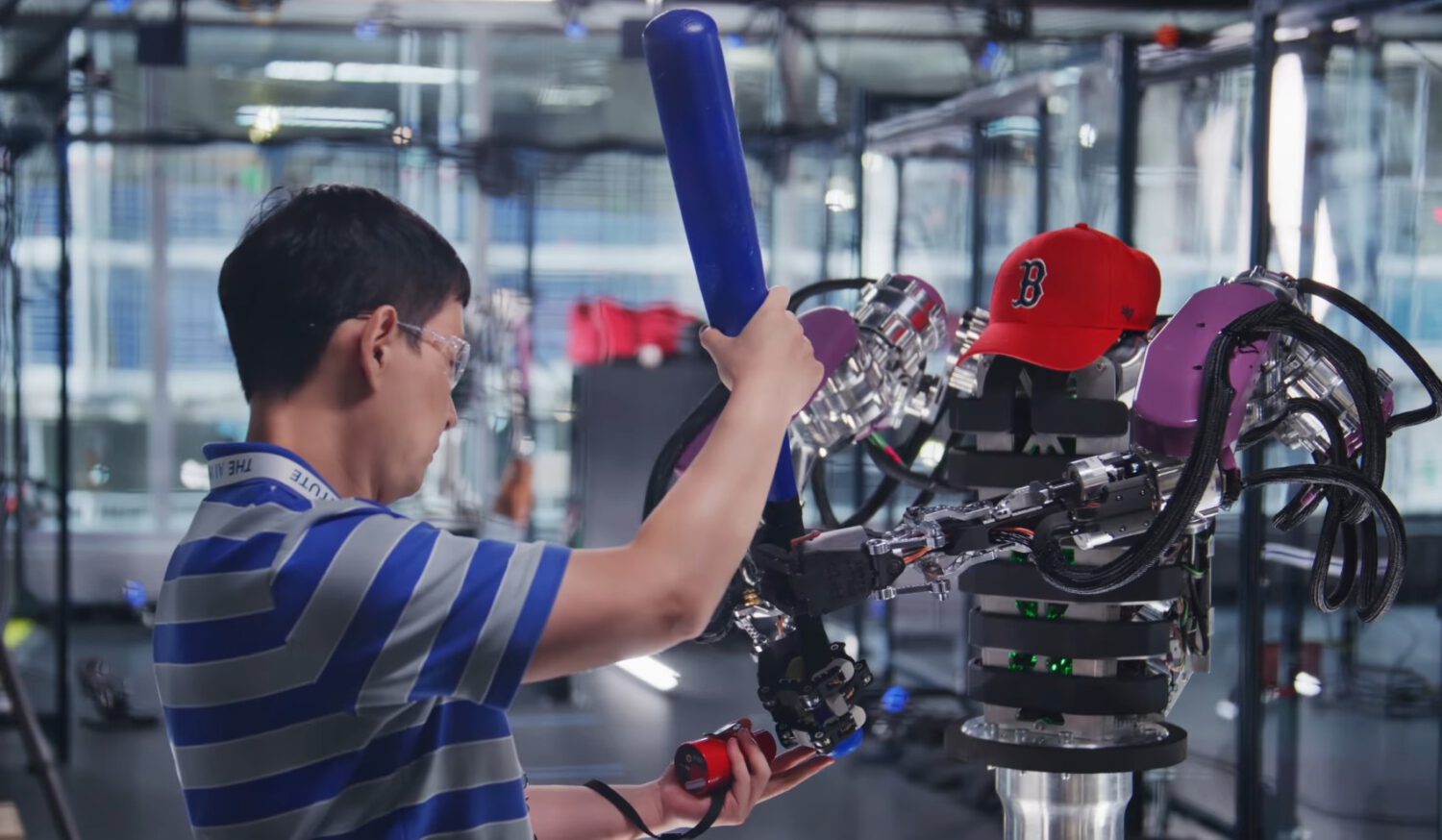
A research robot from the Robotics and AI Institute threw a ball at over 30 meters per second, caught one traveling at roughly 66 km/h under short-distance test conditions, and made contact in 27 of 33 batting attempts. The findings appear in the September 2026 issue of Science Robotics, in a paper titled “A low-inertia, bimanual robot for dynamic manipulation.”
The spectacle is striking. The engineering behind it is the actual story.
Dynamic manipulation, meaning a robot’s ability to handle fast-moving objects with precise timing and controlled force, remains one of the hardest unsolved problems in robotics. AthenaZero’s designers at RAI addressed that problem not only by refining software but by rethinking the machine’s physical properties from the ground up.
Built Different From the Factory Floor Up
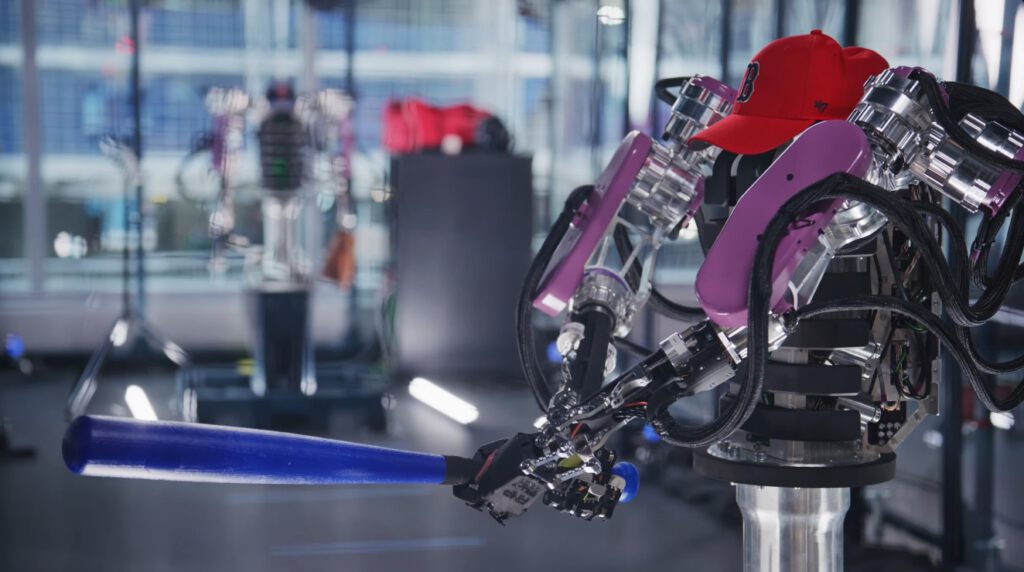
AthenaZero trades the rigidity of many conventional industrial arms for joints that can yield under external force, which changes how the robot handles contact.
Many conventional industrial robots are built for rigidity. High stiffness is useful when a machine must weld, assemble, or position components with millimeter-level repeatability, but it can increase impact forces when contact is sudden or unpredictable.
AthenaZero uses low-inertia, quasi-direct-drive actuation. In this design, motors connect to joints through minimal gearing, reducing the effective mass the robot must move against during fast interactions.
The result is an endpoint mass comparable to a robotic knee and human arm combined, and roughly an order of magnitude below that of conventional manipulators, according to the research. Lower inertia allows the robot to accelerate and decelerate rapidly while the system’s compliant joints help manage contact forces during dynamic interactions.
Three Tasks, One Robot, No Safety Net
Throwing, catching, and batting test progressively harder coordination demands, and AthenaZero completed all three.
Throwing requires coordinated arm motion and precise timing to transfer force to a ball and release it on the correct trajectory. Catching demands that the robot perceive an incoming object, adjust its position, and absorb impact. Batting is harder still: both arms must coordinate, the bat must be positioned correctly, and the swing must synchronize with a ball already in motion.
AthenaZero handled all three. The researchers recorded throws exceeding 30 m/s and catching and batting interactions exceeding 14 m/s over a 7.3-meter distance. Demonstrations included both robot-to-robot and human-to-robot catching sequences.
That 82% contact rate reflects controlled laboratory conditions, not open-environment performance. These are demonstrations of mechanical capability, not proof that AthenaZero can operate reliably outside a structured setting.
Why Researchers Chose America’s Pastime as a Benchmark
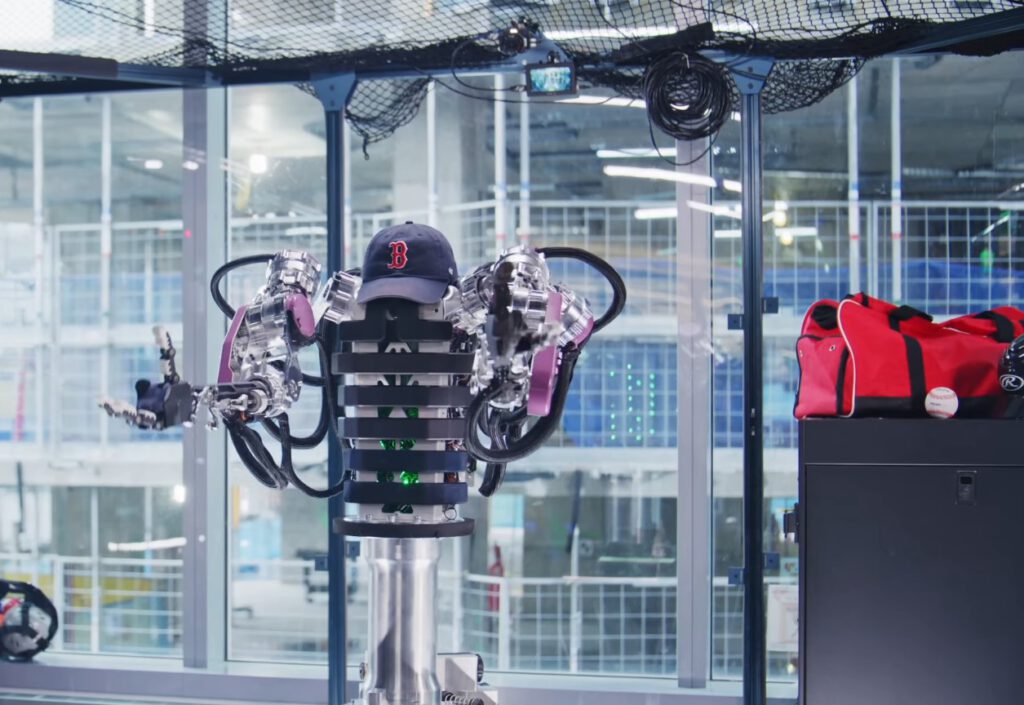
Baseball is a compact stress test for some of robotics’ hardest coordination problems.
Think of baseball as robotics’ version of a technical exam that covers every hard concept at once. High acceleration, millisecond-level timing, two-arm coordination, and objects moving on trajectories that must be estimated quickly are all present in a single sport.
Each task maps onto a category of difficulty that robots encounter in real-world environments. Baseball compresses those demands into something measurable and repeatable, which makes it a rigorous, if unusually cinematic, benchmark.
The broader research goal is dexterous manipulation: enabling robots to reliably handle objects with different shapes, masses, and motion patterns. If that goal sounds abstract, your instinct to connect it to warehouse automation or physical assistance robotics is not wrong, though those remain research directions, not announced products.
Limitations and What Comes Next
High-stiffness systems still have a place. Where maximum precision, payload capacity, and repeatable positioning matter, conventional industrial arms may remain preferable. AthenaZero represents a different point on the design spectrum, one optimized for dynamic interaction rather than static accuracy.
Future progress will require testing with varied object types, moving trajectories under less controlled conditions, and environments that do not cooperate the way a lab does. What the work establishes is a clearer argument that hardware design is not a solved problem. If you want robots that handle the physical world gracefully, writing better control algorithms is only part of the answer. Sometimes you have to change the machine itself.