Each side of Saturn’s newly discovered south polar wave is roughly 16,782 km long — wider than Earth’s diameter. Ten of them, encircling a gas giant already running the strangest geometry experiment in the solar system. NASA’s Hubble Space Telescope caught it forming between 2023 and 2025. The kicker: it behaves nothing like its northern counterpart. And that difference is where things get genuinely interesting.
The Shape That Shouldn’t Exist
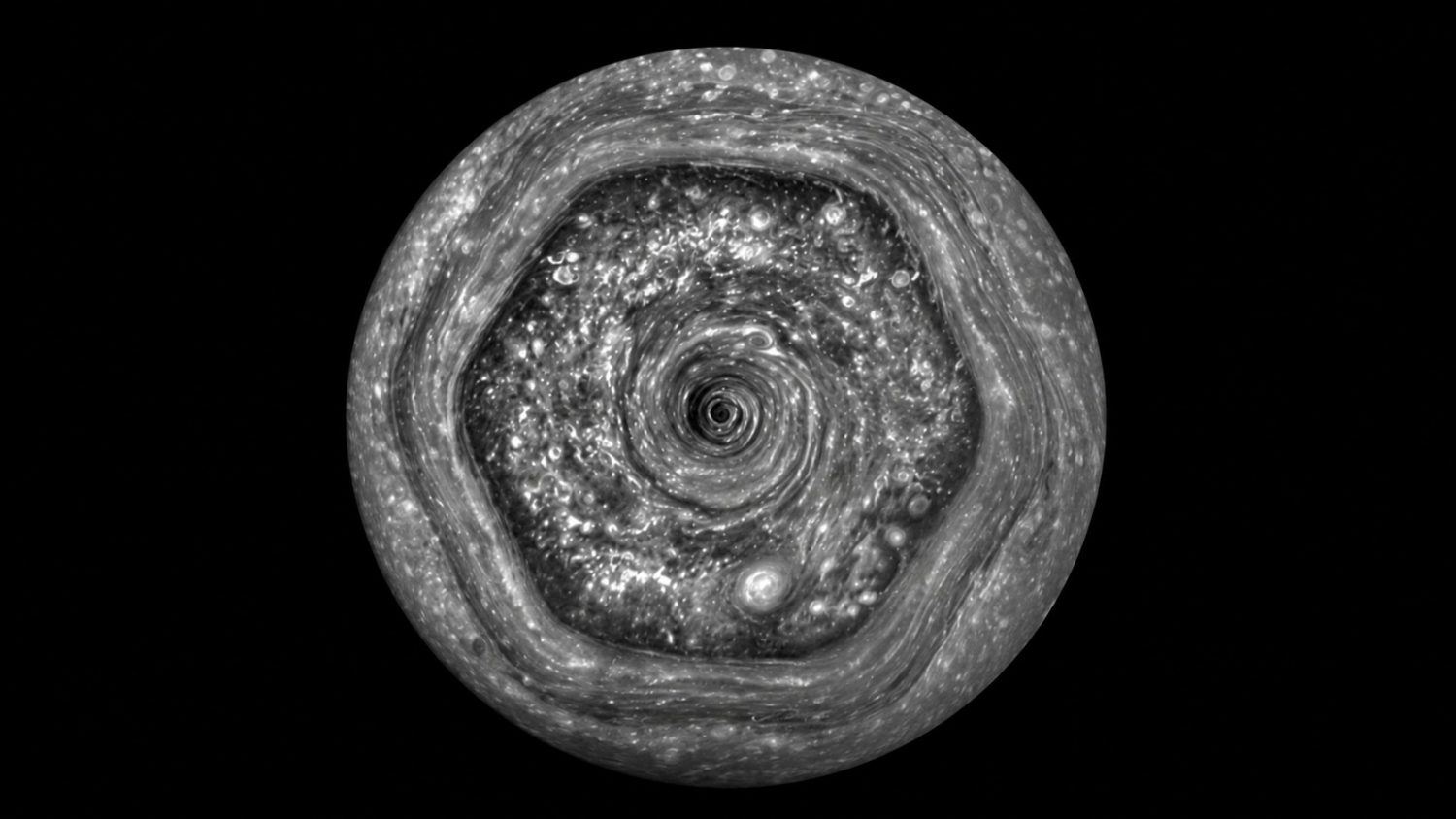
Saturn’s north polar hexagon has persisted, almost perfectly unchanged, since Voyager first captured it in the early 1980s.
Six-sided. Winds exceeding 200 mph. Roughly 25,000 km across — fit Earth twice side-by-side and you’re close. The hexagon just keeps running, decade after decade, barely shifting. At its center sits a polar cyclone with an eye about 1,250 miles wide. Cassini spent years observing it. The structure held.
The reason comes down to physics. Steep wind-shear gradients in Saturn’s northern jet naturally generate exactly six large atmospheric ripples — Rossby waves, shaped by the planet’s rapid rotation — that propagate at nearly the same speed as the jet itself. Result: a polygon that appears almost frozen in place. Notably, earlier models predicted the southern hemisphere’s jet conditions would not produce anything comparable.
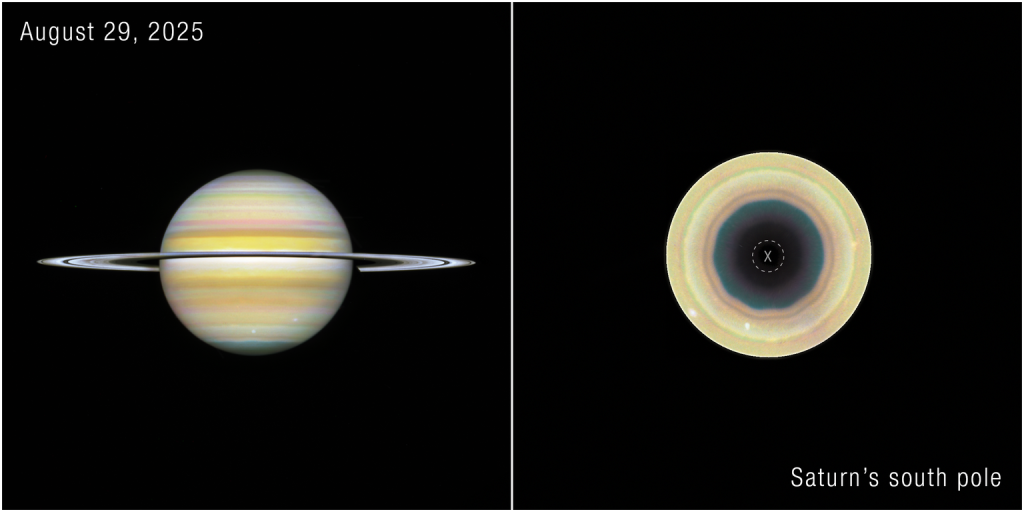
Image: NASA, ESA, STScI, Agustin Sánchez-Lavega (UPV), Amy Simon (NASA-GSFC), Michael Wong (UC Berkeley)
Saturn’s Stranger South
The decagon emerged the moment Saturn’s axial tilt finally returned its south pole to Earth’s line of sight after more than a decade of obscurity.
Saturn’s south pole was hidden from Earth-based observation from roughly 2012 to 2023. When it came back into view, Hubble was ready. What it found sits at approximately 63° south latitude, spanning about 167,820 km total — each of its ten sides around 16,782 km long. Unlike the hexagon’s rigid corners, those ten vertices oscillate longitudinally on a roughly 32-day cycle at about 2.5 m/s. This is not a locked polygon. It breathes. In 2025 images, three sides appear crisp, four moderate, three still diffuse — it’s still assembling itself.
The hexagon is a monument. The decagon is a construction site.
A team at the University of the Basque Country, publishing in Science Advances on September 2, 2026, ran shallow-water numerical simulations to model the southern jet’s behavior. Their conclusion: periodic disturbances along the jet — possibly driven by a large counterclockwise vortex sitting just to its north — could generate a 10-sided wave. Whether it stabilizes or dissolves remains unknown.
“The complex dynamical behavior of the decagon deserves future attention,” the researchers wrote.
Beyond Saturn, the stakes climb. Understanding how polygonal jet waves form on gas giants sharpens the models scientists use to interpret light curves from exoplanets and brown dwarfs — worlds too distant to visit. The decagon is like getting a second data point after 40 years of a single reference: suddenly, patterns become possible.
The hexagon held its shape while multiple missions and observatories watched. The decagon is still deciding what it wants to be. Scientists now have a front-row seat — and Saturn’s atmosphere just got twice as complicated.