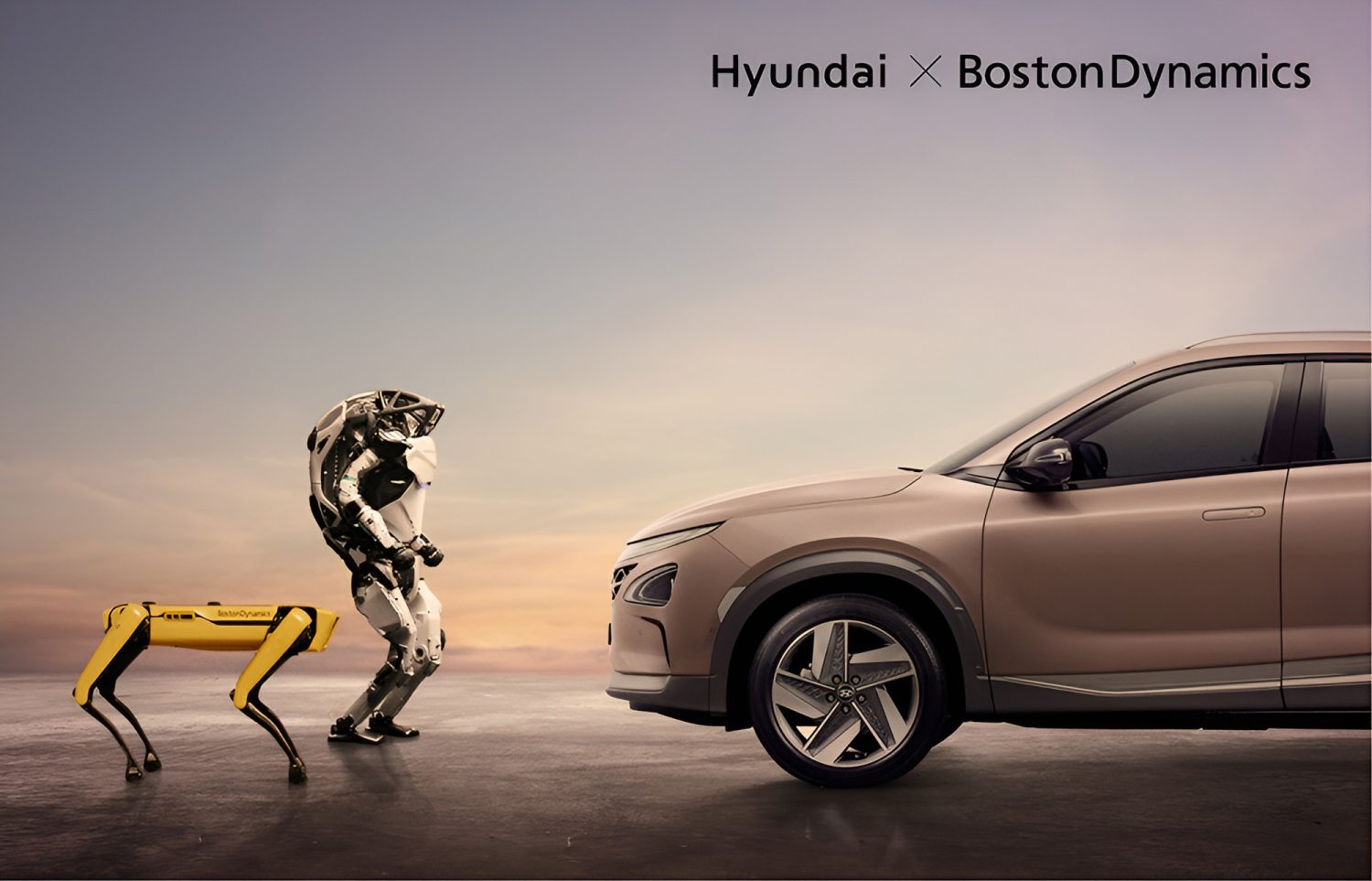
You are in the Hyundai lot, circa 2028: the salesperson walks you past the Ioniq 6, past the Tucson, and stops next to something that moves on four legs and costs more than either. At Hyundai’s August 2026 CEO Investor Day, President and CEO José Muñoz told investors the company has “existing potential distribution for selling robots through our dealer partners” — with Hyundai Capital “exploring the feasibility to finance sales of robots.” The robots in question: Atlas (humanoid worker), Spot (quadruped inspector), and Stretch (warehouse arm). This is real. It’s also not a product announcement.
The Factory Comes First
Hyundai’s robotics ambitions are grounded in industrial scale — 30,000 Atlas humanoids a year is the target, but the factory floor gets them long before any showroom does.
Hyundai acquired 80% of Boston Dynamics in 2021 for roughly $1.1 billion — a bet that robotics would become as central to the company as powertrains. The plan now includes a U.S. factory targeting up to 30,000 Atlas humanoids annually by 2028, with first deployments at Hyundai’s Georgia Metaplant focused on parts sequencing tasks. A few things worth knowing:
- That 30,000 figure is a capacity ceiling, not a launch number — early 2026 production is already committed to internal pilots and partners including Google DeepMind
- Spot’s last public list price was approximately $74,500; it’s now quote-only, depending on configuration and service package
- BMW’s Figure 02 trial supported production of more than 30,000 X3 vehicles over ten months; Mercedes-Benz is testing Apptronik’s Apollo; Tesla is building Optimus at its Fremont facility
Hyundai Motor Group is far from alone in this race. What it does have that Tesla, BMW, and Mercedes don’t is a stated plan to use its existing car dealer network as a robot sales channel — a distribution angle nobody else has explicitly put on the table.
“We have existing potential distribution for selling robots through our dealer partners. And Hyundai Capital is exploring the feasibility to finance sales of robots. Development, production, distribution, sales and finance for robotics. This is the power of the Group!” — José Muñoz, Hyundai Motor Group CEO, August 2026 Investor Day
Note the language: “potential” and “exploring feasibility” are doing considerable heavy lifting there. This is investor positioning, not a launch announcement.
What “Dealer-Sold Robot” Actually Means Right Now
The realistic near-term buyer isn’t a homeowner — it’s a logistics manager with a labor shortage and a Hyundai Capital line of credit.
Stretch is already unloading trucks for DHL and Maersk. Spot handles security inspections at industrial sites. The natural near-term customer for dealer-financed robots looks like a facilities contractor or warehouse operator, not a family cross-shopping an SUV. Think of it the way the subscription economy reshaped software — nobody owns Photoshop anymore, they rent it — and the same model may define how businesses acquire humanoids. RaaS (Robotics-as-a-Service) structures, bundling over-the-air updates and lifecycle support, are the likely commercial direction, though no confirmed program exists yet. The labor displacement question that sits underneath all of this remains real and largely unanswered — a concern that intersects directly with workplace safety as these systems scale.
If Hyundai executes, dealerships evolve from car lots into mobility-and-robotics hubs — and every competitor will eventually have to respond. The robots assembling your next Hyundai might one day be sold by the same person who sold you the car. That’s either the future of retail or a very expensive investor slide. Either way, it’s worth watching.