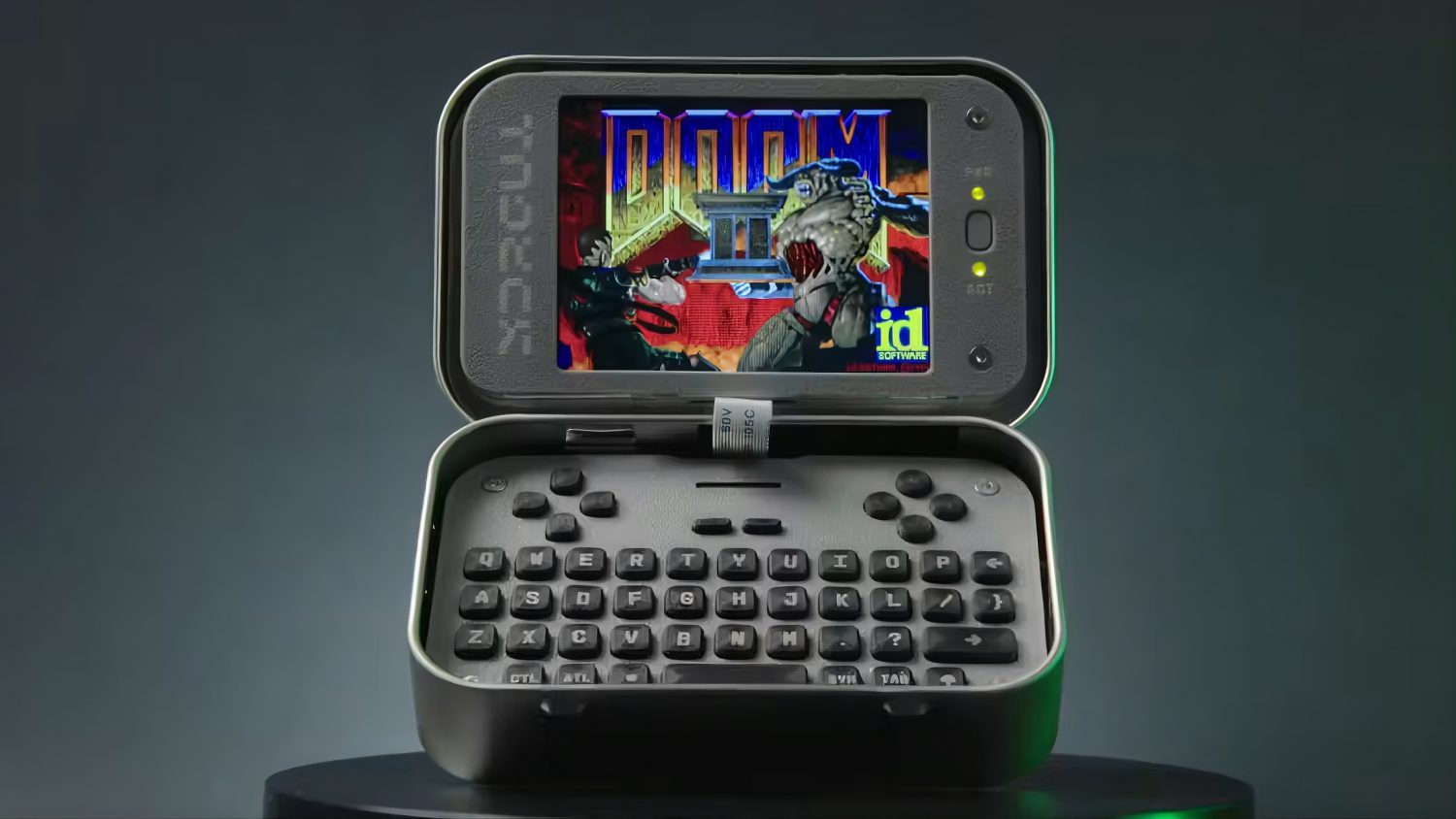
At first glance, it looks like an ordinary mint tin. Open it, and there’s a screen in the lid, a keyboard on the base, a battery inside, audio output, and enough compute power to run Doom. That’s exactly what maker Salim Benbouziyane built — a fully functional Linux cyberdeck hiding inside standard mint packaging. Passing the “Does it run Doom?” test matters here. In embedded computing circles, that question is the informal benchmark separating a computer from a glorified microcontroller demo. This one qualifies.
Why This Build Is Different From Every Other Altoids Tin Pi Project
The hardware decision that made this build significantly harder — and significantly more impressive.
Most Altoids tin Pi builds work by stacking a Raspberry Pi Zero W on top of a UPS HAT and hoping everything fits. Benbouziyane took a harder road. He chose the Raspberry Pi Compute Module Zero — a stamp-format chip with no built-in ports, designed for custom carrier boards. No bulky connectors eating vertical space. Every millimeter of the tin’s interior is intentional. The tradeoff: he had to design the carrier board himself, handling power, display, audio, and keyboard from scratch.
The result is a four-PCB stack inside a tin smaller than your palm:
- Custom two-layer carrier PCB hosting the CM0 — dense routing in a footprint smaller than a playing card
- Secondary LCD interface PCB connected via ribbon cable, letting the lid open and close without stressing the display connection
- Tertiary spacer PCB preventing shorts against the metal tin walls
- Quaternary dome-switch PCB for the keyboard — tactile input at near-zero profile height
- 3D-printed bezels, keycaps, and interior covers giving the whole thing a polished, intentional finish
The ribbon cable threading through the existing tin hinge is the kind of detail that separates a carefully engineered build from a clever hack.
Custom enclosures made by 3D printing became so common that cyberdecks started blending together — bespoke PETG cases everywhere you looked. The Altoids tin feels almost subversive now, a metal relic carrying old-school hacker credibility precisely because it fell out of fashion. Benbouziyane’s build taps that nostalgia deliberately, pairing it with genuinely modern embedded design.
The Craft Is the Point
Fit, finish, and the details that elevate this from clever prototype to something genuinely beautiful.
Screen, keyboard, battery, audio — all self-contained, no power tether required. The device boots Raspberry Pi OS and handles lightweight Linux tasks without complaint. The keyboard is tiny and the screen is small; nobody’s writing a novel on this thing, and that’s not the point.
The 3D-printed interior elements — screen bezel, keyboard surround, protective PCB covers — push the result closer to a miniature commercial product than a weekend prototype. Opening the lid and seeing a cleanly framed display rather than a bare panel rattling around inside tin is the difference between a build that’s impressive and one that’s genuinely beautiful.
Most hobbyists won’t replicate this on a Saturday afternoon. That’s fine. Its value is the proof: when embedded computing tools are wielded by someone who actually knows PCB design, spatial reasoning, and mechanical craft simultaneously, a mint tin becomes a computer. A real one.