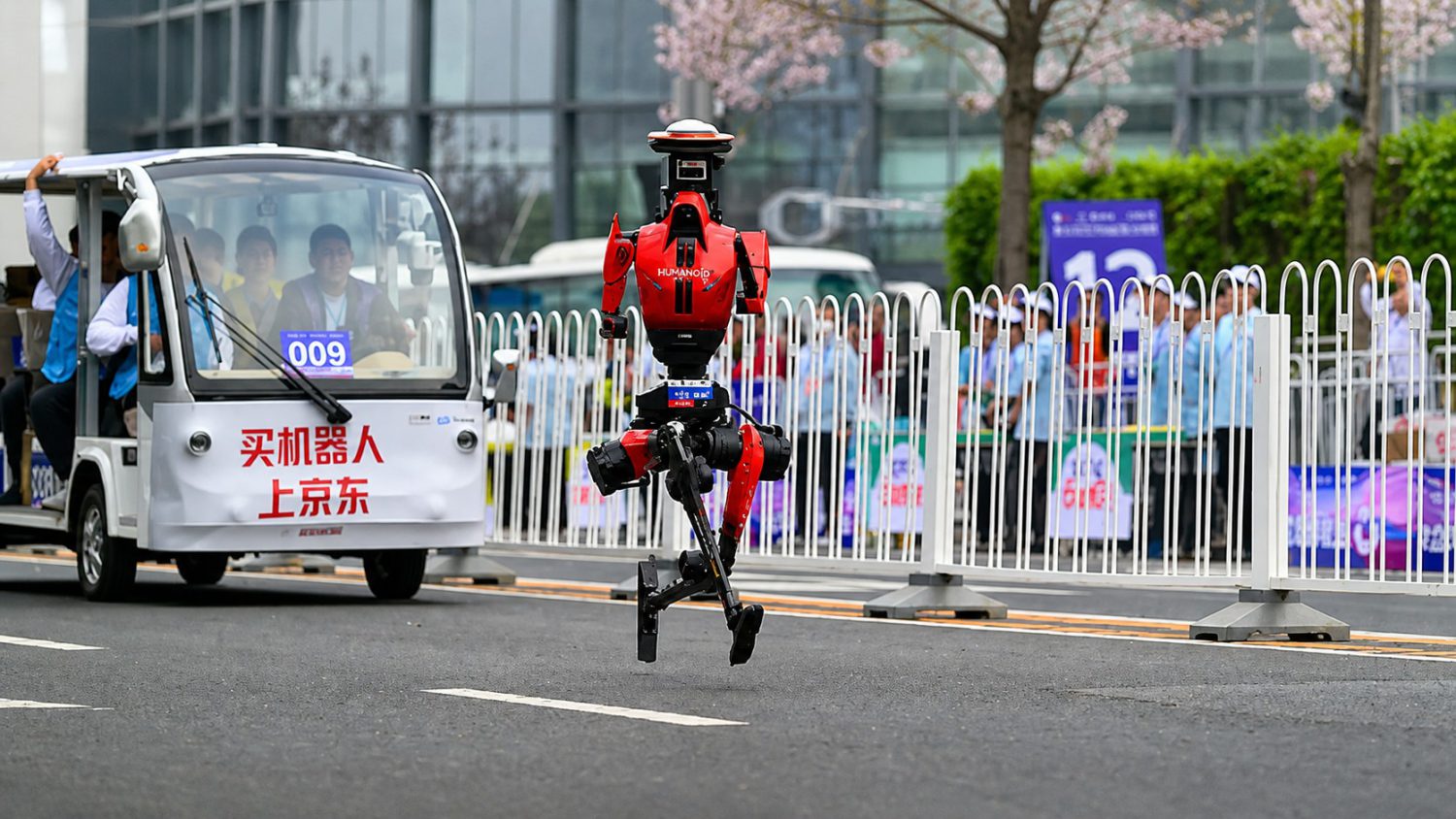
Running at 14.5 meters per second, a humanoid robot named Lightning clocked 9.32 seconds in the 100m during a pre-competition test at the second World Humanoid Robot Games in Beijing last August. Usain Bolt’s human world record — set in Berlin in 2009, still untouched — is 9.58 seconds.
To be precise: this isn’t a World Athletics record. Lightning isn’t an Olympic athlete. But the gap is real, and the time is real. Honor, the Chinese smartphone manufacturer that built Lightning, isn’t letting you forget either number.
This happened at an exhibition event — closer to a very fast science fair than an Olympic final — where tech companies and universities showcase humanoid robots in events ranging from sprinting to weightlifting to table tennis. In official competition heats at the Games, robots clocked times around 9.39 seconds, with Lightning recording 9.47 seconds — still faster than Bolt’s mark. And this sprint wasn’t Lightning’s debut: back in April 2026, the same robot won a Beijing humanoid robot half marathon in 50 minutes and 26 seconds, beating Jacob Kiplimo’s human world record of 57:20 by nearly seven minutes.
A few things worth knowing about Lightning:
- Built by Honor, the smartphone brand — its joint cooling system is adapted directly from smartphone thermal management technology
- 169 cm tall, roughly 45 kg; its legs were extended by 10 cm to 1.05 m before the Games to lengthen its stride
- Peak speed in the 100m test: approximately 14.5 m/s
- During the April half marathon, it stumbled and needed help getting upright — and still won
What “Faster Than Bolt” Actually Means
The jaw-dropping number isn’t 9.32 seconds — it’s how quickly these machines went from barely finishing to rewriting the benchmark.
The 9.32 seconds matters less than the trajectory. In 2025, the winning robot at the previous Beijing humanoid robot half marathon took roughly 2 hours and 40 minutes to finish. Lightning did it in 50 minutes. That’s not iteration — that’s the ChatGPT moment for physical robotics. Gradual progress, gradual progress, then suddenly the old benchmark looks prehistoric.
Here’s the honest counterweight: Lightning runs fast on flat, controlled tracks. It fell over during the half marathon. Cluttered warehouses, hospital corridors, and icy sidewalks are a different problem entirely. Honor is also making a soft-power statement here — beating Bolt’s name into a headline is savvy marketing for a smartphone brand staking its claim in serious robotics. That’s worth noting, even if it doesn’t diminish the engineering behind it.
None of that makes the progress less real. When the locomotion AI that clocks 9.32 seconds gets refined for logistics, emergency response, or industrial inspection, the question won’t be whether it can beat a human in a straight line. That question is already answered. It’ll be whether anyone saw this pace of development coming — and planned accordingly.