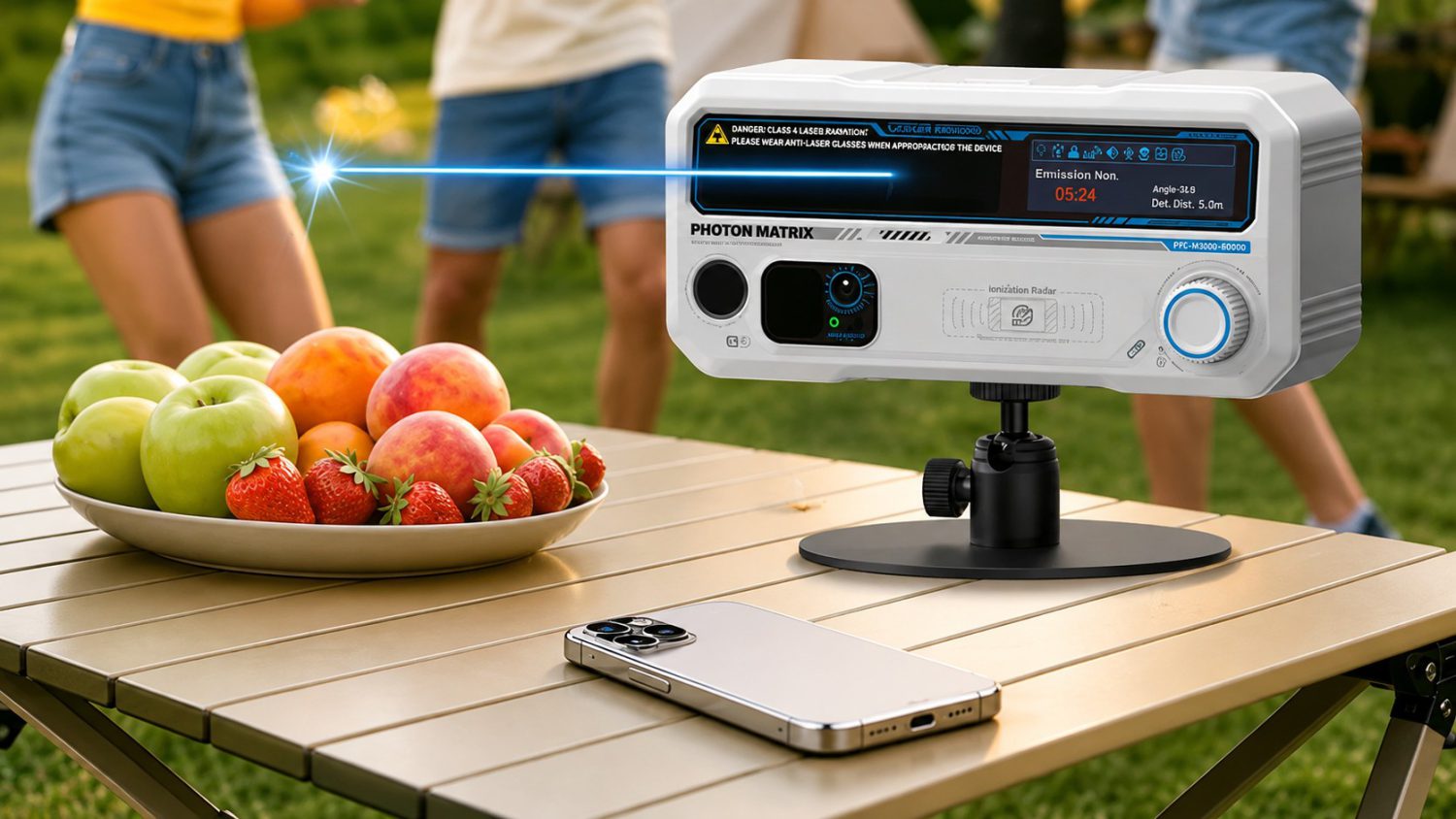
Somewhere in your backyard this summer, you’re losing a war of attrition against insects that weigh less than a grape seed. Photon Matrix Lab, a Changzhou, China startup, thinks the answer is a palm-sized turret using LiDAR, mmWave radar, and AI to hunt mosquitoes mid-flight and neutralize them with a laser. The company raised $2.7 million from 4,000-plus backers across 50 countries on Indiegogo — against an original $20,000 target — and mass production reportedly began in August 2026. Two versions are now available direct from the manufacturer: an infrared model at $988 for indoor use, and a blue laser version at $1,088 for outdoor and industrial settings.
That’s four figures to kill mosquitoes.
How It Actually Works
The detection stack combines three sensing technologies to lock onto a mosquito in roughly the time it takes to blink.
LiDAR sweeps a 90° horizontal plane continuously. mmWave radar and an AI vision module then classify flying objects by size (2–20 mm) and speed (under 1 m/s), locking onto mosquito-sized targets in roughly 3 milliseconds. A galvanometer mirror steers the kill laser to match. The basic model covers a 3-meter radius; the Pro extends to 6 meters. The infrared version fires an invisible beam — suited for nurseries and bedrooms where a pulsing blue laser would feel like living inside a nightclub.
Key specs, per manufacturer materials (figures below are manufacturer-stated; none have been independently verified):
- Kill rate: Up to 30 mosquitoes per second
- Coverage: 90° scan plane; 3m (Basic) or 6m (Pro) radius
- Power: Up to 16 hours on a 39,200 mAh power bank, or wall mains
- Build: IP68 waterproof; compatible with fixed stands or rotating bases
- Safety: Claimed eye, skin, and pet protection via size-and-motion lockouts; no specific laser safety class (e.g., IEC 60825) has been publicly named
Tom’s Hardware stated they want to see the device “in the hands of independent reviewers” before drawing conclusions — a reasonable position given crowdfunding’s well-documented track record of ambitious renders and complicated deliveries.
Before You Spend Four Figures
Every performance claim currently traces back to the manufacturer, and that gap matters before you commit four figures.
Every performance number comes from manufacturer-sourced materials and in-house outdoor demos. Think of it like a movie trailer — the cinematography is flawless, the mosquito dies dramatically, but nobody’s seen the full runtime yet. No third-party benchmarks exist for cluttered real-home environments with furniture, curtains, or a toddler wandering through the beam path at 2am. Safety certifications are described as “stringent” without naming a regulator or standard. First shipments only began in August 2026.
That skepticism doesn’t erase the genuine engineering story. Defense-grade laser hardware shrinking into a consumer form factor is real progress. The chemical-free framing also carries actual weight — particularly for dengue and malaria-risk regions, hospital campuses, or anyone who’d rather not sleep inside a DEET fog. At $988, though, this device is firmly priced for institutional buyers and well-funded early adopters, not the average person losing sleep to one mosquito circling their ear at 3am.