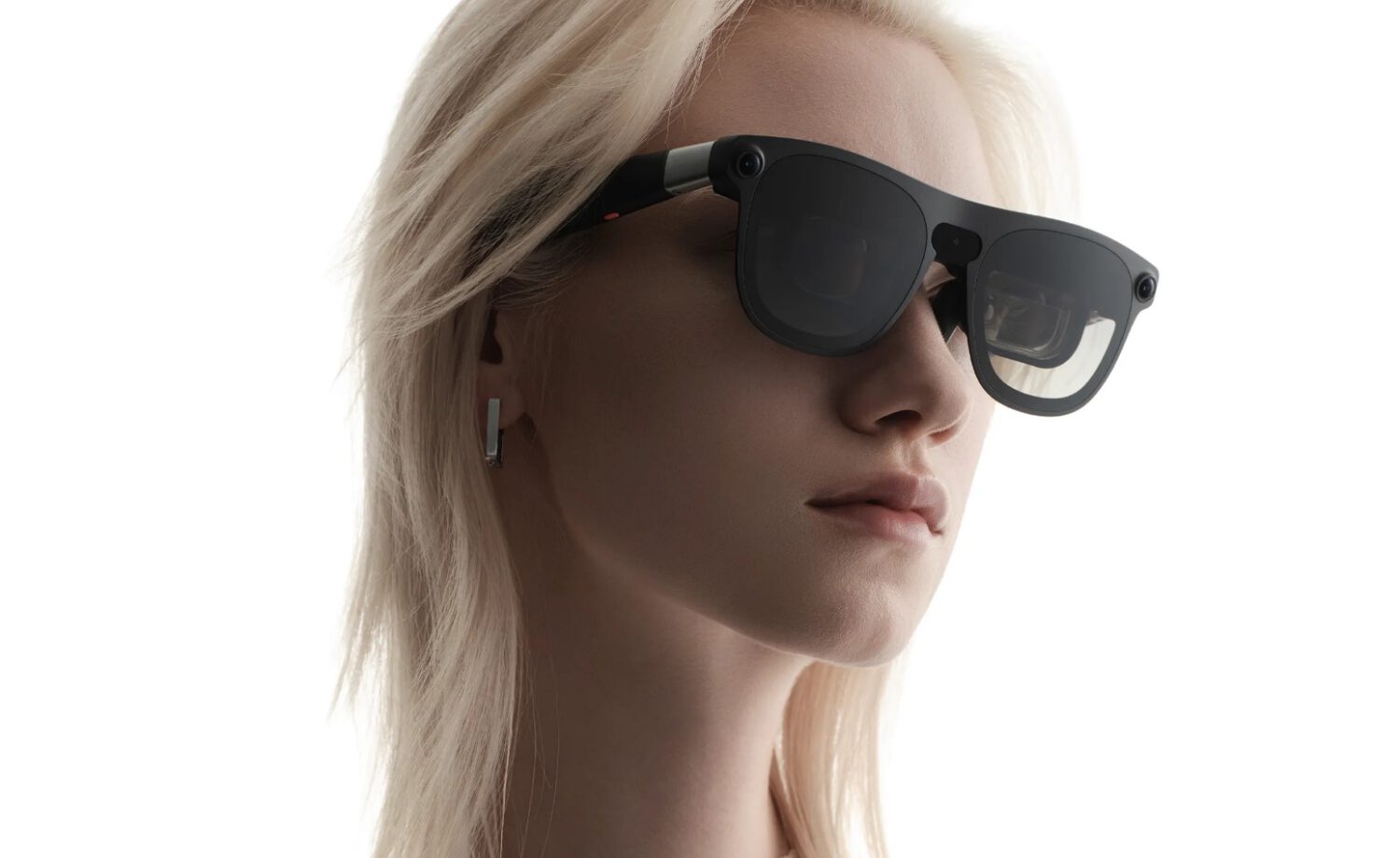
Spending $1,279 on smartglasses is a commitment, and Xreal wants you to know exactly what that buys: not a passive display strapped to your face, but an Android XR spatial-computing system built in collaboration with Google and Qualcomm.
Aura is a tethered two-piece setup. The glasses connect to a separate compute puck that runs Android XR and delivers access to Gemini-powered AI features and Google Play apps, while an X1S spatial coprocessor inside the glasses handles low-latency display and sensor processing.
What You Get for the Price
The hardware packs a 70-degree field of view, sub-95-gram weight, and Bose-engineered audio into a glasses frame that still requires a companion puck in your pocket.
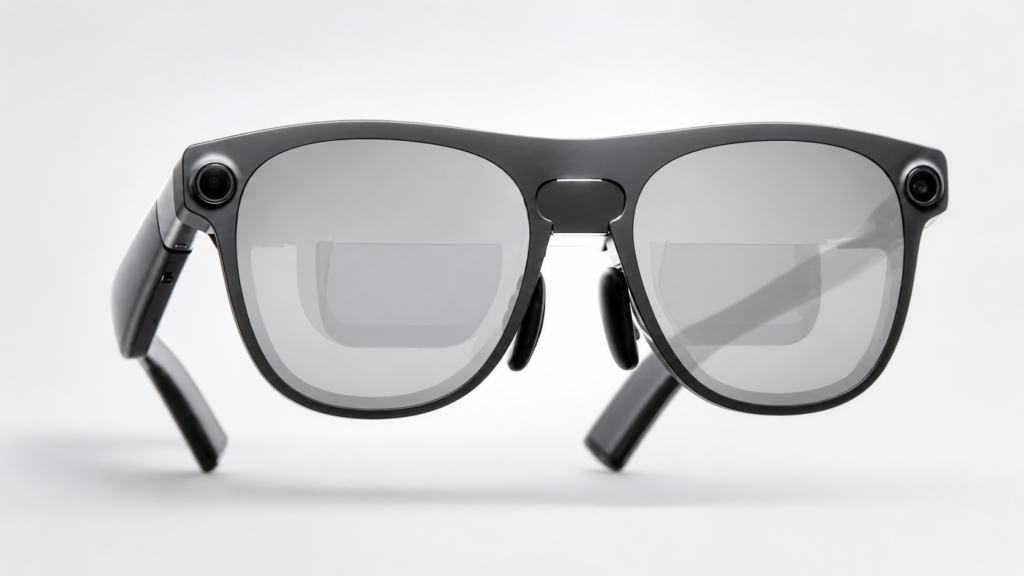
The glasses weigh under 95 grams and offer a 70-degree field of view through optical see-through lenses. The Snapdragon Reality Elite platform in the puck pairs with Xreal’s X1S spatial coprocessor in the frames, and audio comes courtesy of Bose-engineered technology.
Engadget’s early hands-on report described the visuals as sharp and bright, holding up even in direct sunlight outdoors. That represents an early experiential impression rather than a full independent review.
The puck runs Google Play and Gemini, includes a trackpad and fingerprint sensor for navigation and authentication, and can be clipped to clothing or carried on a lanyard.
The smart glasses weigh under 95 grams, lighter than a conventional VR headset by a wide margin. You are still carrying two devices.
Beyond the standalone Android XR experience, Aura can connect to a computer as an external display, which meaningfully widens its practical use cases. Hand tracking, six degrees of freedom tracking, and AI vision experiences round out the feature set, with camera access gated behind user permission.
Pricing, Tiers, and Availability
Two memory and storage tiers are available, with reservation holders able to apply a prior deposit toward the final price.
Two configurations are available: the base model costs $1,279 and includes 12GB of RAM with 256GB of storage, while the higher tier runs $1,499 with 16GB of RAM and 512GB of storage. According to 9to5Google, reservation holders who paid a $199 priority deposit can apply that amount toward their final purchase price.
Pre-orders opened first to those reservation holders, with general-public orders expected to open in the coming weeks. Launch markets are the United States, Canada, Japan, and South Korea, with additional regions expected sometime in 2027. Other reporting places initial deliveries around November 2026, though exact timing may vary by market.
At $1,279, Aura sits in a different category from display-only glasses that rely on your phone or laptop for processing power. The price reflects a dedicated Android XR compute system in the puck, not just a screen extension. If you already understand that distinction and want Google’s spatial-computing platform without the bulk of a conventional headset, the math starts to hold together. If you were hoping for a directly comparable Android XR system closer to $500, no such product is currently available , a gap that Smart Glasses from other major players may eventually help address.