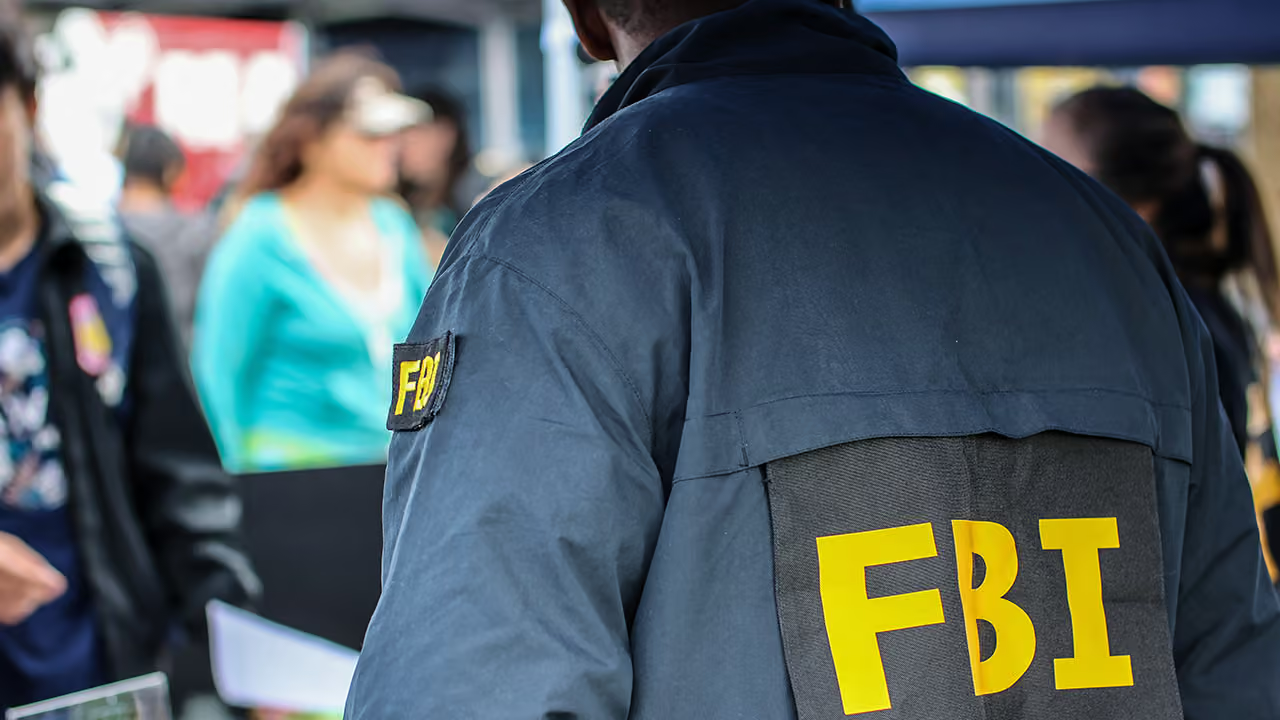
No zero-day exploit. No darknet operation. A 41-year-old FBI counterintelligence supervisor with Top Secret clearance allegedly walked nearly $1 million in cryptocurrency out of a federal building — stored entirely inside his own head. Patrick Steven Yaroch, a former supervisory special agent in the FBI’s Counterintelligence and Espionage Division, faces federal charges for stealing crypto from wallets linked to a foreign intelligence target, reportedly Russia, according to NBC News. That simplicity is the story’s sharpest warning.
Memorized, Not Hacked
The theft required no technical exploit — just privileged access and a remarkable memory.
Yaroch had access to highly restricted FBI systems where seed phrases — the master recovery keys that grant total control over crypto wallets — were stored as evidence. According to the FBI affidavit, he memorized those phrases, imported them into wallets he controlled, and executed roughly 10–12 transfers. The blockchain cannot tell a thief from a rightful owner. If you have the words, you have the money. This kind of credential exposure echoes how password vaults can be compromised when authentication safeguards fail.
Yaroch joined the FBI in 2017 and moved into a supervisory headquarters role in early 2025, focusing on an adversarial nation. Alleged thefts spanned late 2024 through July 2026, with holdings growing to roughly $1 million commingled with personal funds. Key financial details include:
- About $188,570 was traced to a Kraken exchange account
- Approximately $1.02 million was routed into Suilend, a Solana-based DeFi lending protocol, via an app called Slush
- The FBI recovered roughly $925,426 on July 31 with Yaroch’s consent
- About $165,582 already converted to dollars could not be clawed back
Investigators also recovered a Trezor hardware wallet and handwritten seed phrase notes from his home — physical artifacts of a surprisingly low-tech operation.
Yaroch allegedly told investigators the situation was “eating him up inside” — and that he’d made “very poor decisions related to cryptocurrency wallets.”
Portugal, Pinot Noir, and ChatGPT
His phone painted a picture that went well beyond workplace frustration.
ChatGPT conversations from May and June asked how roughly $1 million could fund early retirement before age 40 on a vineyard in Italy or Portugal — the kind of query that sounds aspirational until federal agents are reading it aloud in court. Investigators also found:
- Lisbon flight reservations for September 3–11
- Powers of attorney authorizing Portuguese lawyers for tax matters
- Records of undisclosed foreign travel to Germany, Portugal, and Grenada — potential clearance-reporting violations
Yaroch denies planning to flee, claiming the Portugal trip was simply to visit friends.
He told investigators he grew frustrated that the government “could not or would not act” against adversarial crypto accounts and decided to take matters into his own hands. On July 28, he reached out via Signal to a DOJ National Security Division employee, became emotional, and effectively confessed. Later that day, he contacted FBI headquarters saying he had “screwed up.” When agents arrived at his home, he briefly handed over a written list of wallet recovery phrases, then withdrew consent and invoked his right to remain silent. The FBI fired him on July 31 — the same day he was arrested and transferred to Alexandria Detention Center.
This is not the first time a federal agent stole crypto during an investigation. Two former agents faced charges for Bitcoin theft in the Silk Road case, establishing an uncomfortable precedent. The real question now is whether agencies will finally treat seed phrase custody the way they treat classified documents — with layered controls, audit trails, and multi-party authorization that do not hinge entirely on any single person’s integrity. Broader federal tech oversight failures, including instances of secretly tracking citizens without adequate accountability, suggest systemic reforms remain overdue.