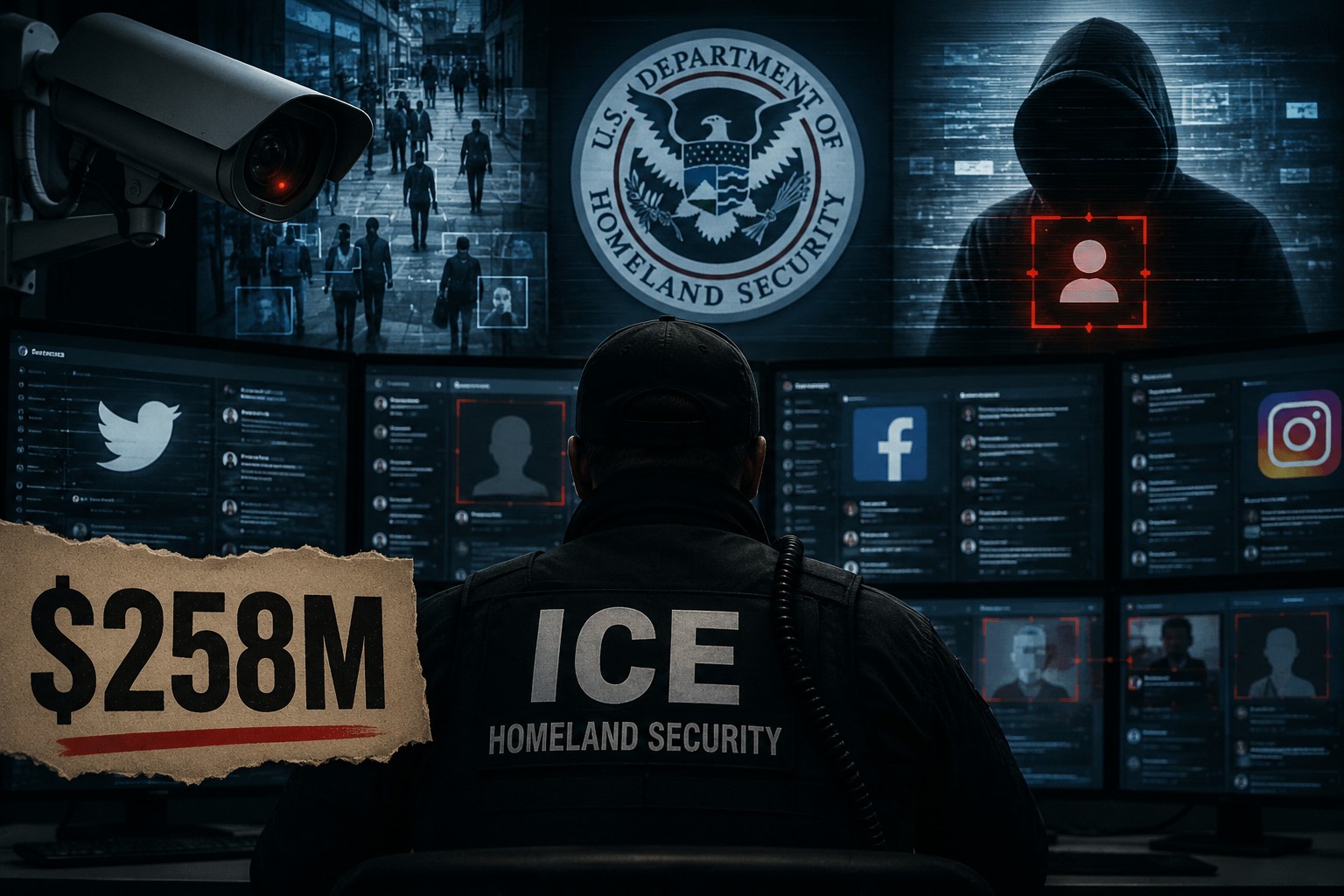
A critical Reddit comment about immigration enforcement can, four months later, bring plainclothes agents to a poster’s door carrying a printout of the post — a scenario no longer hypothetical. According to the Wall Street Journal, ICE has built a funded, contractor-powered surveillance operation that monitors social media around the clock — not just for credible violence, but for speech that challenges the agency’s mission. Since early 2025, DHS has fired off hundreds of administrative subpoenas to unmask anonymous users. The volume is unprecedented, and the targets are often ordinary people.
The Surveillance Architecture Runs Deep
The program pairs AI-driven profiling tools with a contractor network that dwarfs the two-person Privacy Office nominally overseeing it.
Here’s what your tax dollars bought:
- ICE spent roughly $258 million on surveillance technology in Trump’s first full year back — a 57% jump over the prior year, per federal budget analyses cited by the Journal.
- Six contracts totaling nearly $50 million fund social-media threat scanning, with most money obligated since early 2025.
- Virginia-based contractor Amivero, primarily a software shop, landed an $8 million deal to monitor platforms. It subcontracted work to Guidehouse, a global defense and intelligence consulting firm.
- ICE’s Privacy Office — the entity nominally overseeing all of this — employs two full-time staffers.
Contractors don’t just flag posts. They build dossiers that read like a true-crime evidence board: name, date of birth, Social Security number, vehicle registration, criminal history. AI-driven “anticipatory threat intelligence” cross-references social media activity with DMV records and police reports. Civil-rights attorneys and former DHS staffers say the dragnet routinely sweeps up ordinary critics whose speech falls squarely within First Amendment protection.
“As far as I can tell, all of this is about people saying naughty things about ICE and immigration enforcement… Nothing that comes close to true threats.” — Lauren Regan, civil-rights attorney, as reported by the Wall Street Journal
Reddit received 1,179 law-enforcement data requests in the first half of 2025 — its highest volume ever — and disclosed user information in 82% of cases, according to Reason. When Reddit challenged overbroad demands, DHS withdrew them, then escalated to federal grand jury subpoenas, which carry greater legal force and are typically reserved for active criminal investigations.
The Knock on the Door Comes Without Charges
Agents are confronting critics at homes, workplaces, and voting sites — armed with printouts and warning letters, but rarely with formal charges.
The Journal identified at least ten individuals targeted by subpoenas. No criminal charges were filed in most cases. Agents visited a woman at home after she compared ICE officers to Nazis on X, telling her not to post similar content again. They confronted poll worker Paigelynne Gonyea at a New York voting site over an Instagram post referencing a named agent. David Streever was tracked down while on vacation, five months after emailing an ICE director and calling him “a monstrous human being.” He has since filed suit alleging retaliation against protected speech.
“We’re seeing the weaponization of privacy in ways that privilege the powerful, and in particular, law enforcement… Law enforcement who are serving the public, they’re hiding their names. They’re hiding their faces.” — Danielle Citron, UVA law professor, as reported by the Journal
DHS cites an 8,000% spike in death threats and a 1,300% rise in assaults against ICE officers since Trump took office, according to Fox News. Genuine prosecutions exist — an Oklahoma man was convicted for explicit threats to kill federal agents, and two Los Angeles women were found guilty of stalking after secretly tracking and following an agent to his home. Constitutional scholars draw the line clearly: political hyperbole is protected speech; “true threats” require a far higher evidentiary bar that courts take seriously.
By relying on visits, warning letters, and subpoenas instead of formal charges, ICE avoids having its expansive legal theories tested — and challenged — in open court. That may be precisely the strategy. Pending appeals on grand jury subpoenas targeting anonymous users could soon force exactly that reckoning, shaping precedent on online anonymity and the limits of government surveillance of dissent for years to come.