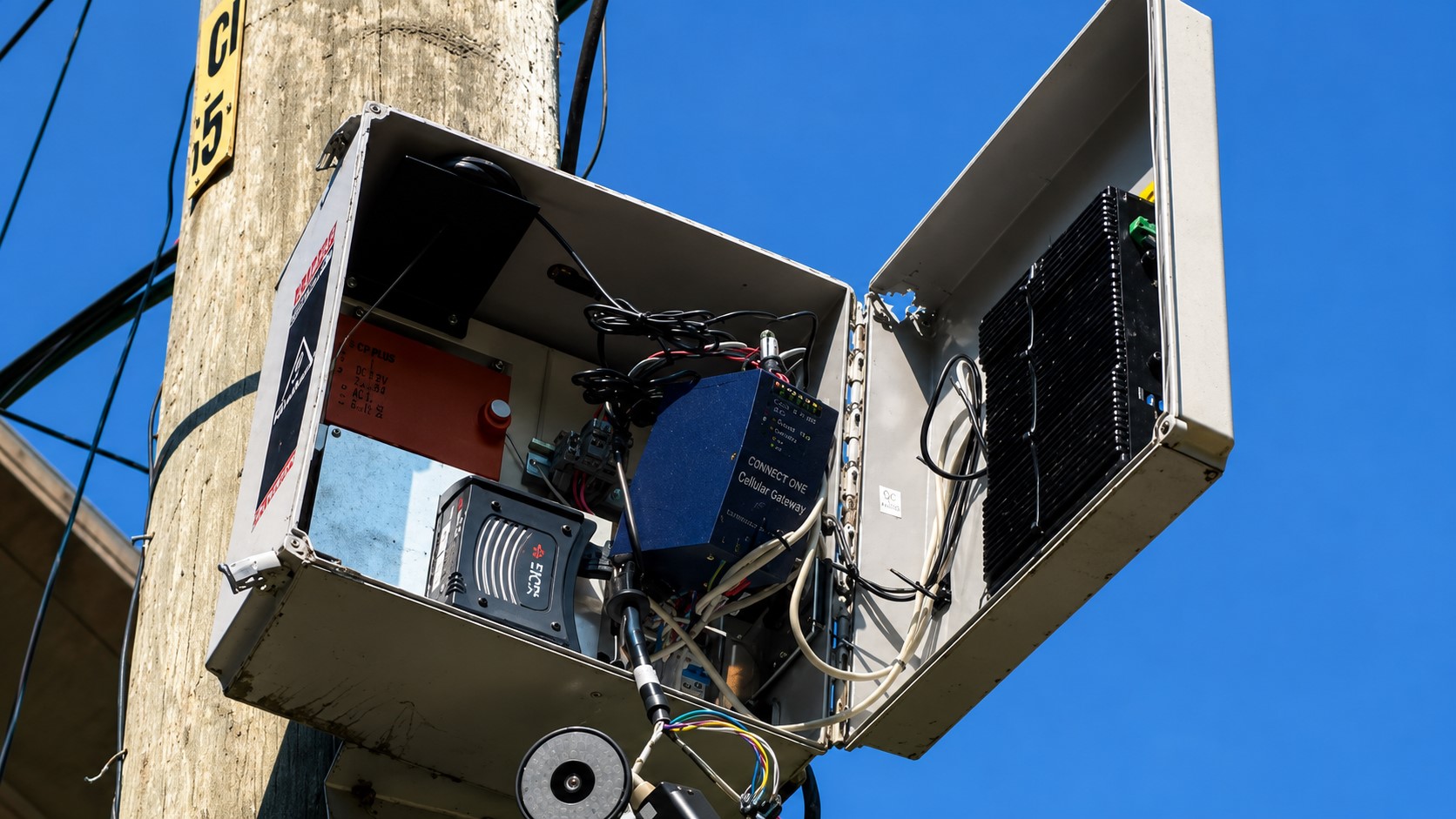
A utility worker reportedly found something unexpected after storm damage near Chain Bridge. A cracked-open box on a nearby pole revealed two camera lenses peering through what appeared to be a standard warning label — printed graphics disguising a lens window. A power cable ran up the pole and into the LED street lamp head, apparently tapping the unmetered 120V feed. No agency markings. No identifying labels. Just cameras reportedly aimed at traffic rolling in from Virginia and a side road near ambassador residences.
Hidden in Plain Sight
The box was built to disappear — until weather cracked its cover story.
The enclosure reportedly mimicked ordinary utility hardware convincingly enough that nobody looked twice. That “warning label” was allegedly the camera’s viewport, printed with graphics designed to deflect casual inspection. Street lamps run constant or scheduled 120V circuits that utilities typically don’t individually meter, making them convenient power sources for bolt-on auxiliary devices. This setup isn’t a prop from a spy thriller. It’s reportedly real surveillance app-era infrastructure sitting in plain sight on a public road — and no agency has come forward to explain it.
What the Cameras Appear to Be Doing
Positioning suggests license-plate capture at a sensitive chokepoint — but no operator has stepped forward to claim the installation.
Camera angles matter. Pointed at the Virginia approach to Chain Bridge and toward an ambassadorial neighborhood access road, the setup carries the signature of an automated license-plate reader (ALPR) targeting vehicle movement near a diplomatic corridor. That said, no operator or agency has been publicly confirmed. The silence tracks with established precedent: the FBI has successfully argued in court that disclosing utility-pole camera locations would compromise active investigations, according to Ars Technica. San Jose’s Flock Problem offers a telling parallel in how communities push back against unacknowledged ALPR deployments.
The Legal Gray Zone
Public roads carry lower privacy expectations — but covert, sustained monitoring near diplomatic residences pushes into genuinely contested legal territory.
Courts generally treat public rights-of-way as low-privacy zones. Sustained, disguised surveillance near sensitive residences is a different conversation entirely. A Western Energy Institute legal analysis notes that “at least one federal court has held that the government may not — without first obtaining a search warrant — use utility pole-mounted video surveillance cameras in a manner that continuously records the activities of individuals on private property where they have a reasonable expectation of privacy.” When a local official defending a comparable roadside camera program told residents they should “get used to it,” that wasn’t reassurance. That was a policy position.
This reportedly isn’t isolated. Smart-city infrastructure quietly absorbs surveillance functions — cameras embedded in street lights, sensors tucked into signs, ALPR systems housed in anonymous boxes — without public registries or visible labeling. Programs secretly tracking users have repeatedly surfaced in legal gray zones where disclosure requirements remain ambiguous. The urban streetscape has become a Black Mirror episode nobody greenlit but everyone is already living in. What cracked open near Chain Bridge is likely one node in a much larger, mostly invisible network.
Residents who spot unexplained lens windows or cables running into lamp heads are advised to photograph — not touch — the hardware and report it to local authorities. Consulting resources on Home Security Systems can help readers recognize camera hardware and lens configurations in the field. The real question isn’t whether these cameras exist. It’s who controls the footage, under what authority, and whether anyone will ever be required to say.