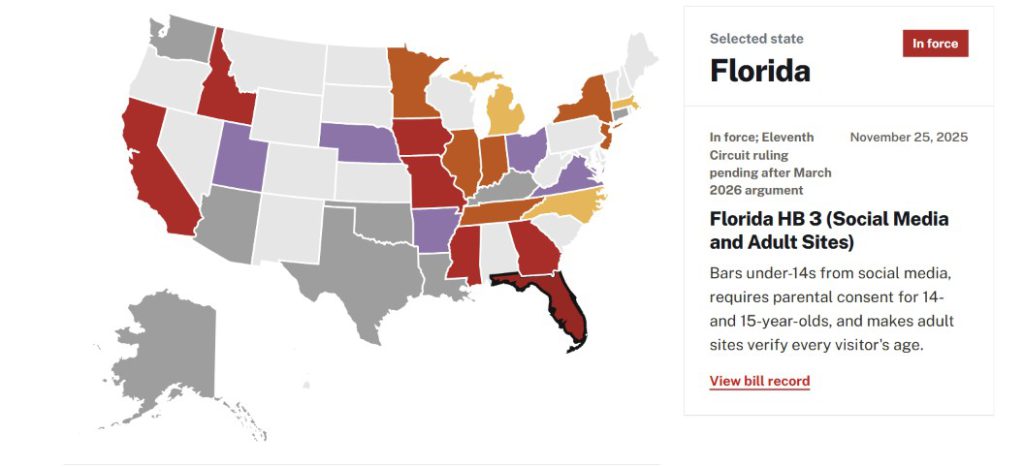
No federal law requires websites to check your age before you access their content. Congress has not passed one. States moved to fill that gap, and they did so differently from each other. As of Reclaim The Net’s September 28, 2026 tracker update, 43 states have some form of age-verification measure on record, and 29 report at least one law currently in force.
Which rules apply to you depends, in part, on where you live.
Not Just Adult Sites
The shorthand that these laws exist only to keep minors off explicit websites tells only part of the story. Tracked legislation also includes requirements around minors’ social-media accounts, parental consent before sign-up, and children’s data privacy frameworks.
Two different counts reflect that distinction. Reclaim The Net’s broader tracker puts 29 states with at least one law in force. A separate compilation from recordinglaw.com, using the narrower definition of enacted adult-content age-verification laws, counted 27 states as of August 13, 2026. The two figures measure different things, and the definitional difference explains the gap.
Those 27 states span Alabama, Arizona, Arkansas, Florida, Georgia, Idaho, Indiana, Iowa, Kansas, Kentucky, Louisiana, Mississippi, Missouri, Montana, Nebraska, North Carolina, North Dakota, Ohio, Oklahoma, South Carolina, South Dakota, Tennessee, Texas, Utah, Virginia, West Virginia, and Wyoming.
When you encounter age verification on a platform, it may take any of these forms:
- Government-ID submission
- AI-based facial age estimation
- Self-declared date of birth
- Parental identity verification
- Anonymous verification (required as an option under Florida’s model)
Florida’s statute applies to sites that “knowingly and intentionally publish or distribute material harmful to minors” constituting a “substantial portion” of their content. It requires operators to offer users a choice between anonymous and standard verification methods.
The Courts Are Still Deciding
A law can be passed, challenged in court, partially blocked, and still partially enforceable at the same time.
Florida’s social-media restrictions became enforceable after an Eleventh Circuit stay in November 2025, according to recordinglaw.com. Arkansas’s social-media law was permanently enjoined in March 2025. Utah’s social-media law was preliminarily enjoined in September 2024. Reclaim The Net’s map accounts for this complexity by distinguishing among proposed, enacted, in force, and court-affected status, and it notes that a ruling may affect only part of a statute.
What This Looks Like in Practice
At the low-friction end, a platform might ask for a self-declared date of birth. At the other end, you could face a facial scan or a document upload before access is granted.
Platforms operating across multiple states may need compliance systems capable of meeting the strictest applicable rule. That could mean geolocation-based triggers, third-party age-assurance vendors, and data-retention controls that vary by jurisdiction. The Congressional Research Service confirms that no federal statute currently requires websites to determine every user’s age, leaving states as the main current source of broad age-verification requirements.
The central unresolved question is whether state requirements keep diverging or whether courts, Congress, or industry practice eventually produces something more uniform. Until then, treat any tracker, including Reclaim The Net’s map, as a starting point rather than a substitute for checking a specific law’s current litigation status.