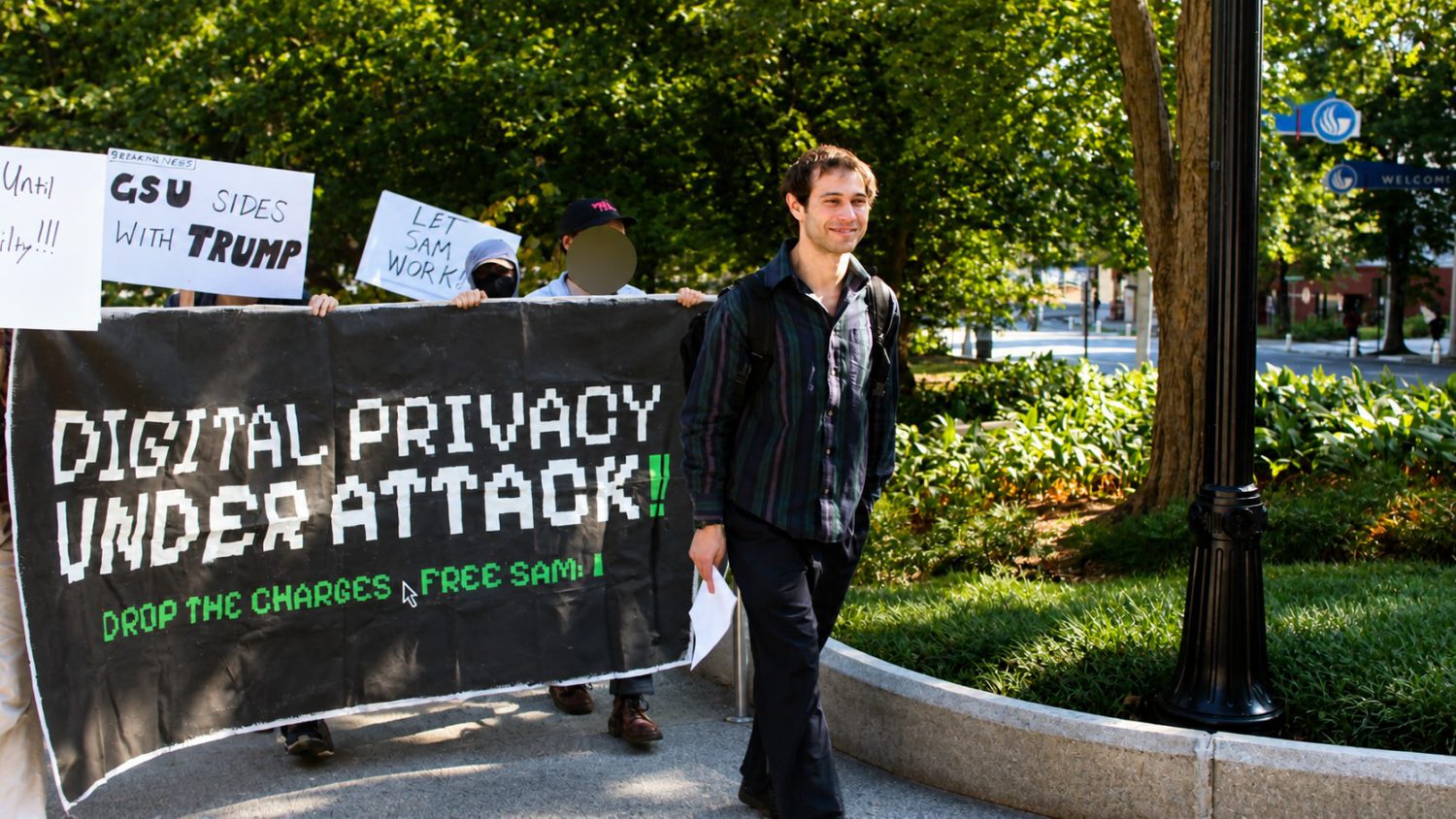
Six hours before Samuel Tunick was due to run his first Geosciences lab at Georgia State University, an automated email arrived: he had not passed the required background check. The TA position was gone, and with it his tuition waiver.
No conviction triggered the rescission. A pending federal charge did.
What Happened at Hartsfield-Jackson
A vacation, a secondary inspection, and a screen that went blank set the stage for what prosecutors would later call a federal crime.
On January 24, 2025, Tunick landed at Atlanta’s Hartsfield-Jackson International Airport after a trip to the Dominican Republic. DHS reportedly flagged him in advance, and CBP directed him to secondary inspection.
Agents searched his bags and his person, according to multiple reports, and found no contraband. They then asked for his phone passcode.
Tunick, an Atlanta-based activist connected to the Stop Cop City movement and a geography graduate student at GSU, asked to speak with an attorney. Agents told him no warrant was required.
He eventually provided a code. The screen went blank, flashed, and the phone appeared to restart.
Secondary reporting and Tunick’s own statements describe the phone as running GrapheneOS, a privacy-focused Android fork for Google Pixel devices. That OS includes a duress password feature: a separate code that, when entered, initiates an irreversible wipe. Primary court documents describe a password entered followed by data deletion, but do not explicitly name GrapheneOS or use the word “duress.”
The Charge and the Defense
A federal grand jury indicted Tunick on a charge that carries up to five years in prison, and his legal team is fighting the case on constitutional grounds.
In November 2025, a grand jury indicted Tunick under 18 U.S.C. Section 2232(a), “destruction of property to prevent seizure.” He has pleaded not guilty.
His lawyers argue the seizure was unlawful and that denying him access to counsel violated his rights. A ruling on their motion to suppress is not expected before late October 2026.
GrapheneOS has publicly stated its software, including the duress feature, is “completely legal” and constitutionally protected. Tunick put it more directly, telling Decrypt: “The Government doesn’t own our data.”
Some coverage reports that CBP justified the search based on suspicion of child exploitation material, though that is not a formal charge in the indictment.
GSU Pulls the Offer
Georgia State’s Background Check Committee rescinded the hire through a case-by-case risk assessment, with no specific written policy to guide the outcome.
According to emails shared by Tunick with 404 Media, a Background Check Committee, the Dean of Students, and GSU’s legal department made the call. His department head reportedly acknowledged there is no specific written policy governing these decisions.
Georgia State University did not respond to 404 Media’s request for comment. Tunick delivered a demand letter asking for reinstatement, greater transparency, and application of an innocent-until-proven-guilty standard.
Supporters outside held signs reading “GSU sides with Trump” and “Digital Privacy Under Attack!”
The Bigger Picture
The airport encounter was not the first sign of official interest in Tunick, and the broader pattern raises a pointed civil-liberties question.
According to 404 Media, Tunick learned through his lawyer that authorities had placed a surveillance app on his car and subpoenaed his cellphone records and Gmail data , and separately, that officials had been secretly tracking users through digital means that mirror the broader pattern of covert data collection. He previously failed a background check for a seasonal job on a Christmas tree lot that involved school property.
“At this point, it almost seems like it’s just intended to make my life miserable and discourage participation in any sort of advocacy or activism,” Tunick told 404 Media.
If invoking a built-in privacy feature during a contested border search can produce a federal indictment, the deterrent effect on activists, journalists, and anyone carrying sensitive data across an international border is real. The motion to suppress is the next legal milestone, and until a court rules on whether CBP’s search was lawful, the question of whether triggering a duress wipe constitutes a federal crime remains unanswered.